Evil Eye Protection: Amulets, Rituals & Cleansing Methods
Evil Eye Protection: Your Complete Defense Against the Envious Gaze
Evil eye protection is not a single object. It is a three-part system: the amulet that intercepts the stare, the daily habit that keeps you from inviting it, and the ritual that scours the harm out once it has landed. The blue bead on your wrist is only the first line. Behind it stands thousands of years of methods for detecting, deflecting, and dissolving one of the oldest curses known to humankind.
For as long as people have envied one another, they have feared the evil eye — the belief that a jealous or admiring look can carry real harm. Every culture that holds this belief also built a defense against it, and evil eye protection is the sum of those defenses: amulets, gestures, cleansing rituals, and quiet rules of behavior refined over millennia across the Mediterranean, the Middle East, South Asia, and Latin America. This guide covers all of them — which amulet to wear, how to tell if you have been struck, and how to remove the curse if you have.
Key Takeaways:
- Real evil eye protection works on three levels — an amulet to deflect the gaze, humility to avoid attracting it, and a cleansing ritual to remove harm that has already landed
- The nazar (blue eye) is a targeted shield; the hamsa hand is a complete protection system — many people wear both, since they do not conflict
- If you already feel struck, diagnosis comes first (the olive oil test), then removal (the curse removal ritual or a traditional cleansing)
What Is Evil Eye Protection?
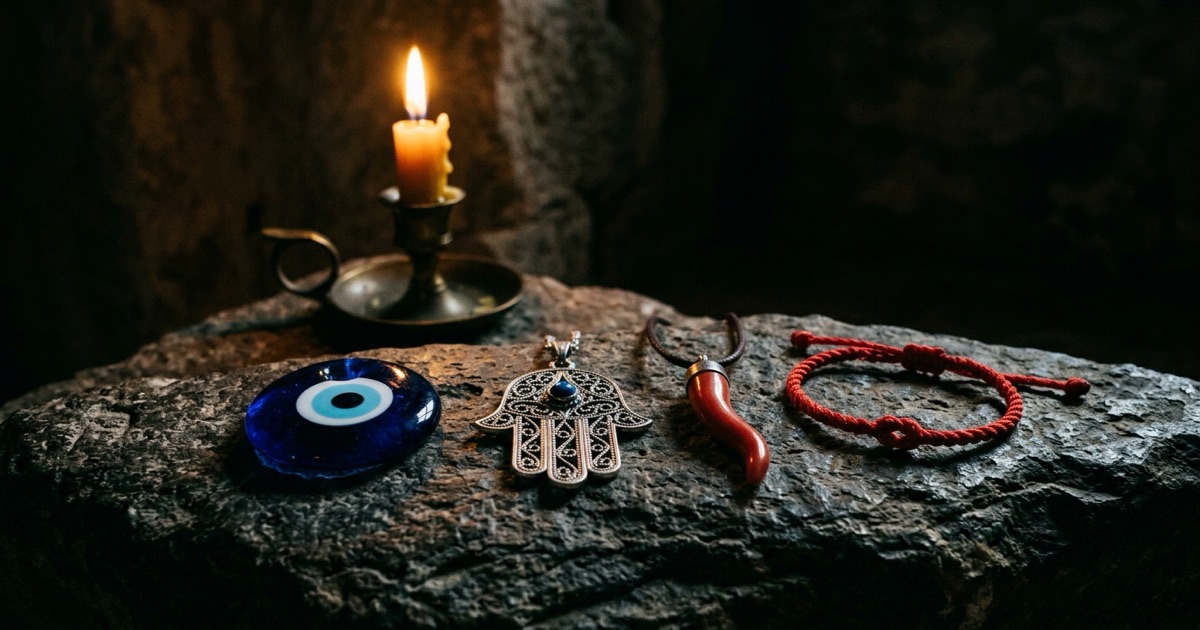
Evil eye protection is any practice believed to shield a person from the harm of an envious or malevolent gaze. The threat it guards against is universal: the idea that when someone looks at your good fortune — your health, your child, your success — with jealousy, that look alone can attach misfortune to you. Protection intercepts that transfer before it can take hold.
The methods fall into four families. The table below is your quick reference — the rest of this guide explains each in depth.
| Method | Tradition | How It Works | Best For |
|---|---|---|---|
| Nazar bead | Turkish, Greek | Reflects the envious gaze back to the sender | Everyday wear, targeted defense |
| Hamsa hand | Jewish, Islamic, Middle Eastern | Blocks all negative energy, attracts blessings | Broad, whole-life protection |
| Cornicello horn | Italian (Southern) | Draws bad luck onto itself, away from the wearer | Personal luck, worn as a gift |
| Red string | Kabbalah, Latin America | Absorbs negativity at the left wrist | Infants, quick daily protection |
| Cleansing ritual | Greek, Latin American, Indian | Removes harm already received | After you feel struck |
| Protective gesture | Italian, Moroccan | Instantly deflects a specific look | In the moment, no object needed |
The most important rule is this: an amulet prevents, a ritual removes. If you are simply worried about envy, wear a charm. If you already feel the symptoms — the sudden headache, the string of bad luck that began the day after someone praised you — you need the removal methods further down this guide.
Protective Amulets: The First Line of Defense
Amulets are the most visible form of protection from the evil eye. Each one carries its own logic, and choosing the right one depends on how much protection you want and which tradition speaks to you. The full catalog — and how to tell a real evil eye amulet from a lookalike — is in the evil eye symbols guide.
The Nazar — The Blue Eye That Stares Back
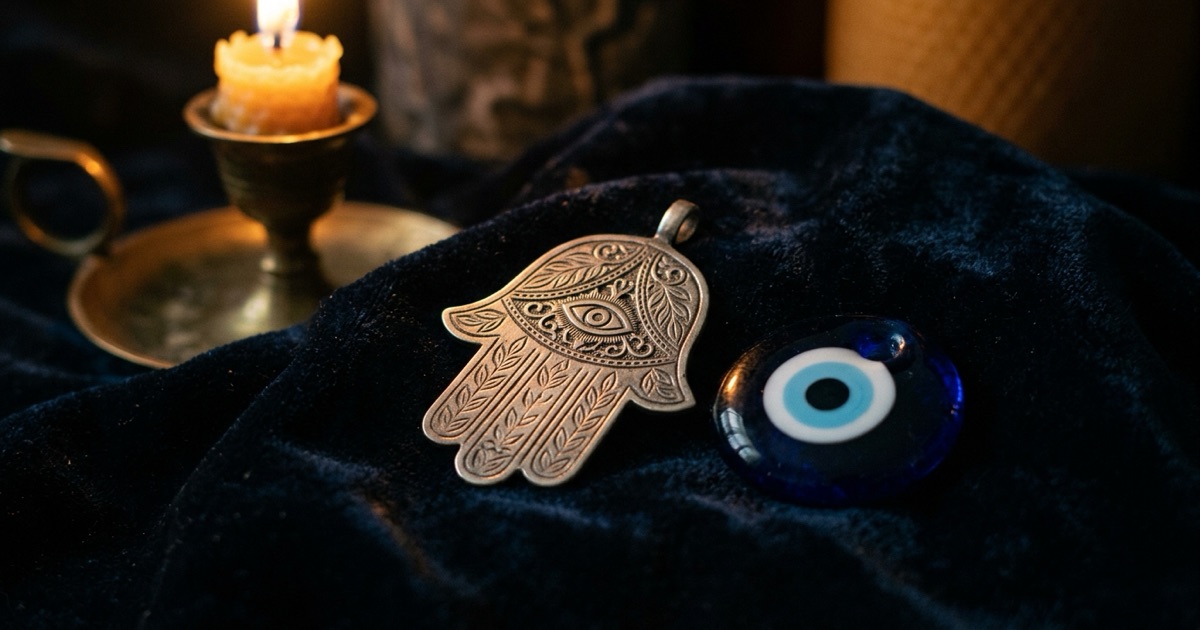
The nazar is the cobalt-blue glass bead with concentric rings of white, light blue, and black. It is the most recognizable evil eye amulet in the world, common from Istanbul to Athens to Cairo. Its protective logic is beautifully direct: to guard against a harmful look, you wear the very thing you fear — an eye. The nazar does not turn away from the envious stare. It returns it.
Blue was chosen deliberately. In Mediterranean belief, the sky and the sea both see everything, and a blue eye borrows that all-seeing power. For a full breakdown of what each shade guards against, see the evil eye color meanings guide.
The Hamsa — The Hand That Blocks All Harm
The hamsa, also called the Hand of Fatima or Hand of Miriam, is a palm-shaped amulet whose name means "five" in Arabic. Where the nazar is a specialist that deflects envy specifically, the hamsa is a generalist: it blocks all negative energy while also attracting blessings, luck, and abundance. It is common in Jewish, Islamic, and wider Middle Eastern tradition, and often incorporates a small blue eye in its palm — combining both defenses in one object.
Think of it this way: the nazar is a targeted shield against one threat, and the hamsa is a complete protection system. This is why so many people wear both together. They do not compete — they cover different ground.
The Cornicello — The Italian Horn
In Southern Italy, where the evil eye is called malocchio, protection often takes the form of the cornicello — a small twisted horn traditionally carved from red coral. Its rules are specific and revealing: the cornicello was traditionally hollow and filled with salt, and it was meant to be given as a gift, never bought for yourself. The horn draws bad luck away from its owner and onto itself. And if it breaks, you replace it immediately — because a broken horn has done its job and can no longer protect you.
The Red String — Protection at the Wrist
The red string is the simplest and most portable amulet. In Kabbalistic tradition, the string is wound seven times around the Tomb of Rachel in Israel to charge it before being cut and tied on the left wrist — the side believed to absorb negative energy first. Across Latin America and the Middle East, a red string on an infant's wrist is one of the most common protections of all, because babies attract the most admiration and are held to be the most vulnerable.
For the amulet you will wear most — the bracelet — the evil eye bracelet meaning guide covers which wrist, what the breaking means, and how to activate it.
Feeling watched? Begin the ritual →
How to Tell If You Have the Evil Eye
Amulets prevent. But what if you suspect the curse has already landed? Before you can remove the evil eye, tradition says you must first diagnose it — and the diagnosis is a ritual in its own right, where the deepest folk knowledge lives.
The Olive Oil Test
The most widespread diagnostic across Greek and Italian tradition is the olive oil test. An elder — usually a woman who knows the prayers — drips olive oil into a bowl of water and reads the result. The interpretations vary by region, which is itself worth knowing:
- The dispersal reading — if the oil spreads and scatters across the surface instead of forming a clean, tight bead, the evil eye is present.
- The merging reading — two separate drops are placed; if they drift together and merge, the eye has been cast.
- The sinking reading — since oil normally floats, a drop that sinks is taken as proof of the curse.
None of these is "the" correct version — they coexist across different families and villages, and that variety is a feature of living folk tradition, not a flaw. After a removal ritual, the test is repeated: if the oil now beads cleanly, the curse has been lifted.
Symptoms Attributed to the Evil Eye
Beyond the oil test, certain symptoms are traditionally read as signs of the eye, especially when they begin right after someone admired or envied you:
- Sudden, unexplained headaches or dizziness
- Persistent fatigue and heaviness with no medical cause
- Uncontrollable yawning during the diagnostic prayer (a classic Greek sign)
- Nausea or loss of appetite
- A run of small misfortunes that all began at once
The tradition reads these as the eye's fingerprints rather than a physician's diagnosis — and a cluster of them following a moment of praise is, within the belief, the signal to act.

Cleansing Rituals to Remove the Evil Eye
Once diagnosed, the evil eye must be removed — drawn out and disposed of. Every culture that fears the eye built its own cleansing ritual, and they share a striking logic: pull the negative energy into a physical medium, then destroy or flush that medium in running water.
The Greek Xematiasma
The Greek removal ritual is the xematiasma ("un-eyeing"). An elder recites a secret prayer — traditionally passed within the family, and in many tellings only to a relative of the opposite sex, its words revealed during Holy Week and never spoken aloud — while making the sign of the cross over the afflicted person and often over a bowl of oil and water. The Greek Orthodox Church acknowledges matiasma but frames it as the spiritual harm of envy, and answers it with prayer, the sign of the cross, and holy water (agiasmos). In practice, many Greeks use both the church's prayer and the family's private xematiasma without any sense of contradiction.
The Salt Cleanse
Salt is the universal purifier — its crystalline structure is believed to absorb and neutralize negative energy. One traditional Greek method: throw a handful of salt into a glass of water, stir while reciting the prayer, and finish with the phrase, "Let the evil eye dissolve as salt dissolves in the water." The salted water is then poured away and the glass washed clean. A related method passes a small amount of salt around the body, focusing on the head, then discards it outside or in running water.
The Egg Limpia
In Latin American curanderismo, the healer performs a limpia by passing a raw egg over the afflicted person's body from head to toe, letting the egg absorb the mal de ojo. The egg is then cracked into a glass of water and read — cloudy strands or an eye-like shape confirm the curse was present and has been drawn out.
The Rue Bath
Rue (Ruta graveolens) is one of the oldest uncrossing herbs. Italian grandmothers hung it over doorways against the malocchio; Cuban and Puerto Rican practitioners use it in uncrossing baths. The Latin American baño combines rue, salt, and sometimes an egg into a cleansing bath that draws out negative energy — a full-body version of the salt cleanse.
Each culture's version of these rituals is detailed in the evil eye traditions guide, and they belong to the same family as broader curse-removal work. If the harm feels heavier than a passing envious glance — if it feels deliberate — the how to remove a curse guide and the black magic removal methods reach further than any single cleansing.

Protection Spells and Daily Practices
Amulets and cleansings are the dramatic tools. But the strongest evil eye protection is woven into daily habit — the small protective spells, gestures, and household rules that keep envy from ever taking hold.
Protective Gestures
Some protection needs no object at all. In Southern Italy, the mano cornuta ("horned hand") is thrown to deflect a look in the moment — the same horn shape as the cornicello, made with the fingers. In Morocco and across the Arab world, raising an open palm — the living hamsa — sends the threat back with the phrase "five in your eye." These gestures are instant protection spells: no preparation, no charm, just the hand and the intent.
Verbal Shields
Words are the oldest protection spell of all. In Islamic tradition, saying "Mashallah" ("what God has willed") when admiring something removes the envy from the compliment — praise without a protective phrase is exactly what invites the eye. The full Quranic and prophetic protections are covered in the duas for the evil eye guide. Across the Mediterranean, a quick "ftou ftou ftou" — a symbolic three-fold spit — wards off a look before it settles.
Guarding the Home and the Vulnerable
- Doorways and windows — hang a blue nazar or a sprig of rue at the entrance so the eye is caught before it enters.
- Newborns — the most vulnerable of all. A red string, a small blue bead, or a kala tika (black dot) placed behind the ear guards a baby whose beauty draws constant admiration.
- Cars and workplaces — the nazar on the rearview mirror or above the shop door is not superstition to those who hang it. It is maintenance.
The common thread is humility: envy is the fuel of the evil eye, so the deepest protection is to avoid inviting envy in the first place — a quiet life attracts fewer hostile stares than a boastful one.

Evil Eye Protection: Myths vs Facts
The evil eye tradition has gathered as much misinformation as genuine folklore. Separating the two is protection in itself — you cannot defend against a threat you misunderstand.
Myth: An evil eye amulet works no matter how you treat it. Fact: Nearly every tradition holds that an amulet must be charged with intent and cleansed periodically. A nazar worn thoughtlessly as fashion carries far less protective weight than one worn with a named purpose.
Myth: Only wicked people can cast the evil eye. Fact: The most common casting is unintentional — a sincere compliment or an admiring glance from someone who wishes you no harm at all. This is why humility and protective phrases matter even among friends.
Myth: The evil eye only affects people who believe in it. Fact: In traditional belief the eye works regardless of the target's faith — the nazar's power is held to be in its form, not in whether you trust it. This is why families hang beads over newborns far too young to believe in anything.
Myth: More amulets always mean more protection. Fact: Intent matters more than quantity. One charm worn with a named purpose outweighs a dozen worn as fashion — stacking beads without meaning is decoration, not defense.
Myth: The evil eye is only a Mediterranean belief. Fact: It appears independently across the Mediterranean, the Middle East, South Asia, Latin America, and beyond — one of the most widespread folk beliefs on earth. For the full cross-cultural map, see the evil eye meaning guide.
Which Evil Eye Protection Is Right for You?
Protection is not one-size-fits-all. Match the method to your situation.
- You want simple, everyday defense → a dark blue nazar bead, worn or hung.
- You want broad protection plus good luck → a hamsa hand, ideally with a blue eye in the palm.
- You are protecting a baby or child → a red string on the wrist or a small blue bead pinned to clothing.
- You received the horn as a gift and want personal luck → the cornicello.
- You want protection you can never lose or leave at home → a permanent evil eye tattoo.
- You already feel struck → skip the amulet and go straight to a cleansing ritual — the salt cleanse or the curse removal ritual.
- The harm feels deliberate, not just envious → this is beyond a passing eye; treat it as a directed curse with black magic removal.
The Chinese Approach: When Protection Becomes Counter-Attack
Everything in this guide is a shield. The nazar reflects, the salt cleanse absorbs, the rue at the doorway turns the eye away. But shields are patient, and patience runs out — especially once you can name the person behind the envy. That is where a different tradition takes over.
Da Siu Yan (打小人), or "villain hitting," is Chinese folk protection turned aggressive. Instead of guarding against a hostile gaze, the practitioner names their enemy, writes them onto a paper figure, and beats it with an old shoe until the villain's grip loosens. Protection stops being something you wear and becomes something you do. When warding starts to feel like waiting, the ritual is the counter-attack no amulet can make.
Ready to cast your curse?
Experience Hong Kong's heritage-listed curse ritual — 5 steps free, no signup required.
Cast a Curse Now →Evil Eye Protection: Summary
| If you want to... | Use | Type |
|---|---|---|
| Deflect envious gazes daily | Nazar bead | Amulet (prevent) |
| Block all negativity + gain luck | Hamsa hand | Amulet (prevent) |
| Protect an infant | Red string / blue bead | Amulet (prevent) |
| Guard the home | Rue or nazar at the door | Household (prevent) |
| Deflect a look in the moment | Mano cornuta / open palm | Gesture (prevent) |
| Diagnose a suspected curse | Olive oil test | Ritual (detect) |
| Remove harm already received | Salt cleanse, egg limpia, xematiasma | Ritual (remove) |
| Strike back at a known enemy | Da Siu Yan (打小人) | Active ritual (counter) |
Protection is layered. Wear the amulet, keep the habit, and know the ritual — so that whether the eye is coming, has landed, or has a name, you already hold the answer.
Further Reading
- Evil Eye Meaning: The Complete Guide — The full history, symbolism, and cross-cultural map of the nazar tradition
- Evil Eye Symbols — The nazar, hamsa, and the lookalikes people confuse them with
- Evil Eye Traditions Around the World — How each culture diagnoses and removes the curse
- Evil Eye Tattoo Meaning — Protection worn permanently in ink
- How to Remove a Curse — When a cleansing is not enough and you need full curse-breaking
- What Is Da Siu Yan — The Chinese ritual that strikes back at the source

Frequently Asked Questions
How do you protect yourself from the evil eye?
Evil eye protection works on three levels: wear a protective amulet such as a nazar or hamsa, keep a daily habit of humility that avoids inviting envy, and perform a cleansing ritual if you feel you have already been struck. The amulet intercepts the envious gaze, the habit reduces how often you attract it, and the ritual removes any harm that has already landed. Most traditions use all three together rather than relying on a single charm.
What is the best protection against the evil eye?
The most reliable protection is the traditional blue nazar bead, because it targets exactly one threat — the envious stare — and reflects it back to the sender. For broader coverage against all negative energy, the hamsa hand is stronger. Many people wear both together, since the nazar is a targeted shield and the hamsa is a complete protection system, and the two do not conflict.
How does the nazar blue eye actually protect you?
The nazar works by the logic of reflection: to guard against a harmful look, you wear the very thing you fear — an eye. Rather than turning away from the envious gaze, the blue eye stares back and returns the malice to its source. In Mediterranean belief, blue was chosen because the sky and sea see everything, so a blue eye shares that all-seeing power.
What is the difference between the hamsa and the evil eye for protection?
The evil eye bead (nazar) is a targeted shield that deflects envious gazes and jealousy specifically. The hamsa, a hand-shaped amulet meaning "five" in Arabic, is a complete protection system that blocks all negative energy while also attracting blessings and luck. The nazar guards against one threat; the hamsa guards against many and adds good fortune. They are complementary, not competing.
How do you know if you have the evil eye?
The classic diagnostic is the olive oil test: a few drops of olive oil are dripped into a bowl of water. If the oil disperses, spreads, or sinks instead of forming a clean bead, tradition holds that the evil eye has been cast. Common symptoms attributed to the evil eye include sudden headaches, unexplained fatigue, nausea, yawning fits, and a run of bad luck that begins right after someone admired or envied you.
How do you remove the evil eye once you have it?
Removal is done through a cleansing ritual. In Greek tradition an elder recites the secret xematiasma prayer while making the sign of the cross; in Latin American practice a curandero passes an egg over the body to absorb the harm; other methods use salt dissolved in water or a bath with rue and salt. The principle is the same across cultures: draw the negative energy out and dispose of it in running water.
How do you protect a baby or newborn from the evil eye?
Infants are considered the most vulnerable to the evil eye across nearly every tradition, because they attract the most admiration. Common protections include a red string tied on the wrist, a small blue nazar bead pinned to clothing, or a black dot (kala tika) placed on the forehead or behind the ear in South Asian custom. Avoid letting strangers praise the baby's appearance excessively without adding a protective phrase.
What color is best for evil eye protection?
Dark blue is the traditional and most versatile color for general evil eye protection — it is the original nazar and covers the broadest range of envious energy. Other colors serve specialized purposes: black for severe curses, red for courage, green for financial envy. If you want one color for everyday defense, choose dark blue.
Do evil eye amulets need to be blessed or activated?
Many traditions hold that an amulet is more powerful when charged with intent. The Italian cornicello, for example, is often said to require activation and is traditionally given as a gift rather than bought for oneself. At minimum, name the threat the amulet protects against when you first wear it, and cleanse it periodically with incense smoke, salt, or moonlight.
What should you do when an evil eye amulet breaks?
A broken amulet is considered good news, not bad: the crack means it absorbed an attack meant for you and did its job. Thank it, remove it from the home rather than keeping it, and replace it with a fresh one. This applies to nazar beads, cornicello horns, and red strings alike — a spent charm should be retired, not repaired.