Da Siu Yan: Chinese Curse Ritual of Beating the Petty Person
What Is Villain Hitting (打小人)?
Villain hitting — 打小人, pronounced Da Siu Yan in Cantonese, "beating the petty person" — is a curse ritual older than its records, still practiced in Hong Kong. Practitioners write an enemy's name on a paper effigy, strike it with a shoe while reciting curses, and burn it to ash at Goose Neck Bridge — a recognized intangible cultural heritage.
If you've ever wondered what is beating petty person or why people whisper curses while striking paper figures with old shoes beneath concrete bridges, you're about to enter one of the most visceral curse traditions still alive today.
This is not a game. It is not therapy dressed in exotic packaging. Villain hitting is a genuine curse ritual — raw, physical, and deeply rooted in Chinese folk magic. Practitioners write the name of their enemy on a paper effigy, strike it with a shoe while reciting incantations, then burn it to ash. The ritual has been performed for generation after generation in the same city, on the same streets, by the same communities.
Key Takeaways:
- Da Siu Yan (打小人) is a Cantonese curse ritual — older than its records — recognized as Hong Kong's intangible cultural heritage — practitioners strike paper effigies with shoes, chant curses, and burn them to ash beneath Goose Neck Bridge
- Six enemy archetypes (backstabber, toxic boss, ex, energy vampire, bully, custom) give the curse precision — each type targets a specific vector of harm
- Experience the ritual yourself — a complete digital Da Siu Yan ceremony, free, 60 seconds, no account needed. What if it works?
In Cantonese culture, a petty person (小人) is someone who operates in shadows — the backstabber who spreads rumors at work, the toxic friend who drains your energy, the ex who refuses to let go, the bully who brings chaos into your life. These are not abstract enemies. They are real people causing real harm. The ritual gives you a weapon against them — a practice whose beginning no scholar can trace, still performed in one of the most modern cities on Earth.
The Meaning of 小人 in Chinese Culture
The concept of 小人 has deep roots in Chinese philosophy. Confucius contrasted 小人 (the petty person) with 君子 (junzi, the noble person) in the Analects. Where 君子 acts with integrity and seeks justice, 小人 seeks profit over principle and schemes in shadows. The distinction is not merely moral — it shapes how Chinese culture understands social harm. A 小人 is not just a bad person. They are a specific type of threat: someone who smiles to your face while poisoning your reputation, who uses proximity and trust as weapons, who operates in the gap between what they say and what they do.
This understanding of 小人 as a social category — not just a personal insult — is essential to understanding why the curse ritual exists. In Chinese folk tradition, small-minded people are not merely annoying. They are dangerous. They drain fortune (財運), create conflict (官非), poison relationships (感情), and destroy reputations (是非). The harm is systematic and ongoing. The ritual exists to stop that harm — to strike back at those who strike from the dark.
This is why the Chinese folk curse tradition endures, generation after generation. It addresses a universal human experience — being wronged by someone who operates through deception and manipulation — with a concrete, physical response. Name them. Strike their effigy. Burn it. The simplicity is the power.
Where the Practice Began
The oldest oral accounts place the practice in pre-war Guangdong — Dongguan and Zengcheng are the names that recur — but it found its spiritual home at Goose Neck Bridge (鵝頸橋) in Hong Kong's Causeway Bay district. This is where the ritual is performed most intensely, most visibly, and most authentically.
The bridge sits under the Canal Road flyover — a stretch of concrete in one of the most densely populated neighborhoods on Earth. During the day, Causeway Bay pulses with shoppers and commerce. But beneath the overpass, a different kind of commerce takes place. Elderly women sit on low stools surrounded by paper effigies, incense, and old shoes. They are the da siu yan poh (打小人婆) — the beat petty person grandmothers. For a modest fee (about HK$50 up), they will curse your enemy on your behalf, striking a paper figure with practiced rhythm while chanting traditional incantations that have been passed down through generations.
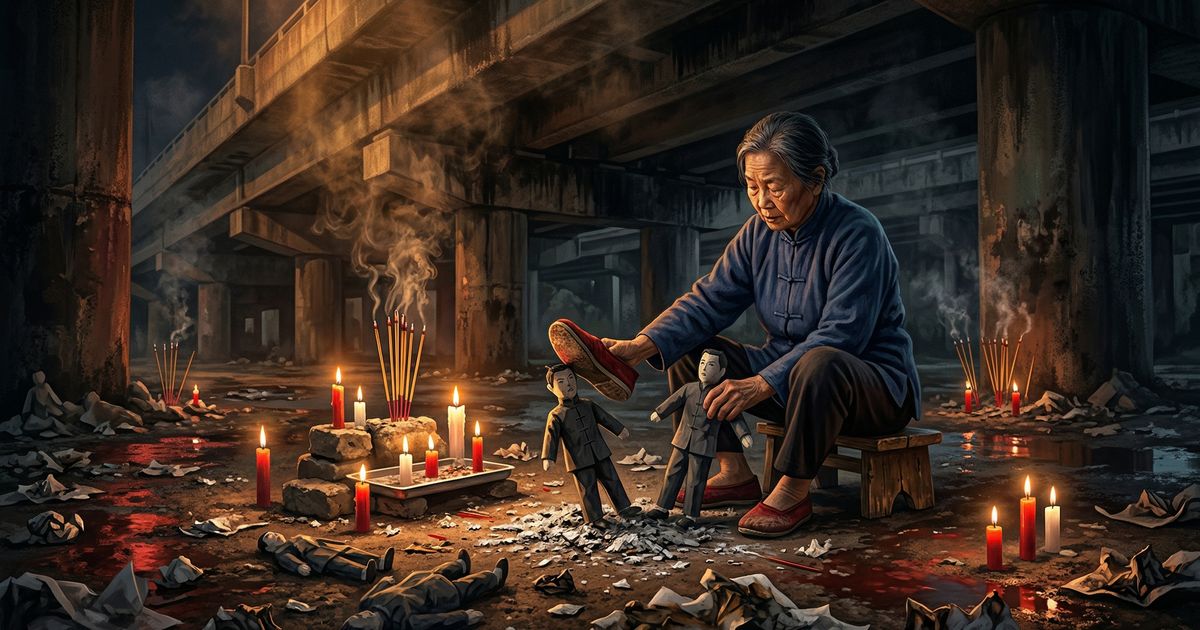
The Beat Petty Person Grandmothers
The practitioners of this tradition are typically elderly women — Cantonese grandmothers who learned the craft from their own mothers and grandmothers. They arrive early in the morning with their supplies: stacks of paper figures, bundles of incense, candles, and worn shoes for striking.
The grandmothers are not ordained priests. They are not trained in formal Taoist or Buddhist ceremony. They are working-class women who carry forward a folk tradition — practical, direct, and unadorned by institutional religion. Their authority comes from experience and community trust, not credentials.
A typical session lasts 10-20 minutes. You tell the grandmother the name of your enemy (or describe their offenses). She writes the name on a paper figure, lights incense, and begins the rhythmic striking — shoe against paper, each blow accompanied by muttered curses specific to your grievance. When the beating is done, she sets the figure alight. The ash scatters. The session is over.
There is no appointment system. No waiting list. You show up, you pay, you curse. The simplicity is part of the tradition's power.
Jingzhe: When the Dark Stirs
The practice is closely tied to Jingzhe (驚蟄), a solar term in the traditional Chinese calendar that falls around March 5-6 each year. Jingzhe literally means "the awakening of insects" — the moment when hibernating creatures stir from their winter sleep, the earth warms, and negative energies begin to emerge from dormancy.
On Jingzhe, Goose Neck Bridge transforms. Hundreds of people queue — office workers in suits, students, elderly couples, young professionals on lunch break — all waiting to have their petty persons beaten. The sound of shoes striking paper echoes under the concrete. Incense smoke thickens the air. The grandmothers work without pause from dawn to dusk.
Jingzhe is considered the most powerful day for the ritual because the boundary between the physical and spiritual worlds is believed to be thinnest. The awakened insects represent stirred negative energy — the perfect time to direct that energy against those who have wronged you.
But the practice is not limited to Jingzhe. Practitioners at Goose Neck Bridge perform the ritual year-round, every day, rain or shine. Some regulars visit monthly. Others come only when a specific petty person has crossed them. The tradition endures because the need endures — there will always be people who scheme, betray, and harm. For a deeper historical perspective, see our article on the history of villain hitting.
Ready to cast your curse?
Experience Hong Kong's heritage-listed curse ritual — 5 steps free, no signup required.
Cast a Curse Now →How the Traditional Ritual Works
The traditional Da Siu Yan ceremony follows eight distinct steps — the 八部曲 (eight movements) of Cantonese folk tradition. While shortened versions exist for quick sessions at Goose Neck Bridge, the full ceremony spans from inviting the gods to confirming the result with divination blocks. Every element has meaning. Every gesture serves a purpose. This is not improvised — it is a ceremony refined through generations of practice.
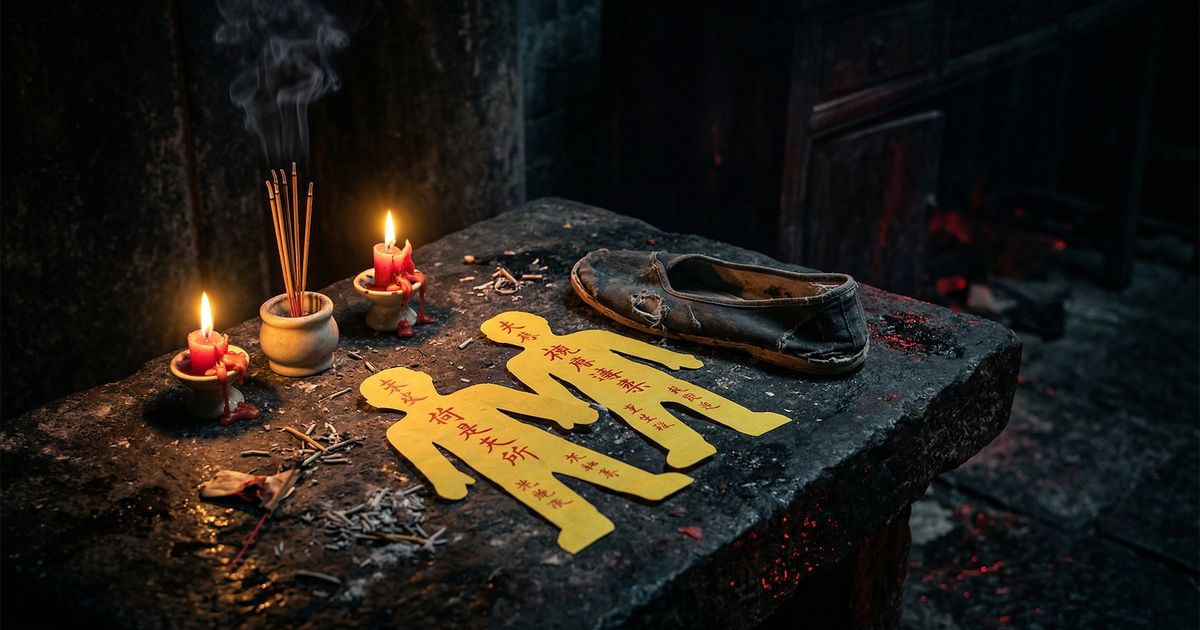
Step 1: 請神 — Inviting the Deities
The practitioner lights incense and red candles, calling upon heaven and earth to witness the ritual. This step establishes sacred space — without divine witnesses, the beating is just vandalism against paper. With them, it becomes judgment.
Step 2: 稟告 — Declaration
The practitioner writes the client's name and birthdate on a 百解符 (hundred-solutions talisman), then writes the target's name on a paper effigy — a humanoid shape cut from ceremonial paper, typically yellow or white. If the target's exact name is unknown, a general curse can be directed at a category of petty person: the backstabber, the tyrant, the thief of fortune. If a photograph is available, it is attached to the figure.
Both the client and the target are formally registered — the complaint is now on the record with the spirit world. The more specific the identification, the more focused the curse. In traditional belief, the paper figure becomes the target through the act of naming — a principle shared across multiple curse traditions worldwide.
Step 3: 過火 — Passing Through Fire
The talisman and effigy are passed over the candle flames. This purification step uses fire to cleanse both documents, burning away anything that might weaken the ritual's focus. Not every practitioner lists this as a separate step — some fold it into the declaration — but it is commonly observed at Hong Kong's Goose Neck Bridge.
Step 4: 打小人 — Striking the Petty Person
The core of the ceremony. The practitioner takes an old shoe — traditionally a worn slipper or cloth shoe — and beats the paper figure against a hard surface. Each strike is deliberate. Each blow lands with a sharp crack that echoes under the bridge.
As they strike, the practitioner recites curse chants. Traditional incantations follow specific patterns: naming the target's offenses, invoking the White Tiger spirit to devour the petty person's influence, and commanding the petty person to retreat. The words vary by practitioner and region, but the structure is consistent — identify the harm, invoke authority, command its end.
The rhythm of the striking matters. Practitioners develop a cadence — steady, accelerating, then climactic. The beating is not random violence against paper. It is a structured release of focused anger. Each strike transfers the practitioner's fury into the ritual, charging it with emotional energy.
The physical destruction of the effigy mirrors the intended destruction of the petty person's influence. As the paper tears and crumples, so too does the petty person's power to harm.
Step 5: 祭白虎 — White Tiger Sacrifice and Burning
The beaten effigy is placed into the mouth of a paper White Tiger (紙白虎). Raw pork is offered to the tiger's mouth — feeding it so it devours the petty person, not the client. Then the paper tiger and effigy are burned together, reducing everything to ash.
The White Tiger is one of the Four Symbols in Chinese mythology — guardian of the west, associated with autumn, metal, and warfare. In the context of this ritual, the tiger is a devourer. The logic: 以凶制凶 — fight ferocity with ferocity. The tiger eats your enemy. Then fire consumes them both.
Not every session includes the full White Tiger ceremony. Short sessions at Goose Neck Bridge may simplify this to burning the effigy alone. But during Jingzhe, and for more serious grievances, the White Tiger sacrifice is considered essential — it ensures the curse has spiritual backing, not just human anger.
Step 6: 化解 — Dispelling Misfortune
The practitioner scatters rice, five-color beans (五色豆), sesame seeds, and peanuts onto the ground. Each grain represents the petty person's retreat — scattering their influence in all directions, ensuring the misfortune they caused is dispersed rather than merely displaced. This step often involves the 百解符, now charged with the ritual's energy.
Step 7: 祈福/進寶 — Praying for Blessings
The ceremony shifts from destruction to restoration. The practitioner uses red 貴人紙 (noble-person paper) to pray for helpful allies and good fortune to enter the client's life. Gold and silver paper money (金銀衣紙) and ingots (元寶) are burned as offerings to the spirits — payment for their assistance. The ritual moves from eliminating the negative to inviting the positive.
Step 8: 擲筊 — Divination and Confirmation
The practitioner throws two crescent-shaped wooden blocks (筊杯) and observes how they land:
- 聖杯 (one face up, one face down) — The spirits confirm the ritual is complete. Success.
- 笑杯 (both faces up) — The spirits are amused but noncommittal. The outcome is uncertain.
- 怒杯 (both faces down) — The spirits reject the ritual. It may need to be repeated.
The divination provides closure — a definitive answer from the spirit world that the matter is settled. When the blocks fall right, the client walks away knowing the ritual succeeded.
The Six Types of Petty Persons
In traditional practice, any enemy can be targeted — there is no formal taxonomy. But Cantonese folk tradition recognizes recurring patterns of petty behavior. In our digital curse ritual, we've captured these patterns as six archetypes:
| Type | Cantonese Name | What They Do | How They Harm |
|---|---|---|---|
| The Backstabber | 是非小人 | Plots behind your back, spreads rumors, undermines trust | Destroys reputation and social standing |
| The Toxic Boss | 職場小人 | Uses authority without empathy, creates hostile environments | Destroys career and daily peace |
| The Ex | 感情小人 | Keeps returning, disrupting closure, preventing new beginnings | Destroys emotional stability and future relationships |
| The Energy Vampire | 財運小人 | Drains your fortune and light — every encounter costs you | Destroys wealth, opportunity, and vitality |
| The Bully | 官非小人 | Brings conflict and legal trouble into your life | Destroys safety and freedom |
| Custom | 自定義 | You know exactly who they are — name them yourself | Specific to your situation |
Each category maps to a specific kind of harm recognized in Cantonese folk tradition. 是非小人 (literally "right-wrong petty person") destroys reputations through gossip and manipulation. 職場小人 ("workplace petty person") weaponizes authority to create suffering. 財運小人 ("fortune petty person") drains wealth and opportunity — the Cantonese equivalent of someone who "curses your luck."
These categories are not arbitrary — they reflect real patterns of human behavior that cause real harm. The six types give the ritual structure and focus. Instead of a vague curse against a vague enemy, you name the specific harm and direct the ritual accordingly.
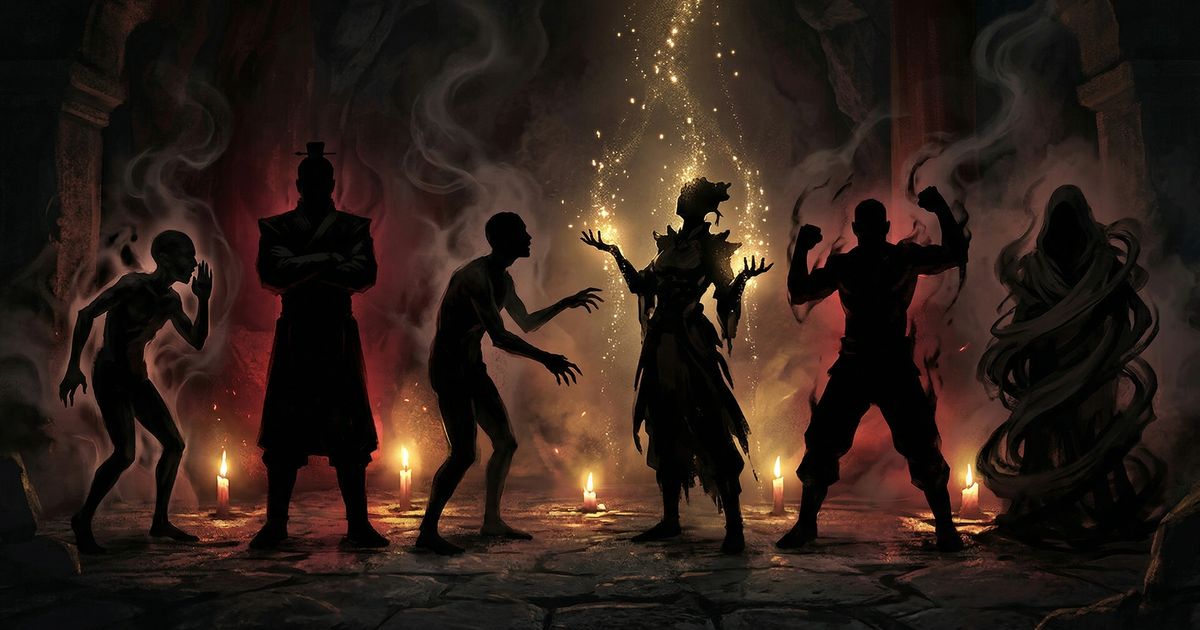
Naming your enemy is the first step in any curse ritual. Whether you choose a category or speak a specific name, the act of identification gives the curse its target. For different approaches to cursing across cultures, see our guide on how to curse someone.
The Curse Ritual Hong Kong Made Famous
There are many curse traditions in the world — voodoo magic from West Africa and the Caribbean, hex spells from European folk practice, revenge rituals from ancient civilizations — but this one stands apart from all of them.
This is not a reconstructed tradition. It is not a modern invention dressed in ancient clothes for the wellness industry. This is the curse ritual Hong Kong made famous — a practice born from the lives of ordinary Cantonese people dealing with ordinary enemies. No priests required. No temples. No expensive ingredients or rare herbs. Just paper, a shoe, fire, and the courage to name your enemy out loud.
What makes villain hitting unique among curse traditions is its raw directness. There is no intermediary between you and the curse. There is no complex theological framework to study, no pantheon of spirits to appease, no years of training required. You identify your enemy. You strike their effigy. You burn it. The simplicity is the point — this is folk magic at its most elemental, practiced by working people who needed real protection from the petty tyrants in their lives.
The cultural authenticity of this tradition matters more than ever. In an era of manufactured spiritual experiences, mass-produced occult content, and "curse spells" written by people who have never set foot in a ritual space, this tradition carries the weight of genuine, living practice. It has survived colonial indifference, the handover, and Hong Kong's transformation into a global financial capital. Through all of it, the grandmothers kept striking paper figures.
The fact that people still queue beneath a concrete overpass in one of the world's most technologically advanced cities — in the age of smartphones, artificial intelligence, and space tourism — tells you something profound about the ritual's enduring power. Some needs don't change with technology. This practice addresses one of those needs.
Villain Hitting vs. Other Curse Traditions
Curse rituals exist in virtually every culture on Earth. The desire to strike back at those who harm you — to restore balance, to reclaim agency, to see justice done — is universal. But the form these rituals take varies dramatically across traditions.
| Tradition | Origin | Core Method | Key Element | Accessibility |
|---|---|---|---|---|
| Cantonese Tradition | Hong Kong / Guangdong | Strike paper effigy with shoe, burn | Physical violence against effigy | Very high — anyone can perform |
| Voodoo / Vodou | West Africa / Haiti | Dolls, pins, veves, loa invocation | Spiritual intermediaries (loa) | Medium — requires knowledge of loa |
| Hex Spells | European / PA Dutch | Written spells, symbols, incantations | Power of words and symbols | Medium — requires spell knowledge |
| Revenge Spells | Western occult | Candles, herbs, moon phases | Magical correspondence | Low — requires materials and timing |
| Execration | Ancient Egypt | Smash inscribed clay tablets | State-sponsored magical warfare | Very low — lost to history |
| Evil Eye | Mediterranean | Malevolent gaze | Envy as weapon | Very high — unintentional |
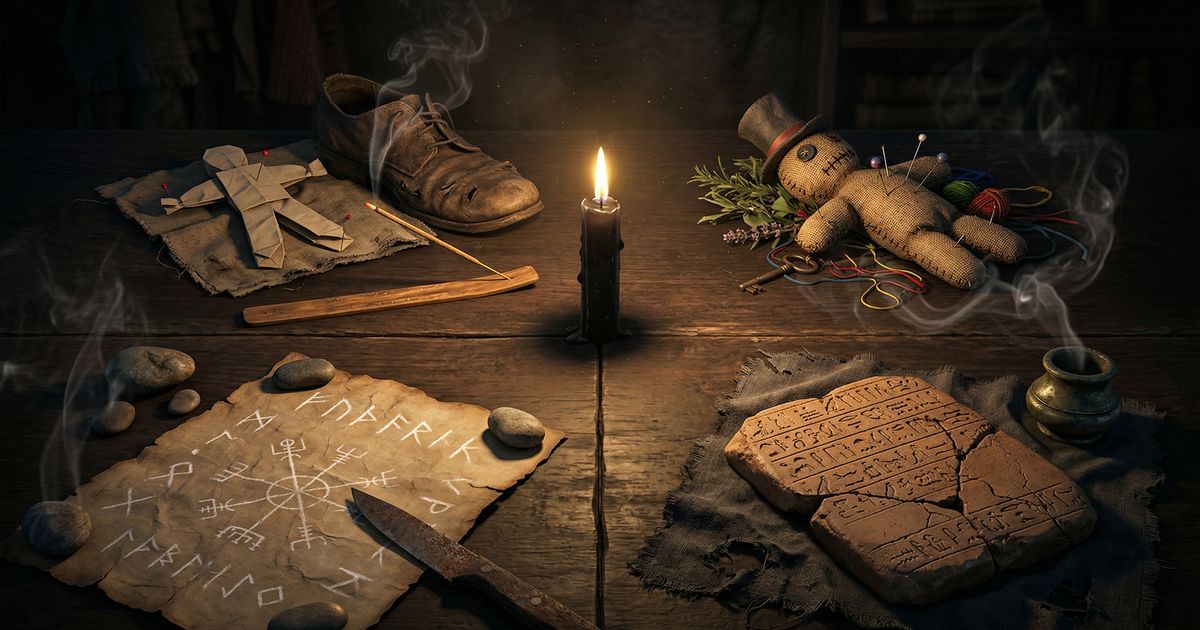
How the Cantonese Tradition Differs from Voodoo
Voodoo operates through a complex pantheon of spirits called loa, each with their own personality, preferences, and domain. A voodoo curse requires knowledge of which loa to petition, what offerings to make, and how to properly invoke their power. Practitioners — houngans and mambos — serve as intermediaries between the living and the spirit world.
The Cantonese tradition has no intermediaries and no pantheon. The White Tiger may be invoked in full ceremonies, but the core ritual — striking the paper figure — requires no spiritual authority. Your anger is sufficient qualification. This democratic accessibility is one reason the tradition has survived so effectively: anyone can learn how to curse someone in minutes.
Eastern vs. Western Curse Methods
Western curse traditions — hexes, Wiccan bindings, ceremonial magic — tend to emphasize words and symbols. The curse lives in the spell, the incantation, the written formula. Power comes from knowledge of the correct words and gestures.
Eastern curse traditions, and this one in particular, emphasize physical action. The curse lives in the striking, the tearing, the burning. Power comes from the physical release of anger and the symbolic destruction of the effigy. Words are important — the incantations matter — but the body is the primary instrument.
This physicality may explain why the ritual feels more visceral and immediate than many Western curse practices. When you strike a paper figure with a shoe, you feel the impact in your hand, your arm, your shoulders. The ritual is embodied in a way that whispering Latin over candles is not. The catharsis is physical, not just psychological.
Shared Principles Across Traditions
Despite the differences in method, virtually all curse traditions share a common framework. Whether it is a Chinese folk curse performed beneath a Hong Kong bridge, a hex cast in a Pennsylvania Dutch farmhouse, or a voodoo ceremony in a Haitian temple, the structure remains remarkably consistent:
- Identify the target — Name, effigy, photograph, or personal item
- Channel intent — Focus anger, visualize the outcome, speak the grievance
- Perform the act — Strike, burn, bind, or otherwise symbolically affect the target
- Seal and close — Complete the ritual to "lock" the curse and prevent backfire
This universal pattern — documented by anthropologists across every inhabited continent — suggests that curse rituals address something fundamental about human psychology. The specific cultural details vary, but the underlying need is the same: to restore agency, to process injustice, to take action when action seems impossible. This tradition has been fulfilling that need in Cantonese communities for generations.
Why the Ritual Endures
Why does this tradition survive? Why do modern Hong Kong residents — people with smartphones, careers, and lives in one of the world's most technologically advanced cities — still seek out the grandmothers at Goose Neck Bridge to curse their enemies?
The answer is not superstition, at least not solely. The answer is that the ritual addresses fundamental human needs that modern life has not eliminated.
The Psychology of Curse Rituals
Modern psychology recognizes the concept of catharsis — the release of emotional tension through expression. The practice is perhaps the most direct form of emotional catharsis ever devised in a cultural ritual.
When someone has wronged you — when a colleague has stolen credit for your work, when a friend has betrayed your trust, when a partner has deceived you — the anger builds. It has nowhere productive to go. You can't confront them without escalating the situation. You can't report them without evidence. You can't ignore them because the harm continues.
The ritual gives that anger a target. Not the person themselves — a paper figure. But the physical act of striking, of hearing the crack of the shoe against paper, of watching the effigy tear and crumble, provides a release that talking about your feelings cannot match.
Research on ritual behavior supports this: structured, repetitive ritual actions are consistently linked to reduced anxiety and a restored sense of control.
There is also the power of naming. The ritual requires you to identify who has wronged you — to write their name or describe their offense. This act transforms vague frustration into focused intent. The petty person is no longer a diffuse source of unhappiness. They are a named target with a specific offense. That clarity alone provides relief.
Cultural Continuity in Modern Hong Kong
For Hong Kong's Cantonese community, this practice is more than a curse ritual. It is a living connection to cultural identity — a practice that links the modern city to its roots in Guangdong province.
Hong Kong has undergone extraordinary transformation. It has been a British colony, a manufacturing hub, a financial capital, and a focal point of geopolitical tension. Through all of these changes, the practice remained constant. The grandmothers at Goose Neck Bridge kept their stools, their paper figures, and their incense through economic booms, political upheaval, and pandemic lockdowns.
The ritual is recognized by Hong Kong's government as part of the city's intangible cultural heritage — not as a museum piece, but as a living practice. This official recognition matters. It affirms that this ritual is not a relic to be preserved behind glass, but a tradition that continues to serve a real purpose in people's lives.
In recent years, the practice has attracted international attention. Travel guides recommend Goose Neck Bridge as a cultural experience. Journalists from the BBC to the South China Morning Post have documented the grandmothers at work — TIME picked the ritual for its 2009 "Best of Asia" list. Social media has spread awareness of the practice far beyond Hong Kong's borders — people in New York, London, and Tokyo now know about this Chinese folk curse tradition, even if they've never visited Causeway Bay.
This global awareness has created a new challenge: how to make the ritual accessible to people who will never stand beneath Goose Neck Bridge. That question led to the creation of digital versions of the ritual — including the one you can experience on this site. The core elements remain the same: identify your enemy, strike their effigy, burn it to ash. The medium has changed. The ritual has not.
寧可信其有 — Better to Believe It Exists
And then there is the question that has kept the ritual alive across generations of skeptics and believers:
What if it works?
This four-word question is the engine of the tradition. You don't need to believe in spirits. You don't need to subscribe to Chinese folk religion. You just need to entertain the possibility — however small — that a curse ritual older than its records might have some power beyond the purely psychological.
The Chinese expression 寧可信其有 captures this perfectly: "Better to believe it exists." The cost of the ritual is minimal — a few minutes and a few dollars. The potential benefit, if it works, is the removal of a petty person's harmful influence from your life. The asymmetry is compelling. For guidance on cleansing negative energy, see our article on how to get rid of bad luck.
Experience the Ritual
The grandmothers at Goose Neck Bridge still practice the ritual today — paper figures, old shoes, and curses spoken beneath a concrete overpass in Causeway Bay. But not everyone can travel to Hong Kong.
We've created a digital curse ritual that preserves the essential elements of the traditional practice. Choose your enemy from six categories. Strike their paper effigy. Burn it to ash. Receive your curse verdict.
Free. 60 seconds. No account required. What if it works?
Ready to cast your curse?
Experience Hong Kong's heritage-listed curse ritual — 5 steps free, no signup required.
Cast a Curse Now →Further Reading
- History of Villain Hitting — The deep history of the practice, from Guangdong province to modern Hong Kong
- Voodoo Magic and Curses — How the Cantonese tradition compares to vodou practices across the Atlantic
- How to Curse Someone — Curse methods across cultures: the four-step framework
- Hex Spells and Curses — Western hex traditions and how they differ from Eastern curse practices
- How to Get Rid of Bad Luck — Protective rituals and curse cleansing methods
- Revenge Spells — When justice becomes personal: curse spells for the wronged
Frequently Asked Questions
What is Da Siu Yan?
Da Siu Yan (打小人) is a traditional Cantonese curse ritual practiced in Hong Kong, most famously at Goose Neck Bridge in Causeway Bay. The name literally means 'beating the petty person.' Practitioners write the name of their enemy on a paper effigy, strike it with a shoe while reciting curses, then burn it to ash. The ritual has been practiced for generations and is recognized as part of Hong Kong's intangible cultural heritage.
What does 打小人 mean in English?
打小人 literally translates to 'beating the petty person' in Cantonese. 打 means 'to beat' or 'to hit.' 小人 means 'petty person' — someone who operates in shadows, causing harm through gossip, betrayal, or manipulation. In Chinese philosophy, 小人 is the opposite of 君子 (junzi), the noble person. The ritual targets those who cause harm through underhanded means.
Is beating the petty person real?
The ritual is a genuine cultural practice recognized by Hong Kong's government as intangible cultural heritage. Whether the curse produces supernatural effects is a matter of personal belief. What is documented is the psychological benefit — the ritual provides structured catharsis and a sense of restored agency. The tradition has survived beyond the reach of its own records, suggesting it fulfills a genuine human need.
Where can you perform villain hitting in Hong Kong?
The most famous location is Goose Neck Bridge (鵝頸橋) under the Canal Road flyover in Causeway Bay. Beat petty person grandmothers set up stalls beneath the bridge and perform the ritual year-round. The practice peaks during Jingzhe (驚蟄), around March 5-6, when hundreds queue to have their petty persons cursed. The location is accessible by MTR Causeway Bay station, Exit A.
When is the best time to beat the petty person?
The most powerful time is Jingzhe (驚蟄), a solar term in the traditional Chinese calendar falling around March 5-6. Jingzhe means 'the awakening of insects' — when hibernating creatures stir and negative energies emerge. However, practitioners at Goose Neck Bridge perform villain hitting year-round. Any day can be the right day to curse someone who has wronged you.
What do you need for a villain hitting ritual?
The full traditional ceremony requires: incense and red candles (for invoking deities), a 百解符 hundred-solutions talisman (for registering the client's information), a paper effigy (for the target), an old shoe or slipper (for striking), a paper White Tiger figure with raw pork (for the sacrifice step), rice or five-color beans (for dispelling misfortune), red 貴人紙 noble-person paper and gold/silver paper money (for blessings), and 筊杯 divination blocks (for confirming completion). Shortened sessions at Goose Neck Bridge may omit some elements. The digital version at BeatPetty requires only a phone or computer.
Does beating the petty person actually work?
The ritual produces documented psychological effects — catharsis, restored agency, and the relief that comes from naming a specific enemy and acting against them. Whether it produces supernatural harm to the target is a matter of personal belief and Cantonese folk religion. The tradition has endured beyond its own records and is recognized as Hong Kong's intangible cultural heritage, suggesting it answers a genuine human need regardless of mechanism.
Is Da Siu Yan a form of black magic?
By Western definition, Da Siu Yan is a curse ritual and would be classified as black magic — it uses an effigy, spoken incantations, and symbolic violence against a named target. But Chinese folk religion does not divide practice into black and white. Da Siu Yan is treated as targeted justice against petty persons, practiced openly in daylight and accepted as an ordinary part of community life rather than forbidden dark arts.