Goose Neck Bridge: Hong Kong's Villain-Hitting Curse Ritual
Villain Hitting — The Curse That Refused to Die
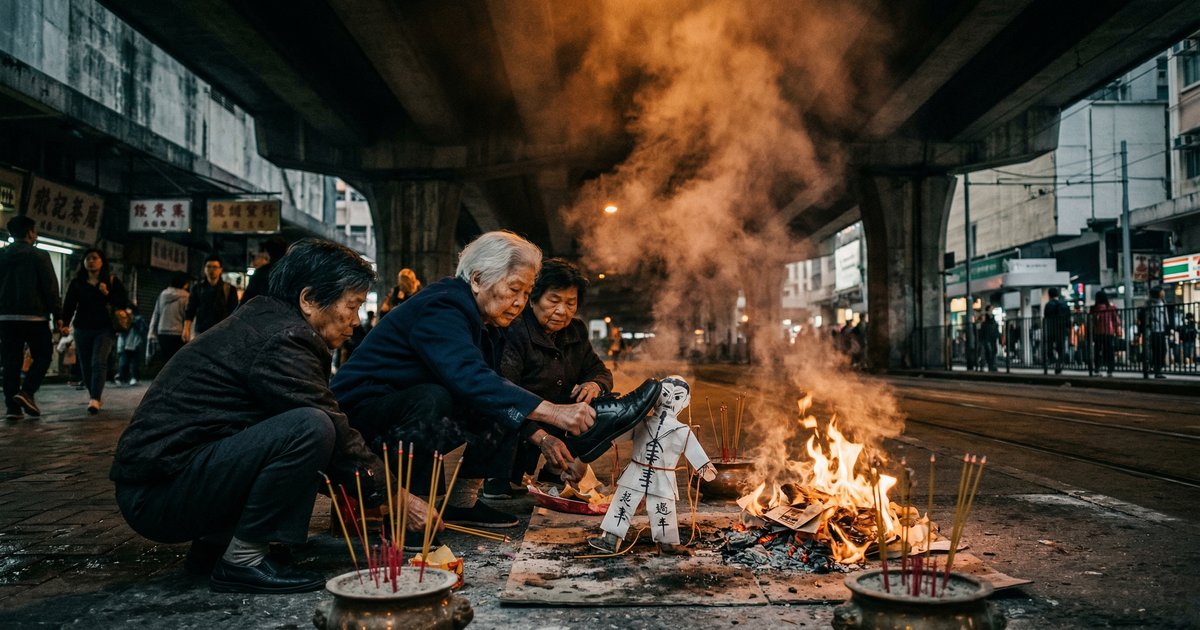
Under Goose Neck Bridge in Hong Kong, paper still burns. Paper figures curl into ash. Old shoes strike with rhythmic violence. Incense smoke curls toward the concrete ceiling while murmured curses in Cantonese fill the damp air. This is villain hitting history — not a museum exhibit, but a living practice in the middle of a modern megacity.
Here is the strangest fact in the Jingzhe curse tradition: nobody can say when it began. The anthropologists who produced the definitive field study of Da Siu Yan — Chiao Chien and Leung Cho-on of the Chinese University of Hong Kong, publishing through Academia Sinica in 1984 — opened their paper by conceding that the ritual's origin and spread are "difficult to trace," and that even the oral accounts placing it in pre-war Guangdong have "no documentary support whatsoever" (無文獻可徵). The rite is older than its own records. What CAN be dated is the impulse behind it — and that trail runs two thousand years deep.
Key Takeaways:
- The origin of Da Siu Yan itself is untraceable — the definitive 1984 academic study found no documentary evidence at all; oral accounts reach only pre-war Guangdong
- The practice-form is ancient: Han imperial histories record wooden effigies buried to curse named enemies (91 BC), and the Tang legal code criminalized carving a hated person's likeness to pierce its heart and eyes
- The tradition was recognized as part of Hong Kong's intangible cultural heritage in 2014 — try the digital ritual — the first five steps are free, no account needed
Villain hitting sits in a worldwide family of curse traditions — with one sharp difference. The Mediterranean evil eye harms by accident, flowing from envy without any ritual at all; villain hitting is the deliberate mirror of that idea: you name the person, you strike the figure. That contrast — the accidental gaze versus the named, targeted act — is why ethnographers file Da Siu Yan with the world's intentional curse rites rather than its protective customs. (For the full cross-cultural map of the accidental version, see evil eye traditions around the world.)
The White Tiger and the Origins of Villain Hitting
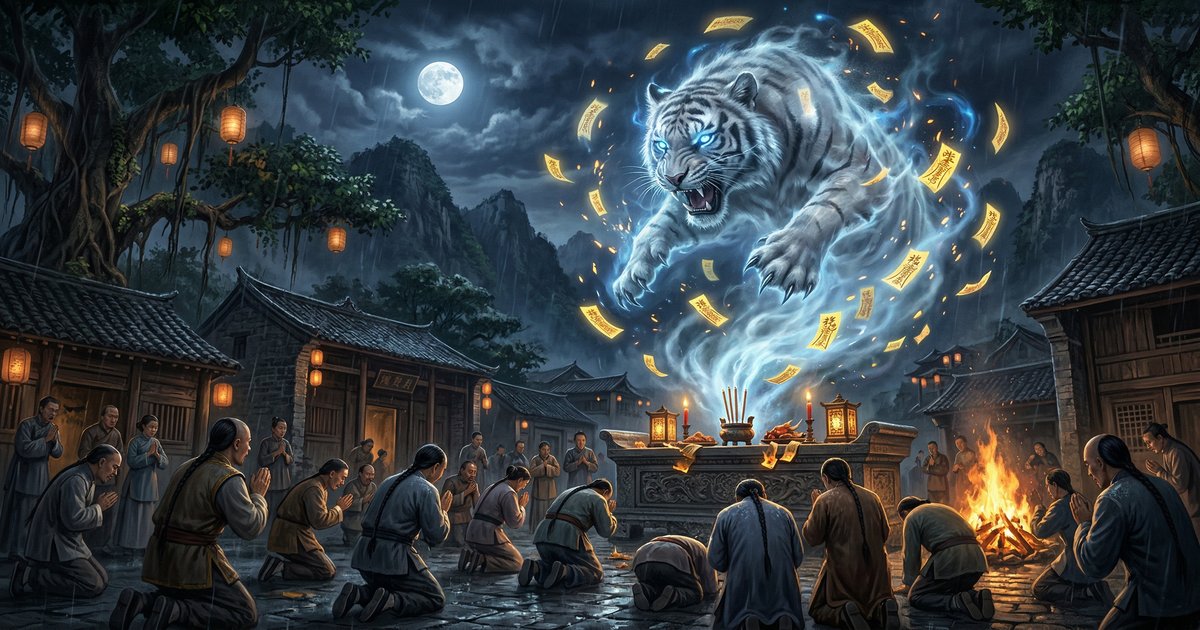
The villain hitting history begins with a creature that doesn't exist — or perhaps, one that exists precisely because people believe in it. The White Tiger (白虎) is a celestial being in Chinese cosmology, one of the Four Symbols guarding the cardinal directions. In folk belief across southern China, the White Tiger represents malice, betrayal, and the petty person — the backstabber who smiles to your face and ruins you behind your back.
Striking an image of your enemy is one of the oldest documented acts in Chinese history. The Han imperial histories record that in 91 BC, shamans dug up buried wooden figurines (桐木人) from palace grounds as proof of curses against the Emperor himself — the infamous witchcraft calamity (巫蠱之禍) in which tens of thousands died. One accusation in the Book of Han describes an effigy buried along the Emperor's own carriage road, "cursed with malicious words." Seven centuries later, the Tang legal code went further: it made effigy sorcery a crime, and the code's own commentary describes the offense in words that could caption a villain-hitting stall today — "carving a human figure, piercing its heart, nailing its eyes, binding its hands and feet" (刻作人身,刺心釘眼,繫手縛足). The state outlawed it because the state believed it worked.
When and where that ancient impulse condensed into the specific rite called Da Siu Yan, no document says. Oral accounts collected by researchers point to the Dongguan and Zengcheng regions of Guangdong before 1949 — accounts the researchers themselves flagged as unverifiable. What is certain is the character of the thing: not sophisticated temple ritual performed by trained priests, but folk magic — grassroots, pragmatic, and deeply personal. People with no access to formal justice used the ritual to process grievances that would otherwise fester. The curse was a pressure valve. Paper effigies of petty persons were beaten with shoes — the most humble, dirtiest object available. The humiliation was the point. You don't use a sword against a petty person. You use what's on your feet.
The connection to Chinese folk religion was organic rather than institutional. Villain hitting drew from the same cosmological framework as ancestor worship, temple ceremonies, and seasonal festivals — but it occupied a distinctly working-class niche. No expensive incense required. No elaborate temple. Just paper, a shoe, fire, and anger.
The Bai Hu Rite: Feeding the Tiger
Villain hitting does not stand alone. Hong Kong's official intangible-heritage inventory lists it inside a larger observance: sacrificing to the White Tiger on Jingzhe (驚蟄祭白虎) — rites performed at roadsides, forked junctions and under flyovers — or in temples — to drive away ill fortune. Practitioners feed a paper or cloth tiger with pork fat and eggs to pacify its hunger. The logic: if you feed the tiger, it won't feed on you.
The two rites travel together, and by folk account they always have. A temple keeper interviewed for the 1984 field study recalled that in the early days, villain hitting was performed only on Jingzhe, alongside the White Tiger sacrifice. Appeasement and aggression are two hands of the same gesture — feed the tiger so it leaves you alone, and beat the petty person so they cannot harm you. The Cantonese didn't just accept the presence of petty persons in their lives. They fought back.
Jingzhe: The Day the Curses Awaken
The Jingzhe curse tradition is inseparable from its timing. Jingzhe (驚蟄) — literally "the awakening of insects" — is the third of 24 solar terms in the traditional Chinese calendar, falling around March 5-6 each year. As the earth warms, hibernating creatures stir. In Cantonese folk belief, what awakens is not limited to insects. Dormant grudges, suppressed anger, and the schemes of petty persons all come alive with the spring.
The specific connection to villain hitting goes deeper than metaphor. Jingzhe marks the moment when the White Tiger becomes active after winter dormancy. The tiger's awakening means petty persons gain power — they become bolder, more destructive, more willing to cause harm. The ritual performed on this day is both preventive (suppressing the coming year's petty persons) and reactive (punishing those who have already wronged you).
On Jingzhe the tradition still draws its biggest crowds. Under Goose Neck Bridge the queue stretches around the block, dozens of rituals running at once — a cacophony of shoes striking paper, incense burning, and Cantonese curse chants echoing off concrete. The communal nature amplifies the psychological effect: you are not alone in your grievance. Everyone has petty persons. Everyone fights back.
Why Spring Curses Matter
One way to read the timing is psychological, and it echoes curse traditions worldwide. Winter isolates. People endure silently, trapped indoors with their grievances. Spring releases — both the literal thaw and the psychological permission to act on accumulated anger. The Jingzhe ritual formalizes this release, giving it structure and tradition rather than letting it explode chaotically.
This is not unique to Chinese culture. Spring cleansing rituals exist across traditions — from Persian Nowruz to the Jewish Passover to European May Day celebrations. But the Chinese tradition is unusually direct in naming the target: not "bad energy" or "winter's darkness" but specific petty persons who have wronged you. The ritual doesn't cleanse abstract negativity. It strikes named enemies.
Goose Neck Bridge: Hong Kong's Curse Epicenter
No location on Earth is more associated with villain hitting than Goose Neck Bridge Hong Kong (鵝頸橋). Situated in Causeway Bay beneath the Canal Road flyover, this unremarkable concrete underpass transforms during Jingzhe into a cathedral of curses. Dozens of elderly women set up stalls with folding tables, paper effigies, old shoes, incense sticks, and pig fat. The queue can stretch around the block.
Why This Bridge?
In feng shui, the area beneath Goose Neck Bridge holds specific properties that amplify banishing rituals:
- Yin energy: Sheltered from direct sunlight, the underpass accumulates yin — the passive, dark, feminine principle. Banishing rituals require yin-dominant spaces to draw out negative forces.
- Running water: The original canal (now covered) flowed nearby. Water carries energy away — in this case, the negative energy of the beaten petty person.
- Road intersection: The bridge sits at a junction where energies converge and can be redirected. Crossroads are universally potent in curse traditions — from European crossroads rituals to West African spiritual junctions.
- Concrete enclosure: The overpass creates a natural enclosed space, concentrating the incense smoke and chanting into an atmosphere thick enough to taste.
The combination made it an ideal site — and once a few practitioners established themselves, the location developed its own gravitational pull. People came because people had always come. Tradition reinforced tradition until Goose Neck Bridge Hong Kong became synonymous with villain hitting itself.
The Scene at Goose Neck Bridge
If you visit during Jingzhe, here's what you encounter:
The air is thick with smoke from dozens of incense sticks. The concrete walls are blackened from years of burning paper. Elderly women sit on plastic stools behind folding tables covered in paper figures, colored paper, shoes of various sizes, and food offerings. The Cantonese chants are rhythmic and hypnotic — a mix of standardized phrases and personalized curse words targeting specific enemies.
Clients line up, wait their turn, then sit across from a practitioner. They whisper the name of their enemy — or hand over a photograph, a strand of hair, or a written note. The grandmother nods, picks up her shoe, and begins.
The price is modest — typically HK$50-300 (US$6-38) depending on the elaborateness of the ritual. Some clients request basic beatings. Others want the full ceremony with additional offerings and extended chanting. The economy of villain hitting is as humble as its materials.
What Happens During Villain Hitting
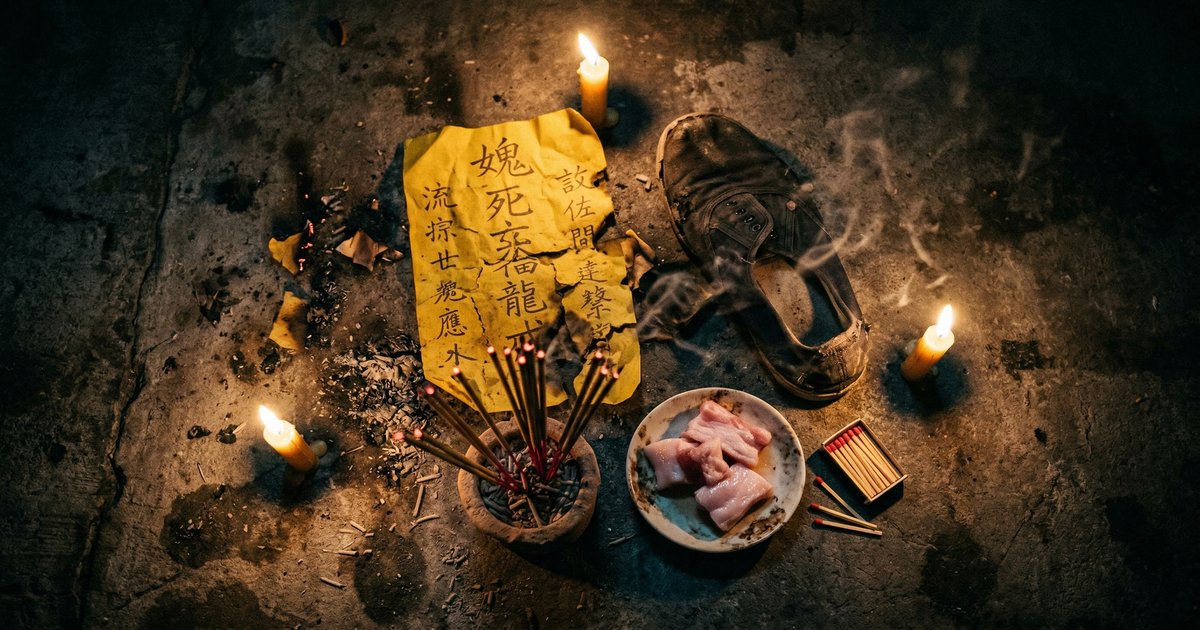
What happens during villain hitting? The full ceremony unfolds in eight steps (八部曲): invite the deities, register the target by name on paper, strike the paper effigy with a shoe, feed it to a paper White Tiger and burn both, then scatter rice to dispel misfortune. The ritual takes 10-20 minutes at Goose Neck Bridge.
The traditional villain hitting ritual follows eight steps known as the 八部曲 (eight movements). While different practitioners may combine or abbreviate certain steps, the complete ceremony as practiced at Goose Neck Bridge encompasses all eight:
Step 1: 請神 — Inviting the Deities
Incense and red candles are lit. The practitioner recites prayers to invoke the White Tiger and local spirits, asking them to witness and empower the ritual. This establishes the sacred context — without divine witnesses, the beating is just vandalism. With them, it is judgment.
Step 2: 稟告 — Declaration
The practitioner writes the client's name and birthdate on a 百解符 (hundred-solutions talisman), then writes the target's name, birthdate (if known), and the type of petty person on the paper effigy. In Chinese folk belief, a name is not just a label — it is a thread connecting the physical person to the spiritual realm. Writing it on paper creates a bridge between the target and the effigy. In folk understanding, both parties are now registered in the spirit world's records.
Step 3: 過火 — Passing Through Fire
The talisman and effigy are passed over the candle flames — a purification step that cleanses both documents before the main ritual begins. The fire burns away anything that might weaken the ceremony's focus.
Step 4: 打小人 — The Beating
The core of villain hitting history. The practitioner takes an old shoe — traditionally a cloth shoe, though modern practitioners use whatever is available — and strikes the paper effigy repeatedly. Each strike is accompanied by a curse chant in Cantonese. The chants vary by petty person type:
- For a backstabber (是非小人): Words exposing their deceit, forcing their lies into the open
- For a toxic boss (職場小人): Curses targeting their authority, withering their influence
- For a romantic enemy (感情小人): Words severing their hold, burning their emotional bonds
- For a financial enemy (財運小人): Curses blocking their wealth, closing their channels of gain
- For a legal enemy (官非小人): Words turning their schemes against themselves, making their traps spring on the trapper
The beating continues until the paper figure is torn and degraded — physically transformed from a representation of the petty person's power into a symbol of their defeat. The sound of shoe on paper, echoing under the concrete bridge, is one of the most distinctive audio signatures in global curse traditions.
Step 5: 祭白虎 — White Tiger Sacrifice and Burning
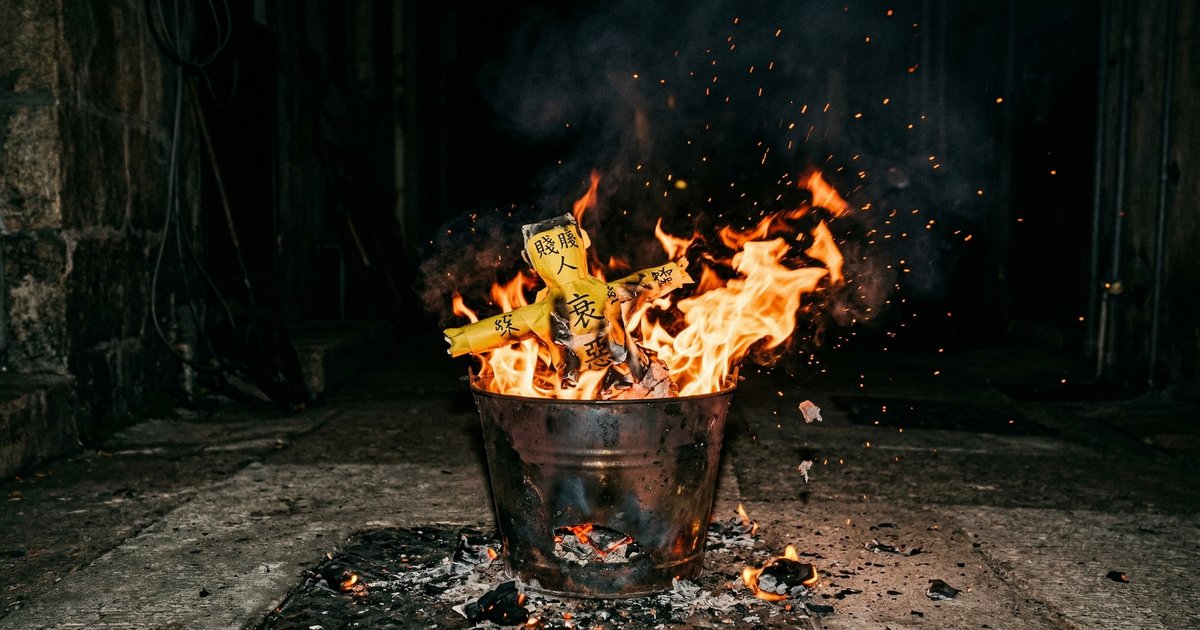
The beaten effigy is placed into the mouth of a paper White Tiger (紙白虎). Raw pork is offered to feed the tiger — ensuring it devours the petty person rather than the client. Then the paper tiger and effigy are burned together in a metal bucket or on a stone surface. This closes the loop with the Jingzhe White Tiger rite: feed the tiger so it spares you — and, in the villain-hitting telling, so it devours your petty person instead. You feed the tiger so it eats your enemy, not you. This transactional relationship with the supernatural is characteristic of Chinese folk religion — the gods are not worshipped from afar. They are negotiated with.
Step 6: 化解 — Dispelling Misfortune
Rice, five-color beans (五色豆), sesame seeds, and peanuts are scattered onto the ground. Each grain represents the petty person's retreat — their influence dispersed in all directions rather than merely displaced. The 百解符 may be used here to aid in dissolving residual negative energy.
Step 7: 祈福/進寶 — Praying for Blessings
The ceremony shifts from destruction to restoration. Red 貴人紙 (noble-person paper) is used to pray for helpful allies. Gold and silver paper money (金銀衣紙) and ingots (元寶) are burned as payment to the spirits for their assistance. The ritual moves from eliminating the negative to inviting the positive.
Step 8: 擲筊 — Divination and Confirmation
Two crescent-shaped wooden blocks (筊杯) are thrown. 聖杯 (one face up, one face down) means the spirits confirm success. 笑杯 (both faces up) means uncertainty. 怒杯 (both faces down) means rejection — the ritual may need to be repeated. The divination provides closure: a definitive answer from the spirit world.
The entire ceremony takes 10-20 minutes. The client pays, stands, and walks away into the Hong Kong afternoon. Something has been set in motion — or, at minimum, something has been released. For the complete detailed breakdown of each step, see our guide to what Da Siu Yan is and how the ritual works.
Six Petty Persons, Six Curses
Traditional practice has no fixed taxonomy — any enemy can be named. But the grievances recur in patterns, and the ritual sorts them with surprising precision: six categories of petty persons, each requiring different ritual approaches, each targeting a different vector of harm:
| Petty Person | Chinese | What They Do | Ritual Focus |
|---|---|---|---|
| The Backstabber | 是非小人 | Spreads rumors, betrays trust, creates conflict | Expose their deceit publicly in the curse |
| The Toxic Boss | 職場小人 | Abuses authority, blocks advancement, takes credit | Undermine their authority and influence |
| The Romantic Enemy | 感情小人 | Destroys relationships, causes heartbreak | Sever emotional bonds and attachments |
| The Financial Enemy | 財運小人 | Blocks wealth, causes financial loss, steals opportunity | Block their wealth channels |
| The Legal Enemy | 官非小人 | Uses law and bureaucracy as weapons | Turn their schemes against themselves |
| Custom Target | 自定義 | Any specific individual who has wronged you | Personalized curse based on the specific harm |
This folk way of sorting harm owes nothing to modern psychology, yet it maps surprisingly well onto contemporary understanding of toxic relationships. The Cantonese weren't performing therapy — they were fighting back with the tools available to them. The classification system ensured that each curse was targeted, not random. A backstabber requires different treatment than a toxic boss. The precision is what gives the ritual its psychological power — it addresses exactly what was done to you.
The Grandmothers: Keepers of Forbidden Knowledge
The practitioners of Da Siu Yan — almost exclusively elderly women — represent something rare in the modern world: a living oral tradition with no written documentation, no formal training school, no certification body. The knowledge passes from hand to hand, generation to generation, entirely through practice.
These women are not priests. They are not scholars. They are grandmothers who learned the craft from their own grandmothers, who learned it from theirs. The specific chants, the timing of strikes, the composition of offerings — all transmitted through demonstration and repetition, not textbooks.
The gender dynamic is not accidental. In traditional Cantonese society, women had fewer avenues for addressing grievances. They couldn't take rivals to court. They couldn't challenge abusive employers. But they could beat a paper effigy and burn it to ash. The ritual provided agency where institutions did not — a theme that runs through black magic traditions worldwide.
The grandmothers at Goose Neck Bridge Hong Kong are the most visible keepers of this oral tradition. Each year, their numbers thin. Most are elderly, and few if any apprentices queue to learn the craft. An oral chain that stretches back beyond any written record is approaching its final links.
What Dies When the Grandmothers Die
Losing the practitioners means losing more than a service. Each grandmother carries a slightly different version of the chants — regional variations, personal innovations, family-specific techniques passed down through generations. When a grandmother stops practicing, her particular version of the ritual vanishes entirely. There is no recording, no transcription. The curse words exist only in the moment of their speaking.
This is why digital preservation matters — not as a replacement, but as a record. The structure of the ritual can survive even if the specific words cannot. The beating, the burning, the sealing — these can be translated. The exact Cantonese incantations of a particular grandmother are irreproducible.
From Superstition to Cultural Heritage
For most of its history, villain hitting was dismissed by authorities as vulgar superstition. Colonial British administrators in Hong Kong tolerated it as a quaint local custom — the kind of thing tourists photographed but nobody took seriously. Mainland Chinese authorities during the Cultural Revolution actively suppressed it as "feudal superstition." Practitioners risked persecution. The villain hitting history is, in part, a story of survival against institutional hostility.
The shift came in the mid-2000s: UNESCO's 2003 intangible-heritage convention was extended to Hong Kong at the end of 2004, an ICH unit followed in 2006, and a territory-wide survey (2009–13) began cataloguing traditions the city had long dismissed — while post-handover Hong Kong was re-examining what counted as its own culture. Suddenly, practices that had seemed embarrassing to modern sensibilities became symbols of local identity. Villain hitting wasn't superstition — it was heritage. It was Cantonese. It was ours.
In 2014, the Hong Kong government officially recognized villain hitting as part of the city's Intangible Cultural Heritage. The designation acknowledged that the practice, regardless of its supernatural claims, represents an important thread in the fabric of Cantonese folk culture — passed down for generations, even though nobody can say exactly how many.
The recognition had practical effects. Stalls that officialdom had long treated as a street-hawking nuisance now carried a listed heritage practice. Tourism brochures began mentioning the ritual. International media covered it as cultural phenomenon rather than superstition.
Yet the irony is sharp: recognition came precisely as the tradition was dying. The designation is a gravestone as much as a celebration.
Villain Hitting Across the Chinese Diaspora
Goose Neck Bridge Hong Kong is the epicenter, but not the only site. The practice traveled with Cantonese immigrants to Chinatowns worldwide:
- Singapore and Malaysia: Chinese temples that worship the White Tiger God commonly offer the service, particularly during Jingzhe.
- Taiwan: Known as 打小人 (dǎ xiǎo rén) in Mandarin, the practice exists but is less visible than in Hong Kong. Taiwan's temple culture provides alternative outlets for similar grievances.
- Global Chinatowns: Informal practitioners in overseas Chinatowns serve diaspora communities. The rituals are typically performed privately rather than in public spaces.
Each diaspora community adapts the ritual to local conditions. The core structure — paper effigy, striking, burning — remains constant. The specific chants, offerings, and timing shift to match available materials and local custom. This adaptability is precisely what has allowed the villain hitting history to survive across borders and generations. The ritual bends without breaking.
The Digital Age: From Goose Neck Bridge to Your Screen
The tradition that survived colonial indifference, official suppression across the border, and the rise of a modern megacity now faces its most radical transformation: digitization. BeatPetty isn't the first attempt to bring Da Siu Yan online, but it is the most faithful to the ritual's structure and atmosphere.
The digital ritual preserves the essential phases: enemy selection (choosing your petty person type), striking (interactive animation), burning (fire and smoke effects), and result (the sealed verdict). What changes is the medium — screen instead of paper, tap instead of shoe strike. What doesn't change is the intent, the structure, and the psychological release.
This isn't replacement. It's translation. The live ritual — a grandmother, a shoe, real smoke under a real bridge — will always be the authentic practice. But for the billions who don't live within walking distance of a Causeway Bay underpass, the digital version keeps the tradition accessible and alive.
Try it — the Da Siu Yan ritual online; the first five steps are free. Begin the ritual →
Ready to cast your curse?
Experience Hong Kong's heritage-listed curse ritual — 5 steps free, no signup required.
Cast a Curse Now →Further Reading
- What is Da Siu Yan — The complete guide to the Chinese petty person curse tradition
- How to Curse Someone — Step-by-step curse methods from Chinese Da Siu Yan to Western hexes
- Voodoo Magic and Curses — Comparing global curse traditions: Voodoo vs Da Siu Yan
- What is Black Magic — The broader context of black magic traditions worldwide
- Hex Spells and Curses — How hexing compares to the Chinese curse tradition
- How to Get Rid of Bad Luck — Curse removal and luck cleansing traditions
Frequently Asked Questions
Where to beat petty person in Hong Kong?
The most famous location is under Goose Neck Bridge (鵝頸橋) in Causeway Bay, Hong Kong. Elderly women set up stalls offering the ritual service, especially during the Jingzhe solar term in early March. The bridge's feng shui properties — sitting at a yin-yang boundary beneath a concrete overpass — make it the traditionally preferred site for villain hitting.
When is the best time for Da Siu Yan?
The traditional time is Jingzhe (驚蟄), the third solar term in the Chinese calendar, falling around March 5-6 each year. This is when hibernating insects awaken and, according to folk belief, when the White Tiger stirs and petty persons become active. However, modern practitioners in Hong Kong perform the ritual year-round.
What happens during villain hitting?
The full traditional ceremony involves eight steps (八部曲): inviting the deities (請神), registering the client and target by name (稟告), passing the documents through fire (過火), striking the paper effigy with a shoe (打小人), feeding the paper White Tiger and burning it together with the effigy (祭白虎), scattering rice and beans to dispel misfortune (化解), burning gold and silver paper for blessings (祈福/進寶), and throwing divination blocks to confirm completion (擲筊). The entire ceremony takes 10-20 minutes at Goose Neck Bridge stalls.
Is Da Siu Yan still practiced today?
Yes. Villain hitting is still practiced at Goose Neck Bridge in Hong Kong and in communities worldwide. In 2014, it was officially recognized as part of Hong Kong's Intangible Cultural Heritage. However, the number of traditional practitioners is declining — mostly elderly women remain. Digital versions like BeatPetty now make the ritual accessible globally.
Why is villain hitting done under Goose Neck Bridge?
In feng shui, the area beneath Goose Neck Bridge sits at a junction of yin energy — sheltered from direct sunlight, near running water, and at a road intersection. Traditional Chinese belief holds that such locations amplify banishing rituals. The bridge became the ritual's most famous stage only in recent decades — 1970s fieldwork still recorded Bowen Road as a bigger centre — while the practice itself is older than its own records.
How much does villain hitting cost in Hong Kong?
At Goose Neck Bridge, a typical villain hitting session costs HK$50-300 (approximately US$6-38), depending on the elaborateness of the ritual. Basic beatings are at the lower end; full ceremonies with extended chanting, White Tiger offerings, and additional incense cost more. No appointment is needed — you show up, pay, and the grandmother begins.
Can I perform Da Siu Yan at home?
The traditional ritual requires minimal materials — a paper effigy, an old shoe, incense, and a way to burn the figure. While Goose Neck Bridge is considered the most powerful location, the ritual can be performed anywhere with the correct intent and structure. BeatPetty offers a digital version that preserves the essential phases: enemy selection, striking, burning, and sealing.
Why is villain hitting done on Jingzhe?
Jingzhe (驚蟄), the solar term around March 5-6, marks the awakening of hibernating creatures and the stirring of dormant energies. Cantonese folk belief holds that the White Tiger becomes active on this day, and with it petty persons grow bolder and more harmful. Performing villain hitting on Jingzhe is both preventive — suppressing the coming year's petty persons — and reactive, punishing those who have already wronged you while the boundary between worlds is thinnest.