Voodoo Curses: Meaning, the Petro Rite, and Are They Real?
Voodoo Magic and Curses
Voodoo magic is not what Hollywood showed you. The pins-in-dolls image, the "black magic" label, the demonic possession trope — all of it is distortion. Real Vodou is a complex, living religion with deep roots in West Africa, forged in the Caribbean through the crucible of slavery, and practiced today by millions. Its voodoo curse traditions are real, structured, and far more nuanced than popular culture admits.
This guide covers the actual history of Vodou, how its spiritual system works, the truth about voodoo curses and hexes, and how this tradition compares to other curse practices around the world — including the Chinese Da Siu Yan tradition.
Key Takeaways:
- Vodou is a religion, not a horror trope. Born from West African traditions and shaped by slavery in the Caribbean, it has a structured pantheon of spirits (Loa), ordained priests (Houngans and Mambos), and codified rituals — including curse practices that are real, specific, and deeply serious
- Voodoo curses work through spirits, not spells. Unlike Western hex spells where the practitioner casts directly, Vodou cursing requires petitioning specific Loa through proper ceremony — the practitioner mediates, the spirit acts
- Experience a real curse ritual based on the Chinese Da Siu Yan tradition — the Eastern parallel to voodoo cursing; the first five steps are free. What if it works?
What Is Voodoo Magic?
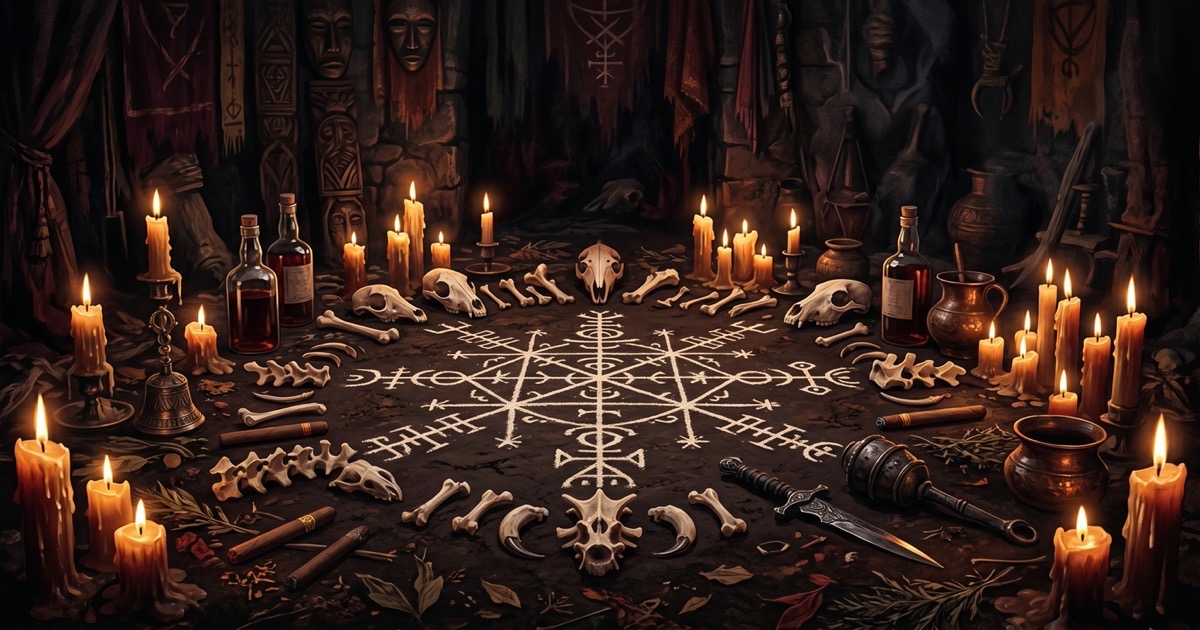
Voodoo magic — more properly Vodou or Vodun — is a system of spiritual practice originating in West Africa and developed primarily in Haiti and New Orleans, in which practitioners petition spirits called Loa through ceremony, offerings, and drawn symbols called veves. The Fon word vodùn means "spirit," not magic or curse, and the religion's core is relationship with these intermediaries, not spellcasting.
Voodoo magic — more properly Vodou or Vodun — is a system of spiritual practice originating in West Africa and developed primarily in Haiti and New Orleans. The word itself comes from the Fon language of modern-day Benin, where vodùn means "spirit" or "divine entity." Not magic. Not curse. Spirit.
This distinction matters. Vodou is not a system of spells. It is a relationship between humans and spirits — the Loa (also spelled Lwa). Each Loa governs a domain of human life: love, war, death, crossroads, agriculture. Practitioners do not command these spirits. They petition them. Offerings are made, ceremonies are conducted, and the Loa choose whether to respond.
There are three major branches that share the "Voodoo" label, each distinct:
| Tradition | Location | Key Characteristics |
|---|---|---|
| Haitian Vodou | Haiti, diaspora | The most complete form — full pantheon, priesthood, ceremonies, Catholic syncretism |
| Louisiana Voodoo | New Orleans, American South | Simpler structure, influenced by Hoodoo and Native American practices, historically centered on Marie Laveau |
| West African Vodun | Benin, Togo, Ghana | The ancestral source — recognized as an official religion in Benin since 1996 |
Each branch shares the same foundation — petitioning spirits through ritual — but differs in practice, pantheon structure, and cultural context. When people search for voodoo magic, they are usually encountering the Haitian tradition filtered through decades of cinematic distortion.
The Real History of Voodoo
West African Roots: Dahomey and the Fon People
The spiritual tradition that would become Vodou originated in the Kingdom of Dahomey — a powerful West African empire that flourished in what is now southern Benin from roughly 1600 to 1900. The Fon people, Dahomey's dominant ethnic group, practiced a sophisticated religion centered on a pantheon of spirits (the Vodun) who mediated between the creator deity and the human world.
This was not primitive superstition. Dahomey was a structured kingdom with professional soldiers, complex trade networks, and an elaborate religious hierarchy. The priests and priestesses of the Vodun were trained specialists who served their communities as healers, advisors, and — when circumstances demanded — agents of spiritual retribution. Curse practices existed within this system, but they were regulated by ethical codes and community oversight. A priest who cursed without just cause faced consequences from the community and, it was believed, from the spirits themselves.
The Middle Passage: How Vodou Was Born in Haiti
The transatlantic slave trade tore these traditions from their soil. Between the 16th and 19th centuries, millions of Fon, Ewe, Yoruba, and Kongo people were transported to the Caribbean. In French colonial Saint-Domingue (modern Haiti), enslaved Africans from different ethnic groups were deliberately mixed to prevent organized resistance.
This brutal mixing had an unintended consequence: it forced diverse African spiritual traditions to merge. Fon Vodun blended with Yoruba Orisha worship, Kongo cosmology, and — critically — Roman Catholicism. Slaves were forced to convert, so they disguised their Loa behind Catholic saints. Damballah, the serpent spirit, became associated with Saint Patrick. Papa Legba, guardian of the crossroads, became Saint Peter. This syncretism was a survival strategy — hiding African religion in plain sight.
Vodou played a direct role in the only slave revolt in history to result in the founding of an independent nation. The Haitian Revolution (1791–1804) began with a Vodou ceremony at Bois Caïman, where a Houngan named Dutty Boukman performed a ritual that galvanized the rebellion. Haiti became the first Black republic — and Vodou became inextricable from Haitian national identity.
New Orleans Voodoo: An American Tradition
Louisiana Voodoo developed along a different path. Before the Haitian Revolution, New Orleans was already a center of African spiritual practice under French and Spanish colonial rule. After the revolution, white colonists fleeing Haiti brought their enslaved people — and their Vodou practices — to New Orleans, creating a second crucible for the tradition.
The figure who defines Louisiana Voodoo is Marie Laveau (1801–1881), a free woman of color who served as the tradition's most prominent practitioner. Laveau held public ceremonies on the shores of Lake Pontchartrain, consulted clients from every social class, and commanded such influence that politicians sought her blessing. She was simultaneously a Vodou priestess, a devout Catholic, and a hairdresser who gathered intelligence from the wives of powerful men — a combination that made her arguably the most powerful woman in 19th-century New Orleans.
Louisiana Voodoo is simpler in structure than Haitian Vodou — fewer Loa, less formal priesthood — but it carries the same core principle: spirits are real, they can be petitioned, and they respond to proper ritual.
How Does Voodoo Work?
How does voodoo work? Vodou works through mediated communication with spirits called Loa. Ordained practitioners — Houngans and Mambos — conduct ceremonies with rhythmic drumming, drawn veves, food and drink offerings, and dancing that can lead to spirit possession. The Loa are invited to descend, and they — not the practitioner — decide whether to heal, protect, or deliver retribution.
The Loa — Spirits That Walk Between Worlds
The Loa are the axis of Vodou. There is a supreme creator — Bondye, from the French Bon Dieu — who is distant and uninvolved in daily human affairs. The Loa are the intermediaries who interact with humanity, each governing a specific domain:
- Papa Legba — Guardian of the crossroads. The first Loa invoked in every ceremony — nothing reaches the other Loa without passing through him
- Damballah — The serpent spirit, associated with creation, wisdom, and the waters. One of the oldest and most revered Loa
- Baron Samedi — Master of the dead, lord of the cemetery. He who digs the grave and guards the passage between life and death. Recognizable by his top hat, dark glasses, and cigar
- Erzulie — Spirit of love, beauty, and fierce passion. She can grant romance or destroy it — often weeping for the suffering of humanity
- Ogoun — Warrior spirit of iron, politics, and conflict. The Loa called upon in war, in struggle, and when justice demands force
The Loa are organized into nanchon (nations), each with a distinct character:
| Nation | Character | Origin | Typical Loa |
|---|---|---|---|
| Rada | Peaceful, benevolent, wisdom-seeking | Direct African lineage | Damballah, Ayizan, Agwé |
| Petro | Fiery, aggressive, fast-acting | Born in the New World from the suffering of slavery | Ogoun Feray, Erzulie Dantor |
| Ghede | Death, obscenity, irreverent humor | Boundary between life and death | Baron Samedi, Maman Brigitte |
For voodoo curses, the Petro nation is most commonly invoked. These are the Loa born from rage and suffering — the spirits of fire and retribution. A practitioner seeking to curse does not approach gentle Rada spirits. They go to Petro, the spirits who understand injustice because they were born from it.
Ceremonies, Veves, and Possession
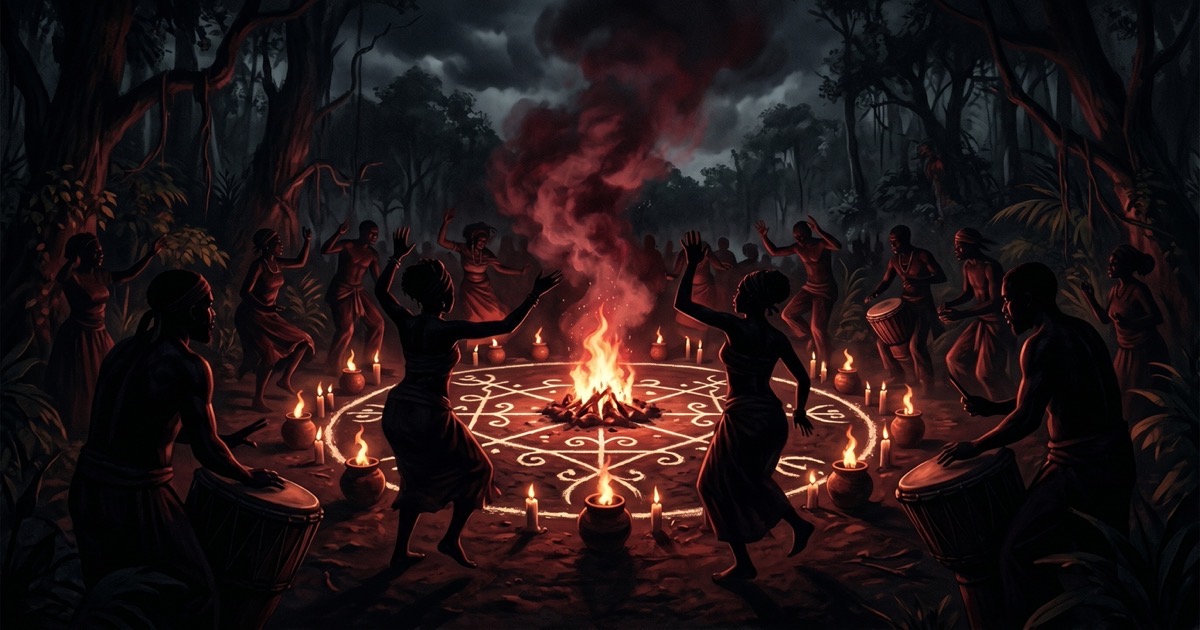
A Vodou ceremony is not a secret rite in a basement. It is a communal event — often outdoors, always with drumming, typically lasting hours. The structure follows a precise sequence:
- Invocation of Papa Legba — The gatekeeper must open the way before any other Loa can be contacted. Without Legba's permission, the ceremony goes nowhere
- Drawing the veve — The Houngan or Mambo draws an intricate symbol on the ground using cornmeal. Each Loa has a unique veve — it serves as their invitation and their seat. The veve for Damballah features serpentine curves; Baron Samedi's includes cross motifs
- Offerings — Food, drink, tobacco, animals. Each Loa has specific preferences. Baron Samedi demands rum and cigars. Damballah accepts eggs and white flour. Erzulie prefers sweet things and perfume
- Drumming and dancing — The rhythm matches the Loa being called. The dancing builds energy until a participant is "mounted" — possessed by the spirit
- Possession — The Loa descends into a practitioner, who speaks and acts as the spirit. This is the moment of contact — the Loa offers advice, performs healings, or — in a curse ceremony — accepts or refuses the petition
This is how voodoo magic actually works. Not through spells cast by individuals, but through spirits petitioned in ceremony. The Houngan or Mambo facilitates the encounter. The Loa decides whether to act.
Voodoo Curses and Hexes
A voodoo curse is a request for harm or retribution directed through Vodou's spirits — usually Petro Loa — rather than a spell cast by personal will alone. The practitioner petitions; the Loa decides.
The Truth About Voodoo Dolls
Let's address the elephant in the room: voodoo dolls are not from Vodou.
The image of sticking pins into a doll to harm someone is a Hollywood invention with roots in European poppet magic and Hoodoo — an African-American folk magic tradition distinct from Vodou. In actual Haitian Vodou, practitioners do not use dolls as cursing tools. The Loa are petitioned through ceremony, veves, and offerings — not through figurines with pins.
The confusion arose because Hoodoo (which developed in the American South alongside Louisiana Voodoo) does use doll-like constructs called poppets or conjuration dolls in binding and cursing work. But these are Hoodoo practice, not Vodou. The two traditions are often conflated in popular culture, which is how the voodoo doll myth was born.
This matters because understanding how voodoo curses actually work requires stripping away the Hollywood distortion. Vodou cursing is not sympathetic magic with dolls. It is petitioning spirits of fire and death to deliver retribution.
Real Vodou Curse Methods
Actual voodoo curse practices within Haitian Vodou include:
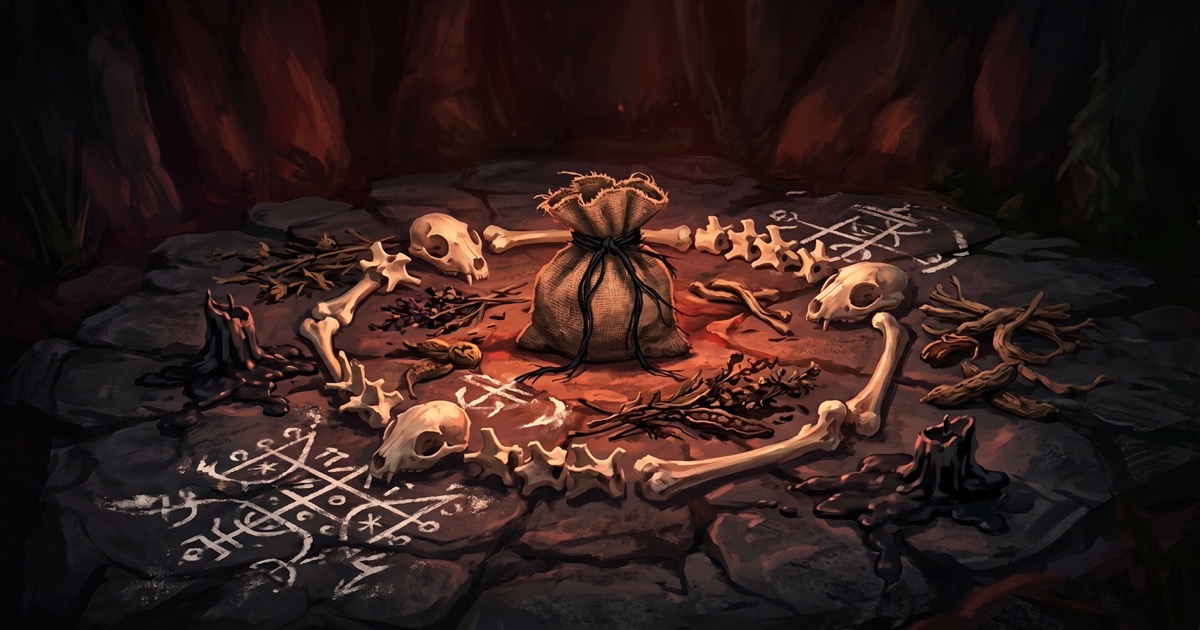
- Wanga — A magical charm or packet containing specific ingredients (herbs, animal parts, personal items belonging to the target) prepared by a Bokor — a practitioner who works with "both hands," meaning both healing and harming. The wanga is charged through ceremony and Loa invocation, then placed where the target will encounter it or hidden near their home
- Left-hand work — Harmful magical work in Vodou, distinguished from "right-hand" healing and protective work. A Bokor who performs left-hand work petitions Petro Loa for retribution against wrongdoers. This is not chaos for chaos's sake — it is a formal grievance presented to spirits who understand injustice
- Baka — In some traditions, a malevolent spirit that can be dispatched against an enemy. This is among the most feared practices and is considered extremely dangerous — the Baka can turn on its sender if the ritual is improperly conducted
- Ghede petition — A ceremony calling upon Baron Samedi or the Ghede spirits (lords of death) regarding a target. This is not casual curse work — it is reserved for the most grievous offenses and carries the heaviest spiritual consequences
Each method follows the same underlying structure found across many documented curse traditions: identify the target, channel intent through ritual, petition a spiritual force, and seal the working. The Vodou difference is that the spiritual force being petitioned is a named, known Loa with specific preferences and protocols — not an abstract "dark energy."
Is Voodoo Demonic?
Is voodoo demonic? No. Vodou is a recognized religion blending West African spirit traditions with Catholicism, and its Loa function much like Catholic saints — some gentle, some fierce, none "demonic" in the Christian theological sense. The demonic narrative was created during the colonial era to justify the subjugation of enslaved Africans and reinforced by Hollywood, not by the religion's own practitioners.
The short answer: no. The longer answer requires understanding why this question exists at all.
The "voodoo is demonic" narrative was created during the colonial era as a tool of control. Enslaved Africans who practiced Vodou were punished, tortured, and killed. Their religion was labeled devil worship not because it was devil worship, but because demonizing the spiritual practices of enslaved people made their subjugation easier to justify. After the Haitian Revolution — when enslaved people overthrew their French masters using the very religion the colonizers had tried to crush — Vodou was further demonized because it had proven dangerously effective.
The Catholic Church, ironically, provided the framework for Vodou's survival. By syncretizing Loa with Catholic saints, practitioners could appear to be practicing Catholicism while maintaining their African traditions. This wasn't deception — it was genuine synthesis. Many Vodou practitioners are sincerely Catholic. They see no contradiction between praying to Saint Patrick and honoring Damballah, because in their understanding, these are the same spiritual entity understood through different cultural lenses.
Modern Vodou is recognized as a legitimate religion. Benin recognized Vodun as an official religion in 1996. Haiti recognized Vodou as an official state religion in 2003. The idea that Vodou is demonic persists primarily in American evangelical culture and Hollywood — not in countries where the religion is actually practiced.
Voodoo vs Black Magic
Voodoo and black magic are not the same thing, though they overlap in the popular imagination. The distinction matters for anyone trying to understand either tradition:
| Aspect | Vodou | Black Magic |
|---|---|---|
| Definition | A complete religion with pantheon, priesthood, and ethical codes | A broad category of harmful magical practices found across cultures |
| Scope | Healing, protection, divination, community, AND cursing | Primarily harm, manipulation, and coercion |
| Practitioner | Ordained Houngan/Mambo (or Bokor for left-hand work) | Anyone who learns the techniques — no ordination required |
| Mechanism | Petitioning Loa through ceremony — spirits decide whether to act | Direct spellcasting — the practitioner's will is the primary force |
| Ethics | Cursing is regulated by community norms — typically last resort | Ethics vary wildly by tradition — some have none |
| Cultural home | Haiti, Benin, New Orleans | Universal — found in every culture |
| Relationship to religion | Vodou IS the religion | Black magic is a category of practice, not a religion |
The key difference: in Vodou, cursing requires spiritual intermediaries and operates within an ethical framework. In black magic traditions, the practitioner typically works directly with magical forces — no Loa, no permission, no framework beyond their own intent.
This is why voodoo curses carry a different weight than generic black magic. A Vodou curse involves a spiritual tradition behind it — the Loa who accepts the petition, the ceremony that validates it, the community that recognizes it. It is not a solitary spell cast in anger. It is a formal grievance presented to a spiritual court.
Voodoo and Da Siu Yan: Two Curse Traditions Compared
On opposite sides of the world, two curse traditions developed independently — yet share striking similarities. Haitian Vodou and the Chinese Da Siu Yan (打小人, "beating the petty person") both emerged from oppressed communities, both involve structured ritual, and both treat cursing as a serious, codified practice rather than casual malice.
| Aspect | Vodou Curse | Da Siu Yan |
|---|---|---|
| Origin | West Africa to Haiti, via the slave trade | Southern China to Hong Kong, via folk religion |
| Age | ~400 years (in Caribbean form) | origin unrecorded (ICH-listed 2014) |
| Practitioner | Bokor (left-hand Vodou practitioner) | 師婆/師傅 (ritual specialist) or self-performed |
| Targeting | Name, personal items, Loa invocation | Paper effigy with target's name, struck with shoe |
| Spiritual intermediary | Petro Loa (fire, retribution) | No intermediary — practitioner acts directly; 白虎 (White Tiger) invoked in sacrifice step |
| Cultural status | Recognized religion, stigmatized in the West | Hong Kong intangible cultural heritage, publicly practiced |
| Location | Temple, ceremony ground | Goose Neck Bridge, temples, street-side |
| Public visibility | Largely private | Openly practiced in public spaces |
The most striking difference is public acceptance. At Goose Neck Bridge in Hong Kong, elderly women perform Da Siu Yan rituals in broad daylight, surrounded by pedestrians. The practice is recognized, respected, and protected as cultural heritage. Vodou cursing, by contrast, operates in a climate of misunderstanding and stigma — a legacy of the colonial demonization described earlier.
Both traditions share the same underlying mechanism: identify the target, externalize intent through physical ritual, invoke a spiritual force, and seal the working. The tools differ. The structure does not.
Experience the Eastern tradition yourself — perform a Da Siu Yan curse ritual →
Ready to cast your curse?
Experience Hong Kong's heritage-listed curse ritual — 5 steps free, no signup required.
Cast a Curse Now →Three Curse Traditions Compared
Across the world, three major curse traditions developed independently, each reflecting its cultural origins while sharing the same fundamental structure:
| Aspect | Vodou | Western Hexing | Da Siu Yan |
|---|---|---|---|
| Cultural home | Haiti, Benin, New Orleans | Germanic Europe, Pennsylvania | Southern China, Hong Kong |
| Primary mechanism | Loa petition through ceremony | Direct spell via symbols, candles | Paper effigy struck with shoe |
| Spiritual intermediary | Named Loa (Petro, Ghede) | None — practitioner's will, or generic spirits | No intermediary — White Tiger invoked in sacrifice step |
| Practitioner | Bokor / Houngan | Hexenmeeschter / modern witch | 師婆 or self-performed |
| Cost | Variable — offerings can be expensive | Low — candles, thread, paper | Low — paper, shoe, incense |
| Public status | Stigmatized, misunderstood | Stigmatized, underground | Public, culturally accepted |
| Historical trauma | Born from slavery | Persecuted in witch trials | Mainland folk-religion suppression after 1949; the rite's documented home is Hong Kong |
| Modern access | Temple ceremonies | Internet, modern witchcraft | Online ritual, Goose Neck Bridge |
Each tradition carries the scars of its history — slavery, witch trials, political suppression. Each persists because the human need to externalize anger and seek retribution transcends culture. For a deeper look at Western hexing, see our complete guide to hex spells and curses.
Further Reading
- What is Da Siu Yan — The Chinese curse tradition and how it compares to Vodou
- History of Villain Hitting — generations of Chinese curse rituals at Goose Neck Bridge
- What is Black Magic — The broader context of dark magic traditions worldwide
- Hex Spells and Curses — Western hexing across cultures
- How to Curse Someone — The four-step curse framework
- How to Remove a Curse — Curse protection and removal methods
- Breaking Generational Curses — When a curse is inherited across a bloodline
Frequently Asked Questions
Is voodoo real?
Vodou is a real, living religion practiced by an estimated 60 million people worldwide, primarily in Haiti, Benin, Togo, and the American South. Its ceremonies, priesthood, and spiritual practices are documented by anthropologists and historians. Whether the Loa produce supernatural effects is a matter of faith — but the religion, its rituals, and its cultural impact are as real as any other spiritual tradition on Earth.
How does voodoo work?
Vodou works through mediated communication with spirits called Loa (or Lwa). Practitioners — Houngans (priests) and Mambos (priestesses) — conduct ceremonies involving rhythmic drumming, drawn symbols called veves, offerings of food and drink, and ecstatic dancing. The Loa are invited to descend and possess participants, providing guidance, healing, protection, or — when properly petitioned with cause — retribution against wrongdoers.
Is voodoo demonic?
No. The idea that Vodou is demonic comes from Hollywood films and colonial-era propaganda designed to demonize African spiritual practices. Vodou is a recognized religion that blends West African spirit traditions with Catholicism. Its spirits (Loa) function similarly to Catholic saints — some are gentle healers, some are fierce warriors, but none are 'demonic' in the Christian theological sense.
What is the difference between voodoo and black magic?
Vodou is a complete religion with a structured pantheon, priesthood, ethical codes, and community practices — curses are one small aspect. Black magic is a broad category describing harmful magical practices found across many cultures. Vodou cursing involves petitioning specific Loa through proper ritual channels, while black magic traditions often involve direct spellcasting without intermediary spirits.
What is voodoo magic?
Voodoo magic refers to the spiritual and ritual practices within the Vodou religion — including healing, protection, divination, fortune-telling, and cursing. It operates through the Loa (spirits) rather than direct spellcasting. Practitioners draw veves (ritual ground symbols), present offerings, and conduct ceremonies to petition specific Loa for specific outcomes.
Are voodoo curses real?
Voodoo curses exist as documented cultural practices within the Vodou religion, typically performed by a Bokor — a practitioner who works with both healing and harming. The psychological effects are well-studied: a person who believes they have been cursed may experience real anxiety, physical illness, and cascading misfortune through the nocebo effect. In Vodou communities, cursing is treated as a serious matter and is typically a last resort.
How do you remove a voodoo curse?
Within Vodou, curse removal is performed by a Houngan or Mambo through cleansing ceremonies, protective charms, and counter-petitions to the Loa. Outside the tradition, salt baths, egg cleansing, and mirror reversal spells are used to sever the curse's hold. Practitioners agree the breaking must be sealed firmly and followed with protection, or the working can reattach.
What is a voodoo doll used for?
In actual Haitian Vodou, dolls are not used as cursing tools — the pins-in-dolls image is a Hollywood invention drawn from European poppet magic and Hoodoo. Real Vodou petitions the Loa through ceremony, veves, and offerings. Doll-like constructs called poppets belong to Hoodoo and European folk magic, where they are used for binding, healing, or harm through sympathetic principles.
What are voodoo curse words?
Vodou has no public list of "curse words" — harm is requested through ritual petition to the Loa, not by reciting a fixed phrase. The "curse words" in films are invented by screenwriters. What is real is the petition itself: a formal grievance presented to spirits such as the Petro Loa, usually through a Bokor.