What Is a Hex? Meaning, Symbols & How Hex Spells Work
Hex Spells and Curses
A hex is a spell cast with deliberate intent to bring misfortune upon a specific person. The word carries weight — darker than a jinx, more personal than a curse. If you're searching for hex spells or wondering how to hex someone, you're engaging with a tradition that stretches back centuries through European folk magic, Pennsylvania Dutch Braucherei, and kindred practices worldwide.
This guide explains what hexing is, how it differs from cursing and jinxing, where hex spells originated, and what actually happens when you put a hex on someone.
Key Takeaways:
- A hex is a targeted spell directed at a specific individual — more deliberate than a jinx, more personal than a curse — originating from German folk magic and Pennsylvania Dutch Braucherei traditions carried to Pennsylvania by German immigrants in the late 1600s and 1700s
- Hexes, curses, and jinxes differ in scope and severity: hexes target individuals, curses can span generations, jinxes cause temporary nuisance — all operate through the same underlying ritual mechanism
- Experience a real hex ritual based on the Chinese Da Siu Yan tradition — the Eastern equivalent of hexing; the first five steps are free. What if it works?
What Is a Hex?
A hex is a targeted magical spell cast with deliberate intent to bring misfortune or harm to a specific, named person. The word comes from German hexe (witch), rooted in Pennsylvania Dutch folk magic. More personal than a curse and more serious than a jinx, a hex requires focused intent and a named target.
The practitioner channels focused intent through ritual — typically involving symbols, spoken words, candles, or physical objects — and directs it at a named individual.
Unlike the broad misfortune of a curse or the mild annoyance of a jinx, hexing is surgical. It targets a person, not a bloodline. It requires intent, not accident. And it typically has a specific desired outcome — financial ruin, social disgrace, romantic failure — rather than general calamity.
The word itself reveals its roots. "Hex" derives from the German hexe — simply "witch." In Pennsylvania Dutch country, a hex was any spell cast by a practitioner of Braucherei (also called Powwowing), a system of folk healing and magic brought to America by German immigrants in the 17th and 18th centuries. Over time, the term narrowed in English usage to mean specifically harmful magic — a spell meant to do damage.
What Does Hexing Mean in Practice?
When someone asks what hexing means, they're usually asking what the practitioner actually does. The answer varies by tradition, but common elements include:
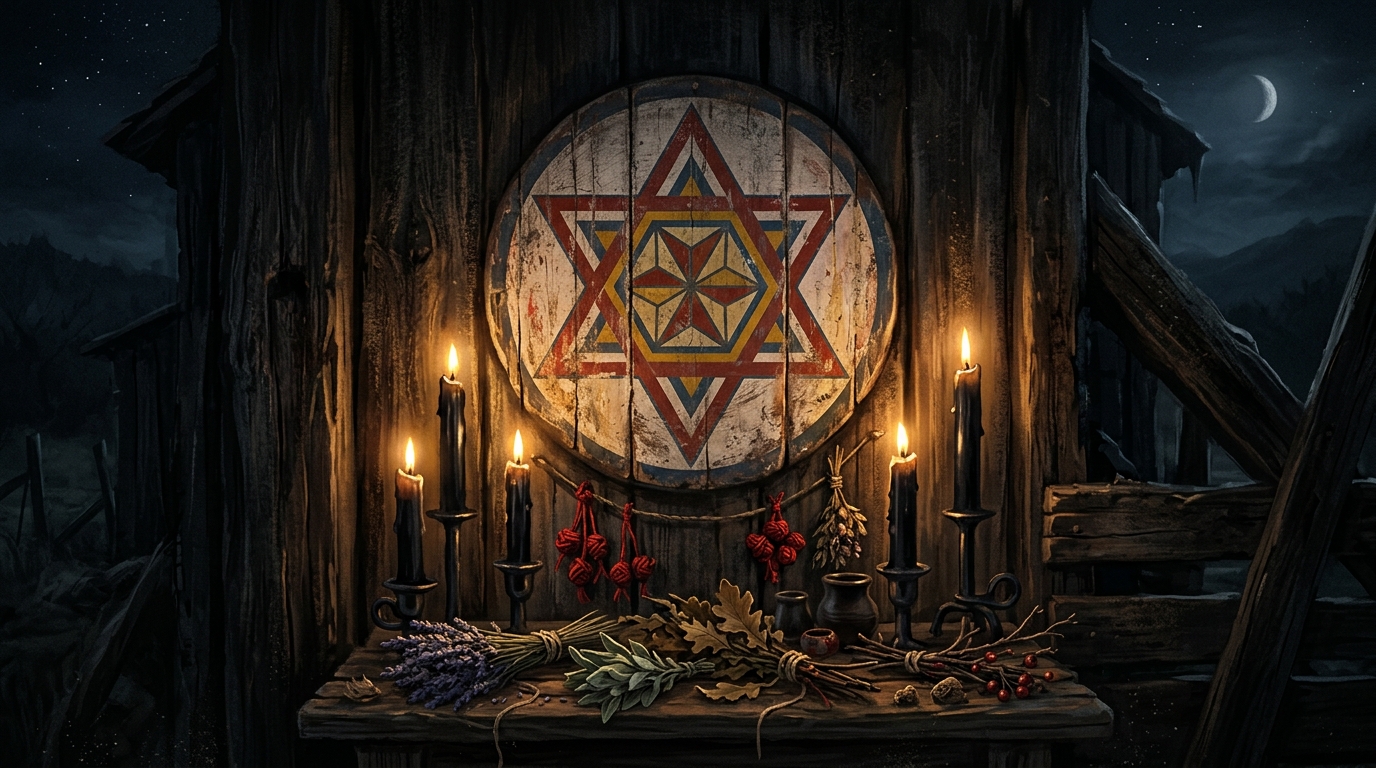
- Written symbols: Hex signs — circular geometric designs painted on barns or drawn on paper — are the most recognizable form of Pennsylvania Dutch hexing. Each motif carries a commonly assigned meaning — a rosette for protection, a distelfink (goldfinch) for good fortune — though those assignments are far younger than the motifs themselves (see Hex Symbols in Witchcraft below)
- Spoken words: Verbal formulas passed down orally through generations of practitioners. These are not "magic words" in the Hollywood sense — they are focused incantations naming the target and the desired outcome
- Candle rituals: Burning specific colors while visualizing the target — black candles for banishing, red for conflict, purple for power over another
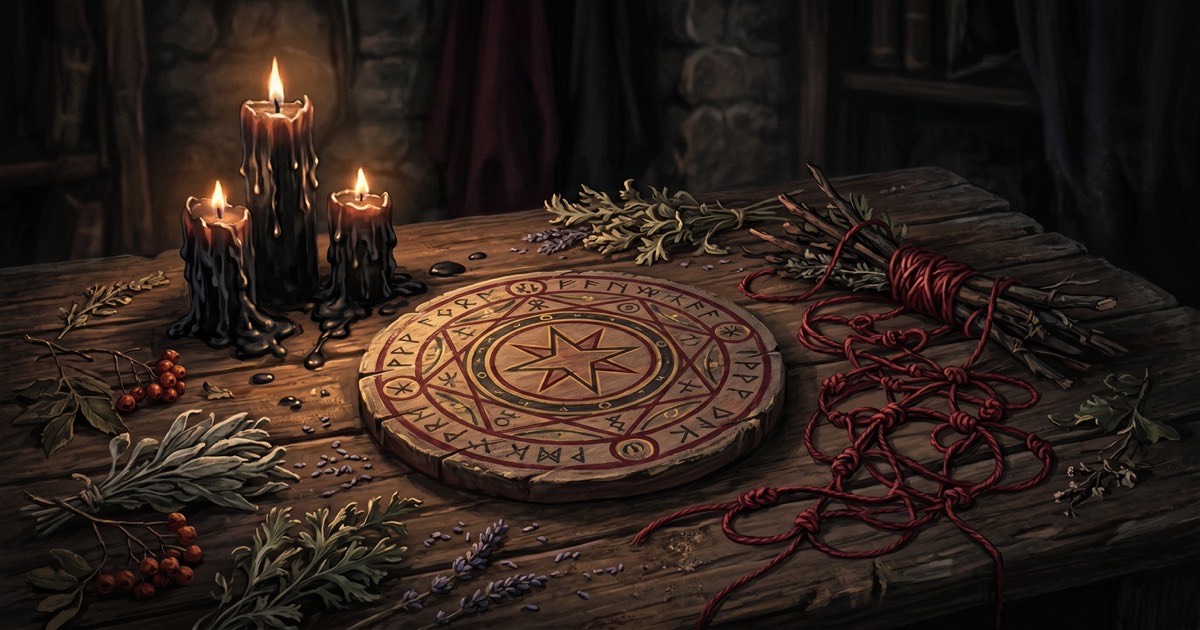
- Binding and knotting: Tying string, cord, or thread while naming the target — each knot "locks in" a portion of the hex
These methods share a common principle with curse traditions worldwide: the physical act mirrors the desired outcome. Tying knots binds the target. Burning candles consumes their influence. Writing symbols encodes intent into physical form.
Ready to cast your curse?
Experience Hong Kong's heritage-listed curse ritual — 5 steps free, no signup required.
Cast a Curse Now →Hex vs Curse vs Jinx
The three terms are often used interchangeably, but they describe different levels of magical harm. Understanding the distinction matters — both for studying magical traditions and for choosing the right approach.
| Aspect | Hex | Curse | Jinx |
|---|---|---|---|
| Scope | Specific individual | Can affect families, places, or lineages | Individual |
| Intent | Deliberate, targeted | Can be deliberate or inherited | Often accidental or careless |
| Duration | Fixed purpose — ends when outcome manifests | Can be generational, lasting decades or centuries | Temporary — days to weeks |
| Severity | Moderate to severe | Severe to catastrophic | Minor — bad luck, clumsiness |
| Reversibility | Often reversible with counter-spell | Difficult to break; may require professional intervention | Usually fades on its own |
| Origin | German/Pennsylvania Dutch folk magic | Universal — every culture has curse traditions | Folklore — often attributed to the "evil eye" or casual malice |
| Example | A hex to cause someone's business to fail | A family curse bringing tragedy across generations | Tripping over nothing after someone gives you a dirty look |
Hexes occupy the middle ground. They are more serious than jinxes but more contained than curses. A hex has a specific target and a specific purpose. When that purpose is fulfilled, the hex is done. A curse, by contrast, can linger like a disease — infecting everything it touches, sometimes passing down as a generational curse across an entire bloodline, until someone performs a curse removal ritual.
What People Mean When They Say "Put a Hex on Someone"
When people talk about putting a hex on someone, they mean performing a ritual designed to bring that specific person misfortune. The phrase implies deliberation — you don't accidentally hex someone. You choose a target, you choose the outcome, and you perform the act. The performing is its own craft — the full working, vessel by vessel, is laid out in how to hex someone.
In Pennsylvania Dutch tradition, this was a serious matter. The community knew who the hexenmeeschter (hex masters) were, and people consulted them for both protection and offense. A farmer who suspected a neighbor of stealing livestock might request a hex to bring the thief to justice. A spurned lover might seek a hex to turn fortune against the one who betrayed them.
The specificity is what distinguishes hex spells from other forms of harmful magic. You don't hex "bad luck into the world." You hex John because John stole your cattle. The name matters. The grievance matters. The ritual gives structure to both.
The History of Hexing
German Origins: Hexe and the Witch's Craft
The hexing tradition begins in the German-speaking lands of central Europe. The word Hexe (witch) descends from Old High German hagazussa, recorded as early as the 10th–11th centuries, becoming hecse in Middle High German — applied to women credited with folk magic, both healing and harming. These practitioners occupied an ambivalent position in their communities: consulted for cures and protections, feared for their ability to hex.
The Protestant Reformation intensified suspicion of folk magic. What had been tolerated as rural custom became grounds for accusation. Witch trials in German territories were among the most severe in Europe — the Würzburg witch trials of the 1620s executed over 200 people. Folk practitioners went quiet; the traditions survived at the margins.
Pennsylvania Dutch Braucherei
When German immigrants settled in Pennsylvania in the 17th and 18th centuries, they brought Braucherei with them — a complete system of folk magic encompassing healing, protection, divination, and hexing. In the New World, these practices adapted to new circumstances. Hex signs — the distinctive circular designs painted on barns across Pennsylvania Dutch country — evolved from European protective symbols into an American folk art tradition with magical roots.
The practitioners of Braucherei were called Powwowers (not to be confused with Native American powwows). Braucherei was overwhelmingly a healing and protective practice; the harmful magic its communities feared went by another name — Hexerei. Powwowers were more often called on to break hexes than to cast them, though suspicion cut both ways: the 1929 York "Hex Murder" trial began when one powwower killed another he believed had hexed him.
The hexing aspect of Braucherei was never the dominant practice — healing and protection were far more common — but it was the aspect that captured public imagination. The idea that someone could put a hex on you through a drawn symbol or a spoken word was terrifying to communities that still lived within a magical worldview.
Hexing in the Modern Era
Today, hexing exists in multiple forms: as a preserved folk tradition in Pennsylvania Dutch country, as a practice within modern witchcraft and Wicca, and as a cultural concept that has entered mainstream vocabulary ("he put a hex on me"). The internet has democratized access to hex spells — for better or worse — making techniques that were once closely guarded secrets available to anyone with a search engine. The same migration has reached cursing at large: the honest map of curse someone online territory, from real ceremonies to the scam economy that shadows them, has its own guide.
The core principles haven't changed. A hex still requires a target, an intent, and a ritual act. What has changed is the context — modern practitioners are more likely to frame hex spells as psychological tools (catharsis, boundary-setting, reclaiming agency) than as supernatural warfare. For a broader exploration of how dark traditions have evolved, see our complete guide to black magic.
How Hex Spells Work
How does a hex work? A hex works through sympathetic magic — the principle that symbolic, physical actions can influence real outcomes. The practitioner focuses intent on a named target, performs a ritual act that mirrors the desired harm (burning, binding, or inscribing), and seals it. The physical act gives the intent its force.
Every hex spell operates through the same fundamental mechanism identified by anthropologists studying magical traditions worldwide: sympathetic magic. The principle is simple — like affects like.
The Ritual Structure
Whether it's a Pennsylvania Dutch hex sign, a Wiccan binding spell, or a revenge ritual, the structure tends to recur:
- Identify the target — Write their name, use a photograph, or create an effigy. The target must be specified — a hex without a target is just anger, not magic
- Channel intent — Focus on the specific outcome. What do you want to happen? Financial loss? Social ruin? The more precise the intent, the more focused the hex
- Perform the act — Draw the symbol, light the candle, tie the knot, speak the words. The physical action externalizes the internal intent
- Seal it — Close the ritual. Blow out the candle, hide the symbol, walk away. The hex is cast
A similar four-step structure shows up in the Chinese Da Siu Yan tradition — where practitioners strike paper effigies with shoes — and in ancient Mesopotamian curse tablets. The methods differ. The mechanism keeps recurring.
Why the Physical Act Matters
The power of a hex lies partly in its physicality. Drawing a symbol requires hand movement, visual focus, and deliberate choice. Lighting a candle requires fire, attention, and patience. These are not abstract thoughts — they are embodied actions that engage multiple senses.
Psychologists distinguish "procedural memory" — the system that makes riding a bicycle feel different from thinking about riding a bicycle. By loose analogy, a hex that involves physical action may leave a stronger impression than one that exists only in thought. This may explain why hex spells that involve tangible objects (candles, knots, written symbols) are reported as more satisfying and effective than purely mental exercises.
Types of Hex Spells
Different traditions categorize hex spells differently, but common types include:
| Hex Type | Target Area | Common Method | Duration |
|---|---|---|---|
| Binding hex | Prevents target from acting | Knot-tying, binding poppets, freezer spells | Until knot is cut or binding broken |
| Reversal hex | Sends negative energy back to source | Mirror spells, reflective symbols | Immediate to short-term |
| Fortune hex | Targets wealth, career, success | Candle burning, written symbols | Persistent until counter-spell |
| Reputation hex | Causes social disgrace, exposure | Written formulas, spoken incantations | Until truth is revealed or hex fades |
| Banishing hex | Drives the target away | Burning personal items, burying symbols | Permanent if properly sealed |
Each type requires different ritual elements and carries different risks. In most traditions, the severity of the hex determines the potential for backlash — a principle found in the Wiccan Threefold Law, the Chinese concept of 反噬 (spiritual backlash), and the Pennsylvania Dutch belief that hexing the innocent invites the hex to return to its caster.
Curious about the revenge tradition specifically? Our guide to revenge spells covers that territory in depth.
Hex Symbols in Witchcraft
What is a hex symbol? Two very different things share the name. A hex sign is a circular geometric design from Pennsylvania Dutch folk art, painted on barns and later on paper. A hex sigil is a glyph a practitioner builds from their own statement of intent, used once and then destroyed. The first is inherited and public; the second is invented and private.
Most guides collapse these two into one list of "hex symbols and their meanings." They are not the same practice, and confusing them is why so much of what circulates online about hexing symbols is wrong.
Pennsylvania Dutch Hex Signs
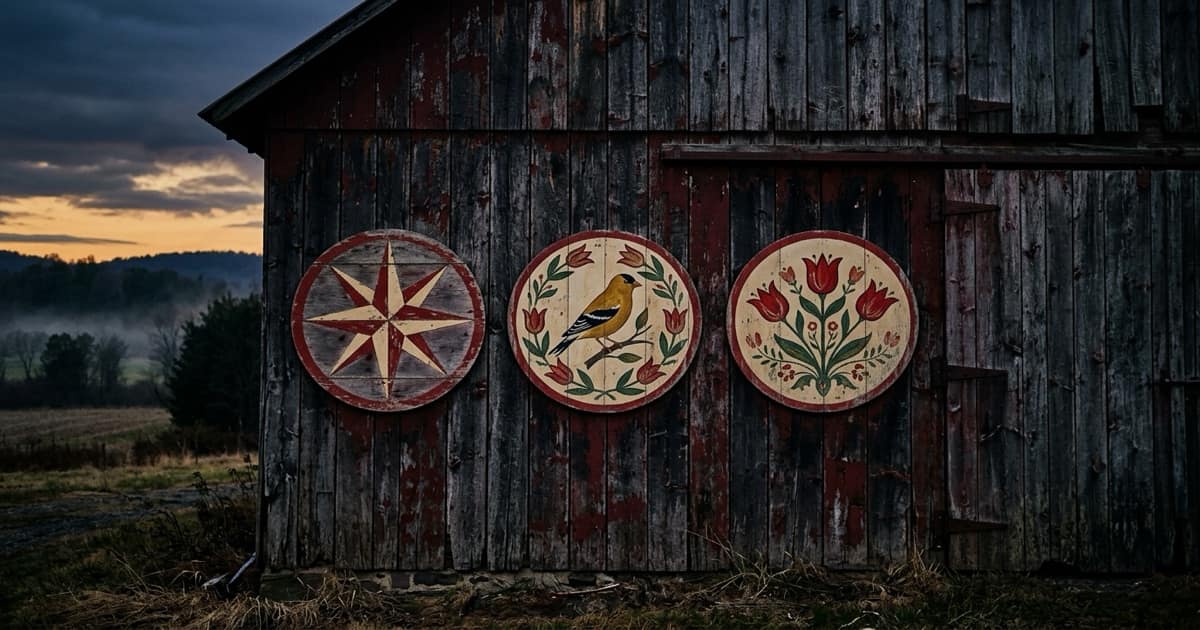
The painted stars on Berks and Lehigh County barns are the images people picture when they hear "hex symbol." In Pennsylvania German the painted discs are also called Scheierschtanne — barn stars. "Hex sign" is the name that stuck in English.
| Motif | Commonly assigned meaning | What it actually depicts |
|---|---|---|
| Rosette / barn star | Protection, warding | A compass-drawn geometric star, the oldest and most common form |
| Distelfink | Good fortune, happiness | A stylised goldfinch, drawn from German folk-art tradition |
| Tulip | Faith, trinity | A three-petalled bloom common across Fraktur manuscript art |
| Heart | Love, union | A symmetrical heart — a fixture of Pennsylvania German Fraktur long before it was painted on barns |
| Scalloped border | Smooth passage, calm | A wavy ring enclosing the whole design |
Here is the part almost no one online will tell you: those assigned meanings are far younger than the signs themselves. The motifs are genuinely old, but the tidy one-symbol-one-meaning dictionary was largely codified in the mid-twentieth century by sign painters selling to tourists driving through Pennsylvania Dutch country. Folklorists have argued about it ever since — one school holds the barn decorations were apotropaic, made to turn away witchcraft and lightning; the other holds they were, in the much-quoted phrase "chust for nice" — just for pretty.
Both schools may be partly right. A community that painted a star because its grandparents painted a star, in a world where hexes were assumed to be real, was not choosing between decoration and protection. It was doing both at once without needing to separate them.
So if you are looking for the "correct" meaning of a hex symbol: the honest answer is that the folk-art motif is authentic and the dictionary is a retrofit. That does not make the symbols useless. It means their meaning is assigned, not discovered — which is exactly how the second kind of hex symbol works.
Hex Sigils: Building a Symbol From Scratch
The other kind of hex symbol is not inherited at all. It is constructed, used once, and destroyed — and the sigil method most modern practitioners use was formalised in early-twentieth-century British occultism, most closely associated with the artist Austin Osman Spare.
The construction is deliberately mechanical:
- Write the intent as a single sentence naming the target and the outcome, in the present tense
- Strike out every repeated letter, leaving only the unique ones
- Fuse what remains into one glyph — overlap, rotate and merge the letterforms until the sentence is no longer readable
- Charge it, then destroy or forget it
Step 4 is the one outsiders find strangest and practitioners consider essential. The glyph is meant to become unrecognisable to its own author. The stated reason, in the tradition's own terms, is that a symbol you can still read is a symbol you keep second-guessing — the intent has to sink below deliberate thought to work.
Note how neatly this maps onto the four-step structure earlier in this guide. Naming, focusing, acting, sealing. The sigil is that whole sequence compressed into a single drawn mark.
Reversal and Mirror Symbols
The reversal hex — one of the types listed under Types of Hex Spells — has its own symbolic vocabulary, and it is the one place where hex symbols are used defensively. Mirrors, reflective surfaces and laterally inverted glyphs all encode the same idea: whatever was sent, send it back along the path it came. A drawn symbol reversed left-to-right, or a sign hung facing outward rather than inward, is doing the same work as a physical mirror. If someone believes a hex has already landed on them, the curse-removal methods that use reflection follow this same reversal logic.
One Name, Written Once
Chinese hexing arrives at the symbol from the opposite direction entirely. There is no motif dictionary and no constructed glyph. There is a slip of paper, and on it the target's name in their own written characters — the plainest symbol imaginable, and the only one the ritual needs. Where a sigil hides the intent until even its author cannot read it, the 打小人 paper figure does the reverse: it puts the name in the open, then destroys it in front of witnesses. Two traditions, two theories of what a written symbol is for.
Eastern Hexing: The Chinese Equivalent
Western hexing has an Eastern counterpart. Image-directed cursing appears in China's own imperial histories two thousand years ago — the Han records describe wooden effigies dug from palace grounds as proof of a curse — but the Da Siu Yan rite itself (打小人, "beating the petty person") has no traceable origin: the scholars who first studied it found no document that dates its beginning. It is functionally identical to a hex — a targeted ritual designed to bring misfortune to a specific individual through symbolic action.
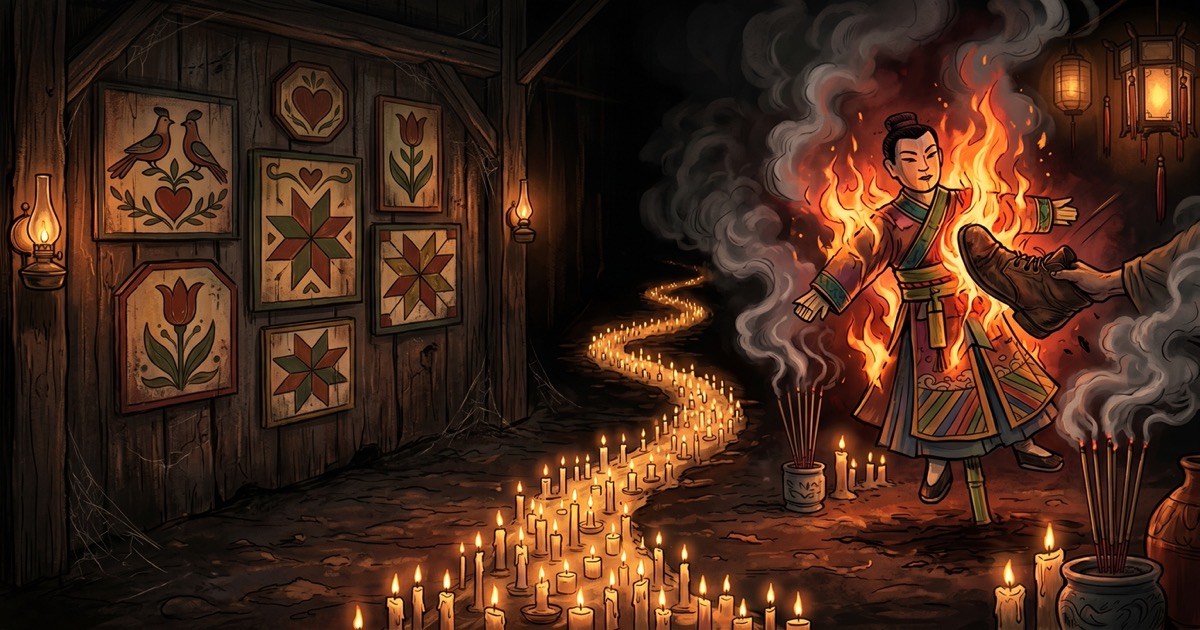
Instead of drawing symbols or tying knots, Chinese practitioners strike a paper effigy with a shoe — each blow transferring focused anger into the ritual. Instead of hex signs, they use paper figures bearing the target's name. The full traditional ceremony involves eight steps (八部曲) including incense, candles, and White Tiger sacrifice — but the striking step is what most outsiders recognize.
The Da Siu Yan tradition offers something most Western hex spells do not: a living, public practice. At Goose Neck Bridge in Hong Kong, elderly practitioners perform hex rituals openly, in daylight, for anyone willing to pay. The tradition has been recognized as Hong Kong's intangible cultural heritage. It is not underground. It is not forbidden. It is simply part of the culture.
This public, accepted status contrasts sharply with the secrecy that has surrounded Western hexing since the witch trials. The Pennsylvania Dutch Powwowers practiced in private. The Würzburg witches were burned. But the grandmothers at Goose Neck Bridge set up their stools in the morning and pack up at dusk, undisturbed, as they have for generations.
Ready to experience it yourself? A complete Da Siu Yan ritual is available online — try the hex ritual →
Ready to cast your curse?
Experience Hong Kong's heritage-listed curse ritual — 5 steps free, no signup required.
Cast a Curse Now →Further Reading
- What is Black Magic — The complete guide to black magic traditions worldwide
- How to Curse Someone — The four-step curse framework
- Revenge Spells — When justice demands supernatural action
- Voodoo Magic and Curses — Afro-Caribbean hex traditions and their African roots
- Hoodoo vs Voodoo — How Hoodoo rootwork differs from the Vodou religion
- What is Da Siu Yan — The Chinese hex equivalent: generations of targeted curse rituals
- How to Get Rid of Bad Luck — Hex removal and curse cleansing methods
Frequently Asked Questions
What does hexing mean?
Hexing means casting a spell intended to cause misfortune, bad luck, or harm to a specific target. The word comes from the German 'hexe' (witch) and is most strongly associated with Pennsylvania Dutch folk magic. A hex is typically more targeted than a curse and more serious than a jinx — it requires deliberate intent, often involves physical ritual objects, and is directed at a named individual.
What does hexing someone involve?
The classic hex working has five movements: the target's name written down, a vessel chosen to carry it (wax figure, knotted cord, photograph, or mirror box), a charging at the waning moon, a seal, and a disposal by burial or concealment. In Pennsylvania Dutch tradition, hex signs carry commonly assigned meanings, though that symbol-to-meaning dictionary was largely codified in the twentieth century rather than inherited. The Chinese Da Siu Yan tradition uses a different method — striking a paper effigy with a shoe — but follows the same underlying framework. The complete stage-by-stage working has its own guide on this site.
Are hexes real?
Hexes exist as documented cultural practices spanning centuries. Rituals are often described as giving a sense of closure and agency — a psychological reading, not a supernatural one. The nocebo effect means that a target who believes they have been hexed may experience real anxiety and misfortune. Whether hexes produce supernatural effects beyond psychology is a matter of personal belief.
What is the difference between a hex and a curse?
A hex is targeted, deliberate, and personal — directed at a specific individual with specific intent. A curse is broader and can affect entire families, lineages, or locations across generations. A jinx is minor — temporary bad luck rather than lasting harm. All three operate through symbolic ritual, but they differ in scope, duration, and severity.
How does a hex work?
Hexes work through sympathetic magic — the principle that symbolic actions can influence real outcomes. A hex spell uses ritual objects (candles, written symbols, effigies) to externalize the practitioner's intent and direct it at a target. The mechanism recurs across many traditions: the physical act mirrors the desired outcome, and the focused intent gives the ritual its psychological and (believers say) spiritual power.
What does it mean to hex someone?
To hex someone means to perform a ritual intended to bring them misfortune, bad luck, or harm through supernatural means. In folk tradition, hexing requires knowing the target's name, having a personal connection to them, or creating a physical representation (like a poppet or written symbol). Unlike a curse, which can be vague and open-ended, a hex is typically specific — targeting a particular aspect of the person's life.
How do you remove or break a hex?
A hex can be broken with counter-rituals that mirror the original act — untying knots, melting binding wax, or performing a cleansing. Chinese Da Siu Yan doubles as hex removal: striking and burning a paper effigy of the source symbolically destroys their hold. A hex also weakens once the target names it and actively reverses the intent.
Can a hex backfire on the person who casts it?
Yes — nearly every hexing tradition warns of backlash. Wicca teaches the Threefold Law (harm returns three times over), Chinese folk practice warns of 反噬 (spiritual backlash), and Pennsylvania Dutch folk stories warn that hexing an innocent turns the spell back on its caster. Backlash is said to strike hardest when the hex is unjust or the target is innocent.