Revenge Spells That Work: Rituals of Retribution Explained
Revenge Spells: When Wronged Demand Answer
Revenge spells occupy the sharpest edge of magical practice. Not the broad sweep of a curse that poisons a bloodline, nor the petty irritation of a jinx — a revenge spell is targeted, personal, and fueled by a specific grievance. Someone hurt you. You want them to hurt back.
The desire for retribution is older than written language. Lead curse tablets buried in Greek graves are among the oldest evidence of spells for revenge; paper effigies are still burned today at Hong Kong's Goose Neck Bridge. The methods change. The impulse does not.
This article covers what revenge spells are, how they have been practiced across cultures and centuries, whether they actually work, and what separates a revenge spell from a hex or a curse.
Key Takeaways:
- Revenge spells are targeted magical rituals driven by personal grievance — documented across many cultures, from ancient Greece to modern-day Hong Kong, often sharing a similar four-step pattern: identify, focus, act, seal
- Psychologically, a revenge ritual gives a sense of agency and a clear ending, and can trigger nocebo effects in a target who knows about it; supernatural effects remain a matter of belief
- A karma spell differs from direct revenge — instead of imposing your will, it asks the universe to deliver justice, making it the most ethically debated form of magical retribution
What Are Revenge Spells?
Revenge spells are magical rituals performed with the specific intent of causing harm, misfortune, or suffering to a named individual who has wronged the practitioner. The defining trait is grievance — unlike a general curse or hex, a revenge spell requires a wound and a reason, fueling a four-step structure of identify, focus, act, and seal that recurs across every tradition.
A revenge spell is a ritual performed with the specific intent of causing harm, misfortune, or suffering to someone who has wronged the practitioner. The defining characteristic is grievance — unlike general curses or hex spells, a revenge spell requires a reason. Someone did something. Now there will be consequences.
This makes revenge magic fundamentally different from other forms of harmful spellwork. A black magic practitioner might curse someone for payment, for power, or for no reason at all. A revenge spell requires a wound. The grievance is the fuel. Without it, the spell has no engine.
The Universal Structure
Across the traditions documented in this article — Greek katadesmoi, Roman defixiones, medieval poppet magic, Chinese Da Siu Yan — a broadly similar four-step pattern recurs:
- Identify the target — Name them, create an effigy in their likeness, or use a personal item. The target must be specific. Vague revenge is not revenge — it is malice without direction
- Articulate the grievance — State what they did. Many traditions require speaking the wrong aloud or writing it down. This transforms raw anger into focused intent
- Perform the symbolic act — Strike, burn, bind, bury, or break. The physical action mirrors the desired punishment. Each tradition has its own methods, but the principle is identical: symbolic harm becomes intended harm
- Seal the spell — Close the ritual. Walk away. Let it work. The sealing is the moment of release — the practitioner lets go of the anger and entrusts it to the ritual
This four-step framework can be read in ancient Greek katadesmoi (curse tablets), Roman defixiones, Norse curse runes, medieval European poppet magic, and the Chinese Da Siu Yan tradition. Different tools. Same architecture.
A History of Magical Retribution
Ancient Curse Tablets — Early Revenge Spells
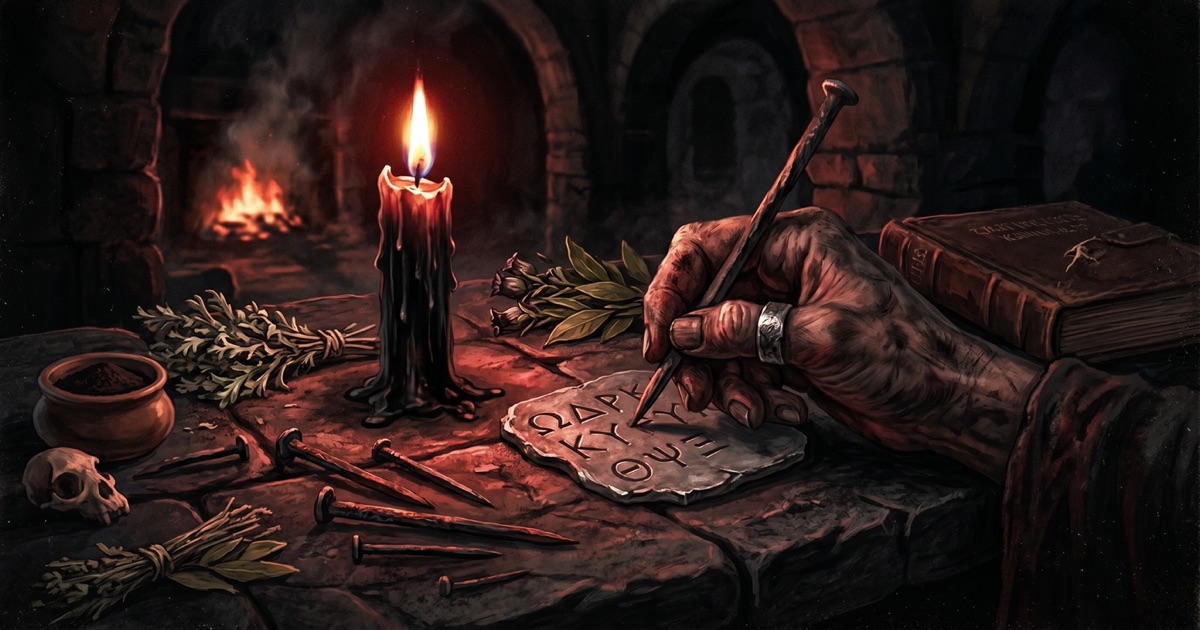
Some of the earliest documented revenge spells are lead curse tablets from ancient Greece, dating to the 5th century BCE. Called katadesmoi (binding spells), these thin sheets of lead were inscribed with the target's name, the desired punishment, and an appeal to underworld deities — typically Hades, Persephone, or Hecate, goddess of witchcraft.
The tablets were buried in graves, wells, and underground springs — places believed to be close to the realm of the dead. The logic was clear: you were sending a message to the powers below, asking them to deliver punishment on your behalf.
Over 1,600 curse tablets have been recovered from the ancient Mediterranean world. Many are explicitly revenge spells — not generic curses, but specific complaints with specific demands, naming the target and demanding a precise punishment.
This is revenge magic at its purest: a named target, a named grievance, a demanded punishment, delivered through ritual to supernatural authority.
Medieval Poppets and Effigy Magic
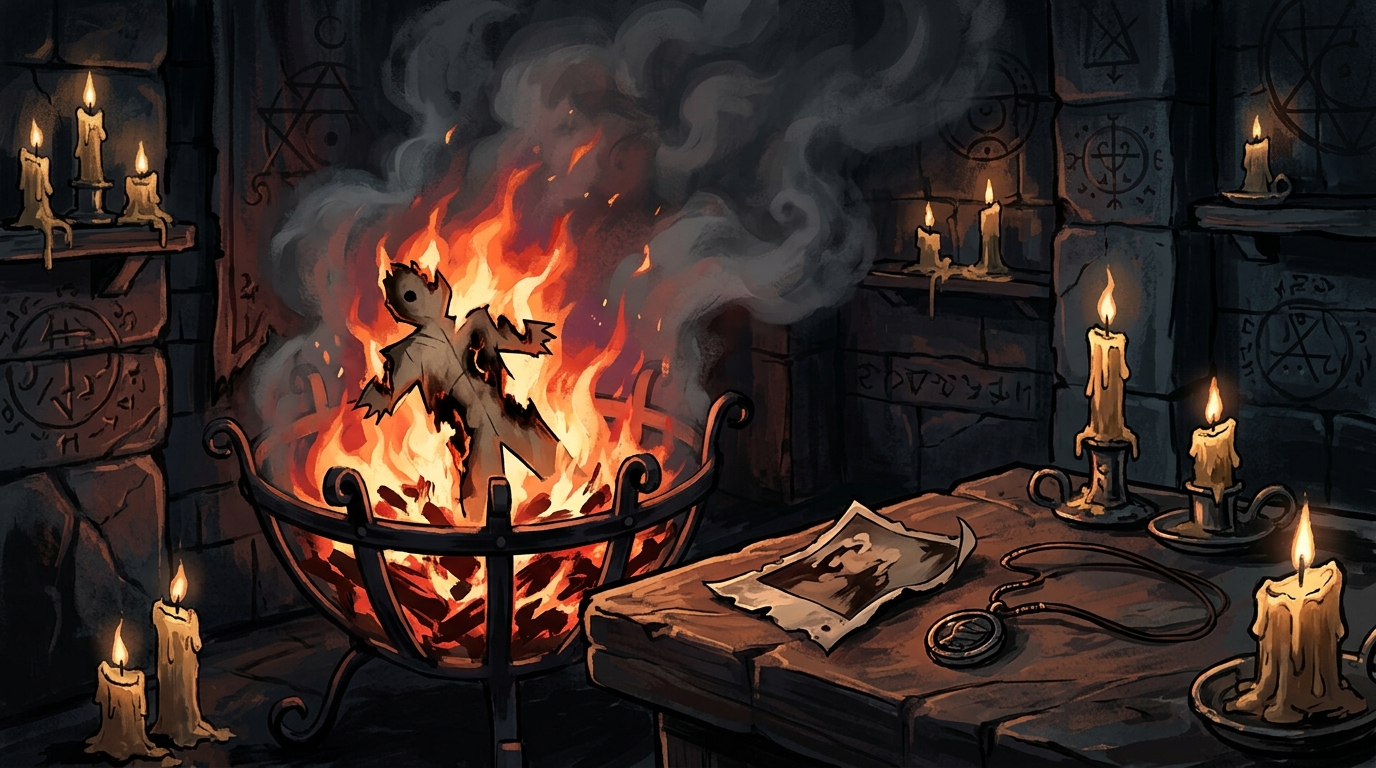
By the Middle Ages, revenge spells in Europe had shifted from written tablets to physical effigies — poppets (dolls) stuffed with personal items and used to inflict harm at a distance. A poppet might contain the target's hair, a scrap of their clothing, or a slip of paper with their name.
The method was straightforward: stick pins to cause pain, bind with thread to restrict movement, burn to cause suffering, bury to cause illness. The sympathetic magic principle — like affects like — was the same one used in ancient Greece, but the tools had changed.
Surviving witch-trial records document accusations involving harmful effigies. In 1590, the North Berwick witch trials in Scotland featured accusations that a group of witches had used poppets to attempt the murder of King James VI. Whether the spells worked was less important than the fact that people believed they could — and acted on that belief.
Non-European Revenge Traditions
Revenge spells are not a European invention. Every continent has its own tradition of magical retribution:
- Chinese Da Siu Yan (打小人) — Practitioners strike paper effigies with shoes to punish those who have caused harm. A living tradition recognized as Hong Kong's intangible cultural heritage
- Arabic sihr — Binding spells and curse rituals documented in medieval Islamic magical texts, often targeting business rivals or faithless lovers
- Indian shaabar mantras — Tantric revenge incantations from the medieval Nath yogic tradition (associated with Guru Gorakhnath), targeting specific individuals for specific harms
- Afro-Caribbean wanga and baka — In Haitian Vodou, a wanga is a charm designed to bring misfortune, while a baka is a more destructive magical attack. Both can be used as revenge tools within the Vodou framework
What unites these traditions is not the method but the motive. Revenge spells worldwide are powered by personal grievance and directed at specific individuals. The cultural vocabulary changes. The human impulse does not.
Types of Revenge Spells
Different traditions classify revenge magic differently, but common categories include:
| Type | Method | Intent | Cultural Origin |
|---|---|---|---|
| Binding spell | Knot-tying, binding poppets, lead tablets | Prevent the target from causing further harm | Greek, Roman, medieval European |
| Return-to-sender | Mirror spells, reflective objects | Redirect the target's own harmful energy back at them | Wiccan, Hoodoo, folk magic |
| Effigy striking | Hitting, burning, or destroying a representation | Transfer physical punishment to the target | Chinese Da Siu Yan, European poppet |
| Karma spell | Prayer, petition, ritual offering | Ask the universe or spirits to deliver justice | Modern Wicca / New Age (drawing on the Eastern concept of karma) |
| Curse tablet | Inscribing lead, wax, or clay and burying it | Petition underworld powers to punish the target | Ancient Greek, Roman, Near Eastern |
| Name burning | Writing the target's name and burning it | Destroy the target's luck or influence through fire | Chinese, Japanese Onmyodo, folk magic |
Each type reflects a different theory of how magical retribution works. Binding spells restrain. Return-to-sender reflects. Effigy striking directly punishes. Karma spells delegate. The choice of method often reveals more about the practitioner's worldview than about the spell's effectiveness.
Revenge Spells by Tradition and Intent
People arrive at this topic using very different words — black magic revenge spells, voodoo revenge spells, a punishment spell, plain witchcraft revenge — and search engines treat them as separate questions. They are not. Each framing maps onto one of the six types above:
| How it's framed | What it actually describes |
|---|---|
| Black magic revenge spells | The petition-to-dark-powers framing — historically the curse tablet (lead, wax, buried), the oldest documented form of revenge magic |
| Punishment spell | The direct-punishment framing — effigy striking and name burning, where the act itself mirrors the penalty |
| Voodoo revenge spells | The formulas sold online under this label are closer to hoodoo formula work — see our guide to hoodoo vs Vodou before buying or casting anything under that name |
| Witchcraft revenge / revenge magic | The general-craft framing — any of the six types worked within a witchcraft practice; Wiccan readers should also read the Wicca section below |
| Spell revenge / spells for revenge | Pure word-order variants of the head term — if you want the practical answer, it is the universal structure above: identify, articulate, act, seal |
One note on intent before you cast: the framing you search in usually reveals what you actually want. "Black magic" framings tend to want the target to suffer. "Punishment" framings want proportion. "Retribution" framings — the cluster this page ranks best for — want balance restored. The traditions treat these as different asks with different ethics, and so should you.
Do Revenge Spells Work?
Do revenge spells work? Psychologically, they can: a revenge ritual gives a sense of agency and closure by turning anger into a structured act with an end (though venting itself does not reduce anger (Bushman, 2002)). If the target believes they have been cursed, the nocebo effect can produce real misfortune. Supernatural harm beyond psychology remains a matter of belief.
The question "do revenge spells work?" has two answers, depending on what you mean by "work."
The Psychological Answer — It Can
Performing a revenge ritual can offer three things:
- A physical outlet — Striking, burning, or destroying a symbolic representation of the person who wronged you gives the feeling a form. Research suggests venting alone does not reduce anger, so the outlet matters less than the ending
- Restored agency — Victims of wrongdoing often feel powerless. A revenge ritual gives them back a sense of control. They are no longer passive — they are acting
- Closure — The ritual provides a defined endpoint. The anger goes into the spell. The spell is sealed. The practitioner can move on
This is not mystical thinking. It is the same mechanism behind punching a pillow, writing an angry letter you never send, or screaming into the void. The ritual externalizes internal pain into physical action. It works because the brain processes symbolic acts differently from abstract thoughts.
The Nocebo Effect — Maybe on the Target
If the target believes they have been targeted by a revenge spell, the nocebo effect can produce real harm. Anxiety, sleep disruption, hypervigilance, and stress-related illness are documented outcomes of perceived curses. The spell does not need supernatural power — it needs the target's belief.
This is why many traditions emphasize secrecy. A revenge spell that the target never knows about relies entirely on supernatural mechanisms. A revenge spell that the target fears relies on psychology. The most effective revenge spells may operate on both channels simultaneously.
The Supernatural Answer — Unresolved
Whether revenge spells produce effects beyond psychology and nocebo is a matter of belief. No controlled scientific study has demonstrated supernatural harm from a curse or spell. But no study has conclusively disproven it either — the claim sits outside the reach of current experimental methods.
Cultural traditions worldwide treat revenge spells as genuinely effective. The practitioners at Goose Neck Bridge are not performing theater. The ancient Greeks did not bury 1,600 curse tablets as a joke. The conviction is real. The mechanism, for now, remains contested.
The Karma Spell — Delegated Revenge
A karma spell is a ritual that asks the universe — rather than the practitioner — to deliver justice. Instead of specifying the punishment, the practitioner states the grievance, releases attachment to the outcome, and walks away. The universe decides what the target deserves.
This differs from a direct revenge spell in one critical way: the practitioner surrenders control. A revenge spell says "I want them to suffer." A karma spell says "I trust the universe to address this." For the complete guide to karma spells — including the four-step method and how they reverse bad luck — see how to get rid of bad luck.
Revenge Spells in Wicca
Does Wicca allow revenge spells? Wicca's central ethical statement, the Wiccan Rede — "an ye harm none, do what ye will" — puts the burden on the practitioner to justify any spell that causes harm, and the Threefold Law holds that magical energy returns to its sender three times over. Many Wiccans respond to a grievance with a binding or protection spell rather than a direct revenge spell, restraining the target's capacity for harm without intending harm themselves.
Wicca is a modern religious movement, not an ancient one — the Rede was first recorded publicly in 1964 — but its two central precepts shape how practitioners within the tradition approach revenge magic more than any other factor:
- The Wiccan Rede. "An ye harm none, do what ye will." The line does not forbid every spell aimed at a wrongdoer, but it shifts the burden onto the practitioner: harm has to be justified, not just wanted
- The Threefold Law (Rule of Three). The belief that magical energy, sent out in either direction, returns to the sender multiplied. A revenge spell cast in anger is, by this logic, a bet against yourself
The practical effect: Wiccan-influenced revenge magic tends toward binding (restraining a target's capacity for further harm) or karma spells (delegating judgment to the universe rather than imposing it directly) more often than the effigy-striking or curse-tablet methods that impose harm outright. The ethics, not the mechanics, set a Wiccan approach to revenge apart from other traditions.
Revenge Meets Real Practice — The Da Siu Yan Tradition
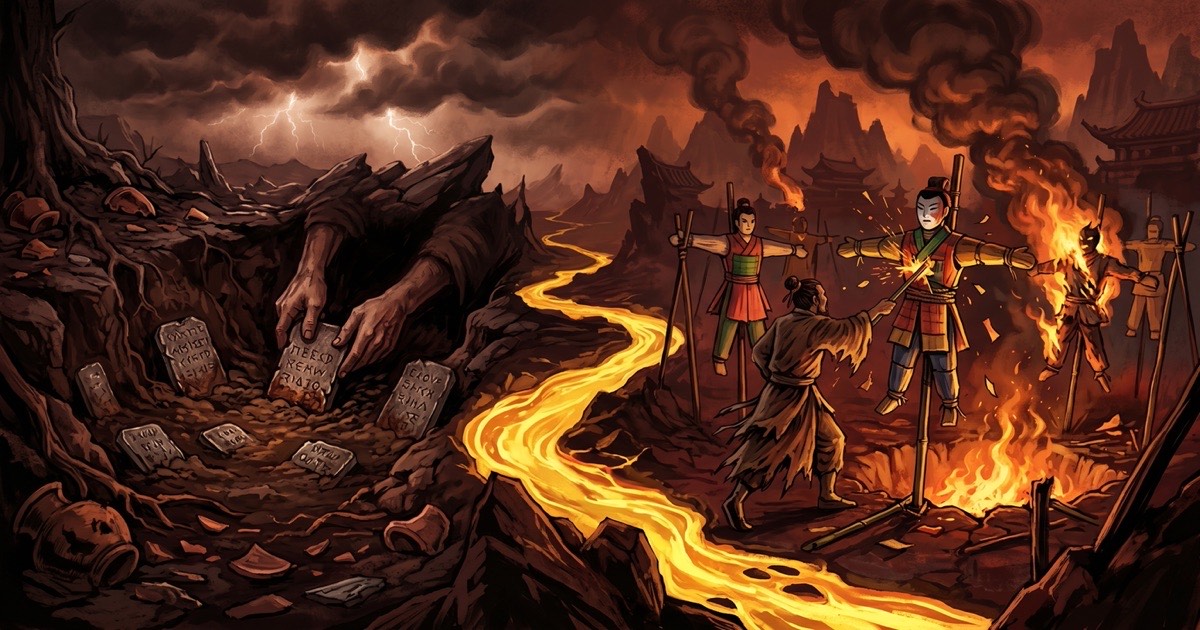
The most accessible revenge spell in the modern world is not found in a grimoire or a Wiccan supply shop. It is practiced openly in Hong Kong by elderly women who set up stools under the Canal Road flyover — known as Goose Neck Bridge — and perform Da Siu Yan rituals for anyone willing to pay.
The ritual follows the same underlying framework found in every revenge tradition — though the full traditional Da Siu Yan ceremony encompasses eight steps (八部曲). At its core: name the petty person on a paper effigy, speak the grievance aloud, strike the effigy with a shoe to transfer focused anger, then burn it to seal the spell. The tradition has been practiced for generations and is recognized as Hong Kong's intangible cultural heritage.
Unlike Western revenge spells, which carry the weight of transgression and secrecy, Da Siu Yan is public, accepted, and ordinary. The grandmothers at Goose Neck Bridge are not witches in the Western sense. They are practitioners of a folk tradition that treats revenge as a natural response to being wronged.
You can experience a complete Da Siu Yan ritual online — perform the revenge ritual →
Ready to cast your curse?
Experience Hong Kong's heritage-listed curse ritual — 5 steps free, no signup required.
Cast a Curse Now →Further Reading
- How to Remove a Curse — Break a bad luck curse, undo a spell someone put on you, or lift a hex
- What is Black Magic — The complete guide to black magic traditions worldwide
- Hex Spells and Curses — Hexing vs cursing vs jinxing explained
- How to Curse Someone — The four-step curse framework
- Voodoo Magic and Curses — Afro-Caribbean revenge traditions and their African roots
- How to Get Rid of Bad Luck — Protection and cleansing after revenge rituals
- What is Da Siu Yan — The Chinese revenge tradition: generations of curse rituals
Frequently Asked Questions
Do revenge spells work?
Revenge spells are often described as giving a sense of agency and emotional closure. The nocebo effect means a target who believes they have been cursed may experience real anxiety and misfortune. Whether revenge spells produce supernatural effects beyond psychology remains a matter of personal belief and cultural tradition.
Are revenge spells real?
Revenge spells exist as documented practices across dozens of cultures spanning millennia — ancient Greek curse tablets, Roman binding spells, Norse curse runes. The Chinese Da Siu Yan ritual, whose own origin no scholar has traced, is the same practice alive today. The practices are real; whether the supernatural effects are real depends on your beliefs.
What is a karma spell?
A karma spell is a ritual intended to accelerate or redirect karmic consequences toward someone who has caused harm. Unlike a direct revenge spell that imposes the practitioner's will on the target, a karma spell asks the universe or spiritual forces to deliver justice — making the practitioner a catalyst rather than an executioner.
How to cast a revenge spell?
Many traditional revenge spells follow a similar four-step pattern: identify the target by name or effigy, focus your grievance and desired outcome, perform a symbolic act (burning, binding, striking), and seal the ritual. The specific methods vary — from striking paper effigies in Chinese Da Siu Yan to writing curse tablets in ancient Greek tradition.
What is the difference between a revenge spell and a curse?
A revenge spell is driven by personal grievance and directed at a specific individual who has wronged the practitioner. A curse can be broader — affecting families, places, or lineages across generations — and may not be tied to a specific act of wrongdoing. Revenge spells are reactive (responding to harm), while curses can be proactive or inherited.
What happens when you cast a revenge spell?
Traditions describe the ritual as a release and a restored sense of control. One reading is that the ritual gives anger a structured physical form and an ending. In folk belief systems, the spell's supernatural effects manifest as misfortune, illness, or bad luck befalling the target.
Can a revenge spell backfire?
Yes. Nearly every magical tradition warns that unjust or poorly cast revenge magic returns to its sender. Wicca teaches the Threefold Law, Chinese folk practice warns of 反噬 (spiritual backlash), and Pennsylvania Dutch Braucherei holds that hexing an innocent turns the spell on its caster. Backlash is said to strike hardest when the grievance is false or the target is innocent.
How long does a revenge spell take to work?
Folk traditions give no fixed timeline. Some practitioners report that a sealed revenge ritual manifests effects on the target within days or weeks, while others describe a slow accumulation of misfortune over months. For the practitioner, the ritual's clear ending comes immediately, regardless of whether any supernatural consequence ever reaches the target.