What Is Black Magic? Meaning, 8 Types & Where It Originated
What Is Black Magic?
Black magic is the practice of using supernatural forces — through rituals, spells, and symbolic objects like effigies or curse tablets — to inflict harm, coerce someone's will, or reshape reality against a target. The oldest surviving magical texts are Mesopotamian incantation tablets from roughly 2500 BCE; the best-documented curse artefacts are the lead defixiones of the Greco-Roman world.
For more than four thousand years, humans have written down harmful magic — from the earliest Mesopotamian incantation tablets to the Chinese Da Siu Yan tradition still performed under Hong Kong's Goose Neck Bridge today. The signs of black magic and its symptoms are documented across cultures — sudden misfortune, unexplained illness, and a persistent sense that something unnatural is at work.
Whether you arrived here because someone wronged you, because you've felt the weight of unexplained misfortune, or because the forbidden draws you in — you are not alone. The desire to understand dark spells and the forces they channel is as old as written language. The Sumerians carved curses into clay. The Egyptians smashed figurines bearing their enemies' names. The Chinese struck paper effigies with shoes. The methods differ. The impulse does not.
Key Takeaways:
- Harmful magic has been documented for thousands of years in many parts of the world — Mesopotamian incantation tablets are among the oldest records. The Chinese Da Siu Yan tradition, whose own origin no scholar has traced, is still practiced openly in Hong Kong today
- The white magic vs black magic binary is a European medieval construct — most real traditions operate on an intent spectrum, using both protective and aggressive practices depending on the situation
- Try a real black magic ritual based on generations of Chinese folk tradition — the first five steps are free, no account needed. What if it works?
This guide covers the complete landscape: the meaning of dark traditions across cultures, its documented origins spanning millennia, the major traditions practiced around the world, the difference between white magic vs black magic, and the honest answer to the question everyone eventually asks — is black magic real.
And if reading about dark traditions makes you want to experience one firsthand — try the curse ritual. The first five steps are free. Based on a real, heritage-listed Chinese tradition. What if it works?
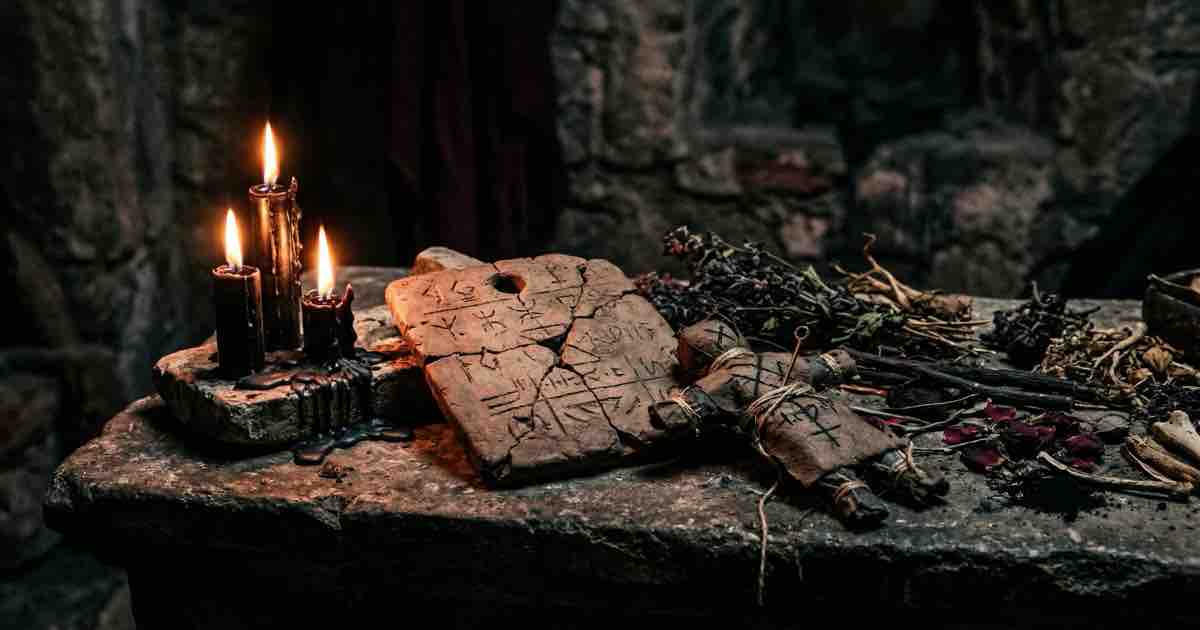
The Meaning of Black Magic
The black magic meaning depends on who you ask — and when. In its broadest sense, black magic refers to any supernatural practice intended to cause harm, coerce, manipulate, or gain power over others. The "black" in black magic signifies its association with darkness, malevolence, and forbidden knowledge — as opposed to "white" magic, which traditionally aims to heal and protect.
But this color-coded distinction is far from universal. Many cultures don't separate magic into black and white at all. In Chinese folk tradition, ritual practices exist on a spectrum — Da Siu Yan (打小人, "beating the petty person") is a curse ritual, but it is not considered evil. It is considered justice. Similarly, in many African and Caribbean traditions, what outsiders label "black magic" is simply part of a complete spiritual system that includes both protective and aggressive practices.
Where the Term Comes From
The English phrase "black magic" has roots in the medieval European association of darkness with evil. Medieval Latin texts from the 13th century used nigromantia — "black divination," its spelling bent by Latin niger, "black" — and by the early 14th century church authorities were condemning such magic as heresy. Before that, the ancient Greeks distinguished between goeteia (sorcery, often harmful) and theurgia (divine magic, always beneficial) — a similar binary with different labels.
The concept of harmful magic, however, predates the term by millennia. The earliest incantation tablets from Sumer (c. 2600–2500 BCE) are mostly protective — but Mesopotamian magic had a documented dark side: the Akkadian anti-witchcraft corpus names kišpū, "evil sorcery," with named techniques for sealing a rival's mouth or making him lose his lawsuit.
Understanding what is black magic requires looking past Hollywood stereotypes. It is not about Satanic altars or dramatic sacrifices. In most traditions, black magic is practical, methodical, and deeply personal — a tool used by ordinary people to address real grievances when conventional justice fails them.
Black Magic Across Languages
Every culture has a word for it. In Mandarin, 黑魔法 (hēi mó fǎ) literally translates to "black magic," while the more culturally specific term for harmful ritual practice is 降頭 (jiàng tóu) in Southeast Asian Chinese communities. In Arabic, سحر أسود (sihr aswad) carries the same meaning. The Fon, Ewe and Yoruba peoples of West Africa — whose traditions fed Vodou, Santería, and Candomblé — do not separate magic into moral categories at all; the same practice can heal or harm depending on intent.
This linguistic diversity reveals something important: the desire to channel supernatural forces against enemies is not a Western invention or an Eastern superstition. It is a human universal. The black magic meaning in every language points to the same core concept — using hidden knowledge to exert power over the unseen world.
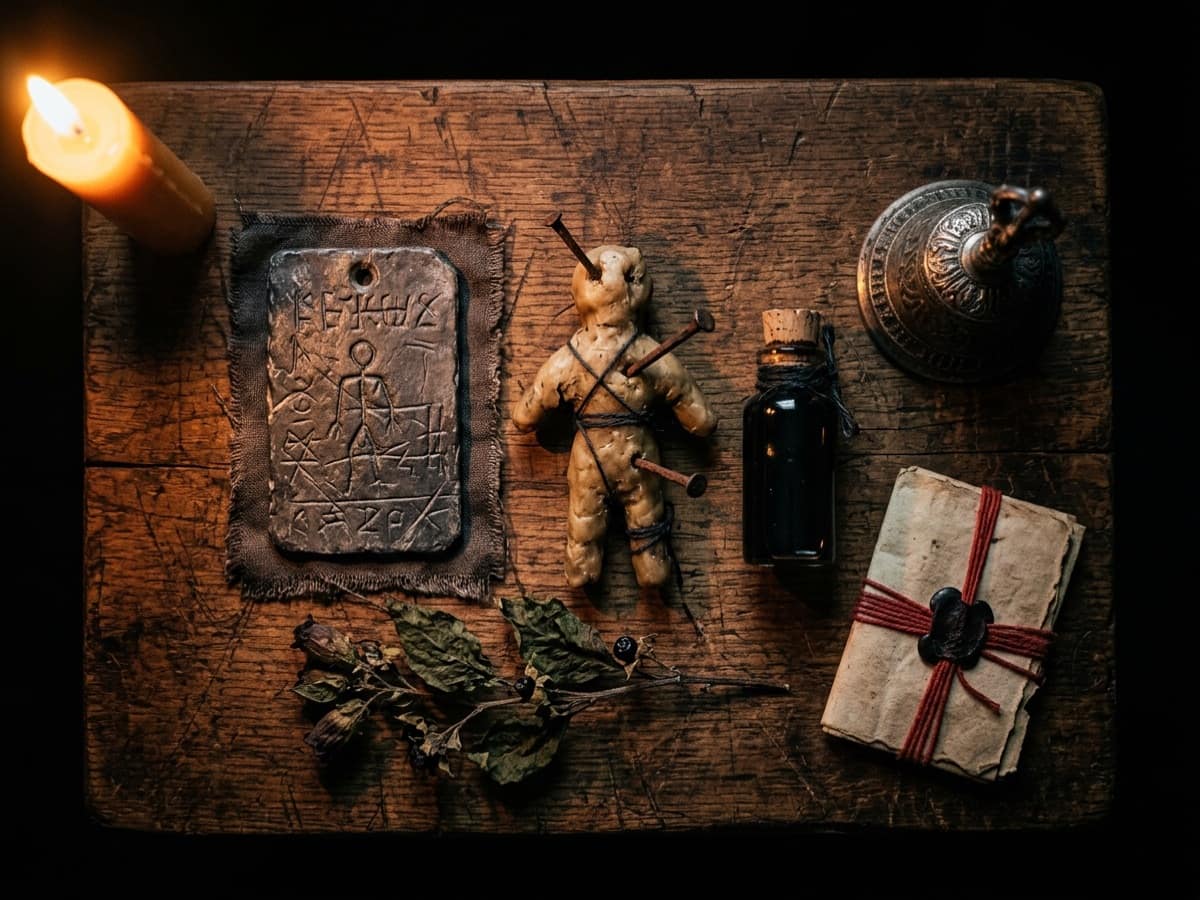
Black Magic Throughout History
The history of black magic is the history of humanity's relationship with power, justice, and the unknown. Every civilization that left written records also left evidence of curse practices — suggesting that black magic is not an aberration but a fundamental feature of human culture.
Ancient Mesopotamia: The First Curse Spells
The oldest known black magic spells come from Mesopotamia, dating to approximately 2500 BCE — but the earliest incantation tablets from Sumer (c. 2600–2500 BCE) are mostly protective, and the clay tablets of the era were not the nailed-and-buried curse objects of later centuries. Mesopotamian magic still had a documented dark side: the Akkadian anti-witchcraft corpus names kišpū, "evil sorcery," with named techniques for sealing a rival's mouth or making him lose his lawsuit. These were not fringe practices. The royal library at Nineveh held extensive anti-witchcraft literature, such as the Šurpu and Maqlû incantation series, showing how seriously ancient Mesopotamians took the threat of curses in civic and personal life.
Centuries later, Mediterranean curse tablets made the format explicit: identify the target by name, state the grievance, call on a deity to enforce it, then seal the tablet — folding the lead and driving a nail through it, or burying it in a grave. This four-step structure — identify, intend, act, seal — appears in virtually every dark curse tradition that followed, including the modern Da Siu Yan ceremony, whose own origin no scholar has traced.
Ancient Egypt: State-Sanctioned Dark Magic
Egyptian black magic was sophisticated, bureaucratic, and deeply integrated into daily life. The Egyptians developed execration rituals — ceremonies in which figures representing enemies were smashed, burned, or ritually destroyed. These were not private affairs. Pharaohs performed execration rituals as state ceremonies, smashing inscribed pottery bearing the names of foreign enemies before assembled courts.
Egyptian dark spells also existed at the personal level. Love spells to coerce affection, binding spells to prevent rivals from speaking in court, and curses designed to inflict illness were all documented in the magical papyri. The Greeks later adopted and expanded many of these practices, spreading Egyptian magical techniques across the Mediterranean world.
Medieval Europe: Witch Hunts and Forbidden Knowledge
The medieval period transformed black magic from an accepted cultural practice into a capital crime. The Catholic Church's campaign against witchcraft — culminating in the publication of the Malleus Maleficarum in 1487 — created the modern stereotype of the black magician: a heretic in league with Satan, performing dark rituals at midnight.
The reality was more mundane. Most accused "black magicians" were folk healers, midwives, or simply inconvenient neighbors. But the Church's campaign did produce one lasting effect: it cemented the association between black magic and genuine fear. The black magic meaning in European culture became inextricable from the threat of persecution — a shadow that still colors how the West understands dark magic today.
The Colonial Era: Exporting Fear
European colonization spread the concept of black magic — and the fear of it — across the globe. African spiritual traditions were rebranded as "black magic" by colonial authorities. Caribbean practices like Voodoo were demonized. Chinese folk rituals were dismissed as superstition. It took anthropology the better part of a century — from Evans-Pritchard's Azande fieldwork in the 1920s onward — to study these traditions on their own terms, revealing sophisticated systems of justice, healing, and community protection.
Types of Black Magic Around the World
Every continent has its own black magic traditions — each with unique methods, beliefs, and cultural context. Here are the major traditions that have shaped how humanity understands dark magic:
| Tradition | Region | Primary Method | Core Belief | Age |
|---|---|---|---|---|
| Curse tablets (defixiones) | Greco-Roman Mediterranean | Inscribed lead, folded and nailed | Gods enforce the curse | ~2,500 years |
| Execration Rituals | Ancient Egypt | Smashed figurines, burned names | Destruction of enemies | ~4,000 years |
| Da Siu Yan (打小人) | Southern China | Paper effigy struck with shoe, burned | Justice against petty persons | origin unrecorded (ICH 2014) |
| Voodoo / Vodou | West Africa, Caribbean | Offerings to loa, ritual petition | Spirits execute the practitioner's will | W. African roots; Haitian form ~400 years |
| Hoodoo | American South | Candle burning, mojo bags, roots | Natural forces channel intent | ~200 years |
| European Witchcraft | Europe | Poppets, cauldrons, incantations | Magic as natural force or demonic pact | ~2,000+ years |
| Left-Hand Tantra | South Asia | Rituals, mantras, yantras | Harnessing cosmic energy for worldly goals | ~1,300+ years |
| Onmyōdō | Japan | Paper familiars, divination | Spiritual beings serve the practitioner | ~1,300 years |
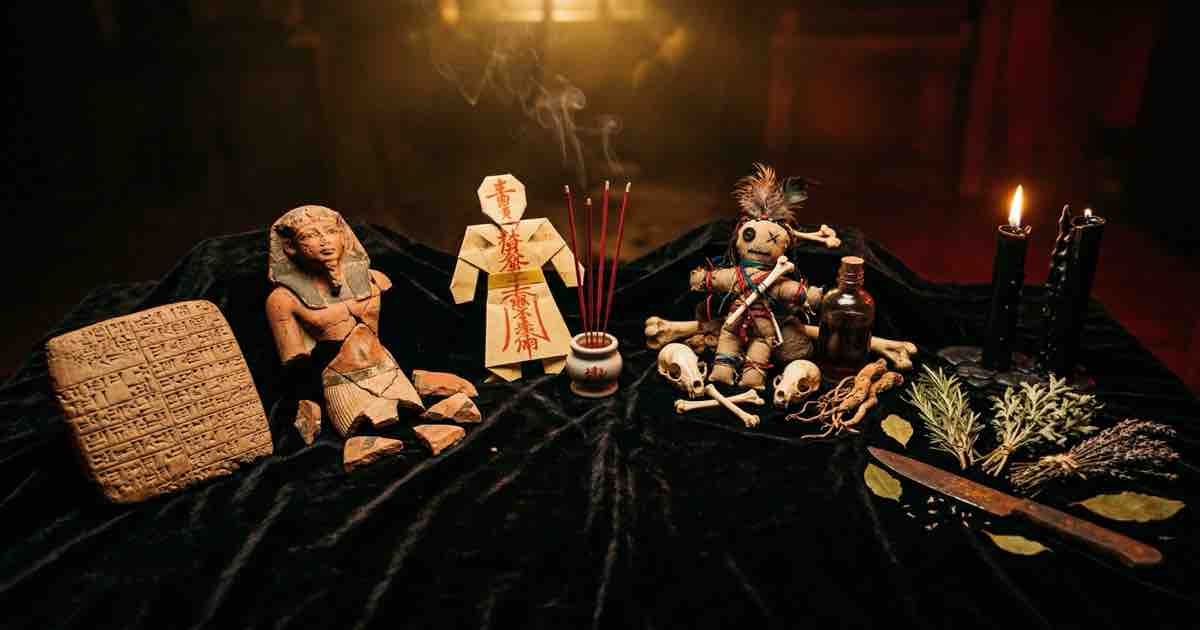
Curse Tablets and Binding Spells
The Mediterranean tradition of curse tablets — called defixiones in Latin — represents the oldest documented form of black magic. Over 1,500 curse tablets have been recovered from the ancient Greco-Roman world, found in graves, wells, and temple sanctuaries. Most target rivals in love, legal disputes, or athletic competitions.
Binding spells were particularly common — the practitioner would inscribe the target's name on a lead tablet, fold it over (symbolically "binding" them), and pierce it with a nail. The target would supposedly lose the ability to speak, act, or succeed. For a binding-first alternative, see our guide to freezer spells. This method of sympathetic magic — where the physical act mirrors the desired outcome — appears in virtually every curse tradition ever documented.
Voodoo and Hoodoo
Voodoo and hoodoo are often conflated, but they are distinct traditions. Voodoo (properly Vodou) is a religion with a complex pantheon of spirits called loa, each governing different aspects of life. Hoodoo is an African-American folk magic tradition that incorporates elements of Vodou, Christianity, and Native American practices.
Both traditions include practices that would be classified as black magic — doll magic, candle rituals, and crossroads ceremonies. But both also emphasize protection, healing, and justice. The labeling of these traditions as purely "dark" reflects Western bias, not the practitioners' own understanding of their work.
Da Siu Yan — Chinese Curse Ritual
The Chinese Da Siu Yan tradition (打小人, "beating the petty person") is one of the few black magic traditions still practiced openly, in living form. Concentrated in Hong Kong's Causeway Bay under the Goose Neck Bridge, practitioners perform curse rituals using paper effigies — striking them with shoes, reciting incantations, and burning them to ash. The full traditional ceremony follows eight steps (八部曲) including White Tiger sacrifice and divination confirmation. The history of villain hitting runs through Chinese folk religion — and its origin is untraceable: the definitive 1984 academic study found no documentary record of when it began.
Unlike Western conceptions of black magic, Da Siu Yan is not practiced in secret. It happens in broad daylight. It is an accepted part of Chinese folk religion, particularly around the solar term of Jingzhe (驚蟄, "awakening of insects") in early March, when the practice is believed to be most potent.
White Magic vs Black Magic
The binary between white magic vs black magic is one of the most persistent ideas in Western occultism — and one of the most misleading.
The Traditional Distinction
In Western esoteric tradition, the division appears straightforward:
| Aspect | White Magic | Black Magic |
|---|---|---|
| Intent | Heal, protect, bless | Harm, coerce, manipulate |
| Methods | Prayer, herbalism, positive visualization | Curse tablets, effigies, binding spells |
| Target | Self or willing recipient | Unwilling target |
| Consequence | Positive karma, spiritual growth | Backlash, spiritual corruption |
| Association | Light, divine, celestial | Dark, infernal, chthonic |
| Practitioner | Healer, priest, white witch | Sorcerer, warlock, dark practitioner |
This looks clean on paper. Reality is messier.
Why the Binary Doesn't Hold
Most magical traditions do not recognize a strict white magic vs black magic divide. In Chinese folk practice, the same practitioner who performs Da Siu Yan (a curse ritual) might also perform blessing ceremonies and protection rituals on the same day. In Voodoo, the loa serve both protective and aggressive functions — and a houngan serves them all without moral conflict. In hoodoo, a single rootworker might lay a curse on Tuesday and remove one on Wednesday.
This light-dark framework is primarily a European medieval construct, reinforced by the Church's need to categorize all non-Christian practices as demonic. When colonial authorities encountered African, Asian, and Indigenous spiritual systems, they applied this binary to traditions that had never used it — distorting them in the process.
The Intent Spectrum
A more accurate model is the intent spectrum. Rather than two categories, magical practices fall on a continuum:
- Purely protective — Wards, shields, cleansing rituals
- Neutral divination — Reading signs, foretelling outcomes
- Persuasive influence — Love spells, success charms (coercive but not directly harmful)
- Direct harm — Curses, hexes, revenge spells
- Total destruction — Rituals designed to completely eliminate a target's influence
Most real-world practitioners operate across this spectrum, using different methods for different situations. The question is not "is this black or white?" but "what does this situation require?"
In the Da Siu Yan tradition, the ritual exists specifically for situations where someone has wronged you — it is targeted justice, not random malice. This aligns with what most cultures actually practice: black magic as a last resort when other forms of justice have failed.
How Does Black Magic Work?
How does black magic work? Every dark ritual works through the same four-step structure: prepare the space, identify the target (by name or effigy), perform a symbolic act — striking, burning, or binding — and seal the ritual. The specific objects and words vary across cultures, but this structure is universal.
Every dark ritual — regardless of culture or era — operates through the same fundamental mechanism: symbolic action directed by focused intent. The specific objects and words change. The structure does not.
The Universal Ritual Structure
Many curse rituals across cultures can be read as a four-part pattern (our framework):
- Preparation — Create sacred space, gather ritual objects, enter the right mental state
- Identification — Name or represent the target through an effigy, photograph, or spoken name
- Symbolic Act — Perform the central action — striking, burning, binding, or speaking words of power
- Sealing — Close the ritual — burn the remains, speak a closing formula, physically leave the space
This pattern appears in Sumerian curse tablets, Egyptian execration rituals, medieval European witchcraft, and modern Da Siu Yan. When someone asks how to do black magic in any tradition, they are learning variations of this same four-step structure. The step-by-step guide to cursing breaks this down in detail for those who want to perform a complete ritual.
The Role of Symbolic Objects
The objects used in curse spells are not random — they operate on the principle of sympathetic magic, where "like affects like." A paper effigy represents the target because it is shaped like a person. Burning it represents destruction because fire consumes. Striking it with a shoe represents domination because the foot is the lowest, most degrading part of the body.
In Chinese tradition, the shoe specifically represents grounding and power over the earth. In European traditions, iron nails represent binding because iron was believed to trap spirits. In hoodoo, graveyard dirt represents death and endings. Each tradition has its own symbolic vocabulary, but the underlying principle is identical — the physical act mirrors the desired supernatural outcome.
Why People Seek Out Black Magic
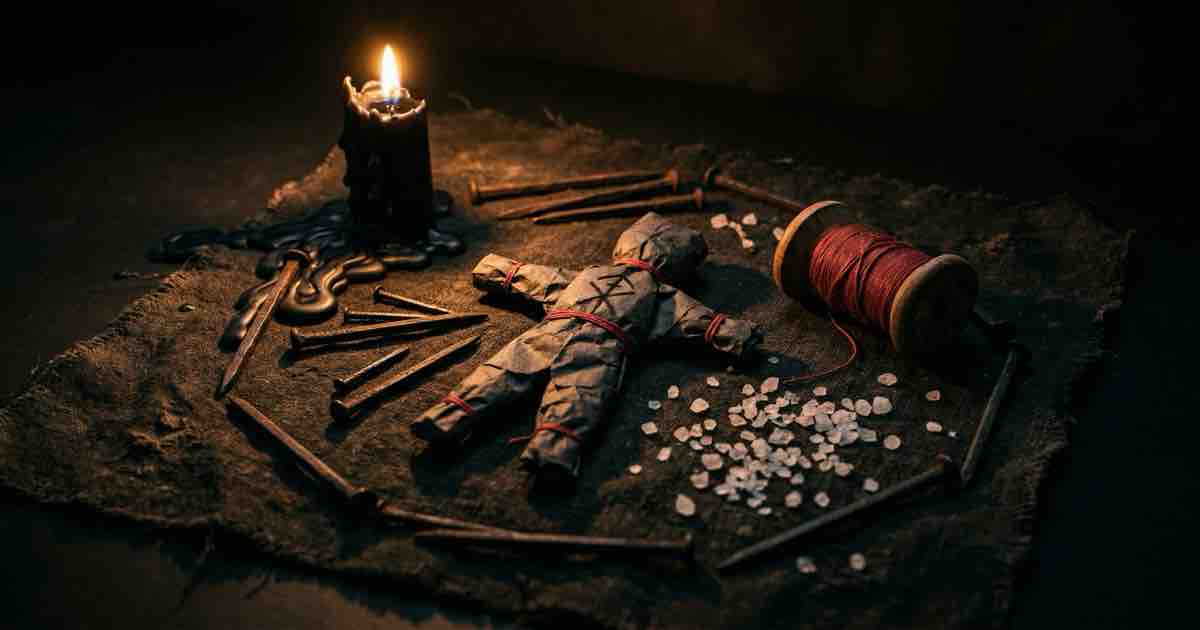
People seek out black magic for consistent reasons across cultures: a sense of powerlessness, a desire for justice, an experience of being wronged without recourse. Ritual behavior is widely observed to reduce anxiety and restore a sense of control in people who feel they have lost control of a situation.
The structure of a curse ceremony provides something that raw anger does not: a beginning, a middle, and an end. A process. A sense of having done something about the wrong, rather than simply enduring it. This is why curse rituals have survived for thousands of years — they address a fundamental human need that no amount of modernization has eliminated.
Curious about what the experience actually feels like? Try the ritual →
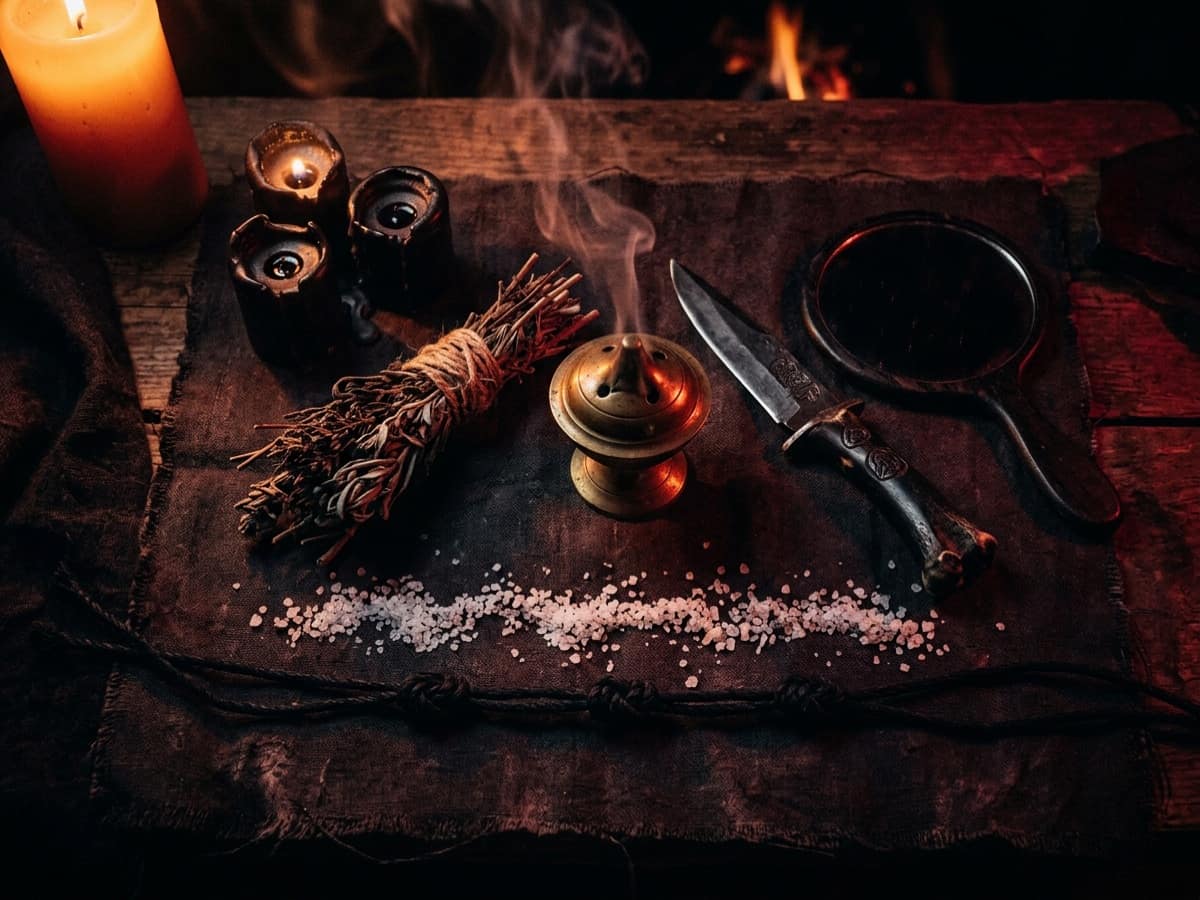
Signs and Symptoms of Black Magic — How to Know If You're Affected
What are the signs of black magic? The most reliable signs are a sudden onset of misfortune across unrelated life areas with no natural cause, unexplained physical symptoms (fatigue that sleep doesn't fix, chills, nightmares), objects breaking repeatedly without explanation, and a persistent gut-level sense that something unnatural is affecting you. One sign alone is not black magic — the pattern appearing together is what practitioners across traditions treat as confirmation.
Knowing the theory of black magic is one thing. Knowing whether it's actually affecting you is another. Every tradition that practices dark magic also identifies specific signs and symptoms that indicate a curse, hex, or spell has been cast on someone. Here is what to look for — and what to rule out first.
The Pattern: Sudden Onset Across Multiple Life Areas
The single most important diagnostic criterion for black magic symptoms is: did everything start going wrong at the same time, across unrelated areas of your life?
Ordinary misfortune clusters in one domain. You lose your job — that's terrible, but it has an explanation. The economy shifted. The company downsized. There is a cause. But when your job and your relationship and your health all collapse simultaneously, with no connecting cause, traditional practitioners across cultures treat this as the primary sign of a black magic attack.
The pattern typically presents as:
- A clearly identifiable starting point — often within days or weeks of a conflict, betrayal, or falling out with someone who might wish you harm
- Problems in three or more unrelated areas — career, relationships, finances, physical health, mental health — all deteriorating at once
- No natural connecting cause — you didn't cause these problems through your own behavior, and external circumstances don't explain the simultaneous collapse
Physical Signs and Symptoms
Folk traditions across cultures identify a consistent set of physical symptoms associated with being the target of black magic spells:
- Unexplained fatigue — exhaustion that sleep does not fix. You wake up tired. You stay tired. Rest does nothing. Practitioners describe this as the curse "feeding" on your energy
- Chills and cold sensations — feeling cold in warm rooms, cold spots on your body that come and go, a persistent chill down your spine
- Pressure or heaviness — a sensation of weight on your chest, shoulders, or the back of your neck, as if something is pressing down on you. In Chinese tradition, this is described as 煞氣 — oppressive, heavy energy
- Recurring nightmares — vivid, disturbing dreams, often featuring the person you suspect, water, or being trapped. If the same nightmare repeats night after night, many traditions treat this as a clear sign of supernatural interference
- Headaches that appear and disappear suddenly — not migraines with medical causes, but sharp headaches that arrive without warning and leave just as abruptly
- Unexplained physical marks — scratches, bruises, or marks appearing on the body with no memory of how they got there. Some traditions interpret these as evidence of spiritual attack during sleep
Psychological Signs
The psychological symptoms of black magic can be the most disturbing — and the hardest to distinguish from ordinary mental health struggles:
- Overwhelming dread or anxiety — not the normal anxiety of a stressful situation, but a pervasive, crushing sense that something is terribly wrong, with no clear trigger
- Feeling watched — the persistent sensation that you are being observed when you are alone
- Intrusive thoughts about a specific person — thoughts of the suspected curser that arrive unbidden and won't leave, even when you try to focus on other things
- Sudden personality changes — you or people close to you notice you've become irritable, withdrawn, or "not yourself" with no apparent cause
- Loss of motivation or will — activities you used to enjoy feel empty, goals you cared about feel meaningless. This goes beyond ordinary depression in its suddenness and severity
Environmental Signs
Black magic is often believed to affect not just the target but the target's environment:
- Objects breaking without cause — mirrors cracking, electronics failing, jewelry snapping, glasses shattering. Items that should not break keep breaking, and the damage has no physical explanation
- Electronics malfunctioning around you — lights flickering when you enter a room, phones dying unexpectedly, computers crashing more frequently around you than around others
- Plants dying — houseplants that were previously healthy suddenly wilting or dying, especially near your bed or workspace
- Pets behaving strangely — animals that were previously affectionate becoming fearful or aggressive around you, or staring at empty corners of rooms as if seeing something you cannot
What to Rule Out First
Before concluding you are experiencing signs of black magic, rule out the ordinary explanations. Many of the symptoms above overlap with conditions that have nothing to do with curses:
| Symptom | Possible Natural Cause | When to Suspect Black Magic |
|---|---|---|
| Fatigue, heaviness, dread | Depression, anxiety disorder, burnout | Onset coincides with a specific conflict + symptoms span multiple life areas + standard treatments have no effect |
| Nightmares, feeling watched | PTSD, hypervigilance, sleep disorder | Dreams feature the same person repeatedly + began after an interaction with them |
| Objects breaking | Coincidence, confirmation bias | Frequency is statistically abnormal + multiple categories of objects + others in your household notice it too |
| Relationship deterioration | Normal conflict cycles, communication problems | Multiple unrelated relationships deteriorate simultaneously + conflicts have no identifiable trigger |
| Physical symptoms (chills, marks) | Medical conditions, dermatographia, anxiety | Medical tests are normal + symptoms began at the same time as other signs |
The nocebo effect is real — if you believe you've been cursed, your mind can produce genuine physical symptoms. This is why every responsible tradition emphasizes ruling out natural causes before assuming supernatural ones. See a doctor. Rule out the medical. Then, if the pattern persists with no natural explanation — the folk traditions have methods for that.
The Gut Test
One sign rises above all others in practitioner accounts across cultures: the persistent intuition that something unnatural is happening to you. Not the fleeting thought, not the anxious speculation — but the deep, quiet certainty that stays with you for weeks.
Call it instinct. Call it spiritual sensitivity. Call it pattern recognition below conscious awareness. Whatever you call it, virtually every curse-breaking tradition treats the target's own gut feeling as evidence — sometimes the most important evidence.
If you recognize the pattern described above and your gut tells you something is wrong, our guide on how to remove a curse covers specific methods from multiple traditions, from salt baths to effigy destruction. And if you want to break the curse by confronting it directly — the Chinese Da Siu Yan tradition is designed for exactly this.
Da Siu Yan: Black Magic in the Chinese Tradition
Where does the Chinese Da Siu Yan tradition fit within the global landscape of black magic? The answer challenges Western assumptions.
Da Siu Yan (打小人, literally "beating the petty person") is not practiced in secret. It is not associated with demons or dark pacts. In Hong Kong, it happens in broad daylight under the Goose Neck Bridge in Causeway Bay — a public space where elderly practitioners set up their stations and perform curse rituals for anyone who pays a small fee. The atmosphere is not fearful. It is matter-of-fact.
What Makes Da Siu Yan Different
Most Western black magic traditions operate underground — hidden from public view, associated with forbidden knowledge and social stigma. Da Siu Yan is the opposite. It is an accepted part of Chinese folk religion, particularly around the solar term of Jingzhe (驚蟄, "awakening of insects") in early March, when the practice is believed to be most potent.
The ritual classifies enemies into specific categories:
- 是非小人 (The Backstabber) — those who spread lies and betrayal
- 職場小人 (The Toxic Boss) — those who abuse workplace power
- 感情小人 (The Ex) — those who betrayed love
- 財運小人 (The Energy Vampire) — those who drain your resources
- 官非小人 (The Bully) — those who use force or legal threats
This classification system is unique among black magic traditions. Rather than a generic curse aimed at a generic enemy, Da Siu Yan targets specific types of harmful behavior. It is not about wanting someone destroyed — it is about wanting a specific type of injustice to end. The ritual gives structure to anger and channels it into symbolic action.
The Bridge Between Traditions
Da Siu Yan occupies a fascinating position in the global taxonomy of dark magic. It is clearly a black magic ritual by any standard definition — it involves an effigy, symbolic violence, spoken incantations, and a curse. But it lacks the secrecy, the demonology, and the moral stigma that Western traditions attach to black magic.
It is practiced openly. Discussed casually. Considered as normal as visiting a temple or burning incense for ancestors.
This makes Da Siu Yan perhaps the most accessible living black magic tradition in the world — and the one most likely to surprise someone asking "what is black magic?" for the first time.
Is Black Magic Real?
Is black magic real? Yes — as a cultural practice with thousands of years of documented history and measurable effects; curse rituals are widely observed to reduce anxiety and restore a sense of control in practitioners. But no peer-reviewed evidence shows a curse supernaturally harming a distant target. It is real in its effects on the practitioner, not in supernatural causation.
What "real" means depends on what you're asking — and the honest answer has been debated for millennia.
What "Real" Means
If "real" means "supernatural forces that can physically harm someone from a distance" — the scientific evidence is absent. No peer-reviewed study has demonstrated that a curse can directly cause illness, misfortune, or death through supernatural means alone.
But if "real" means "a cultural practice with measurable psychological and social effects" — then black magic is as real as any religious ritual. Three effects come up again and again in discussions of curse rituals:
- A sense of agency — A curse ritual gives people who feel powerless something to do, with a clear ending. Venting itself does not reduce anger (Bushman, 2002), so the value is in the structure, not the release.
- Nocebo effect — Belief in a curse can produce real symptoms. People who believe they have been cursed often experience anxiety, insomnia, and psychosomatic illness — not because of supernatural forces, but because of the power of belief itself.
- Social function — Curse rituals can serve as a pressure valve in communities where formal justice systems are unreliable. They give the wronged a structured way to express anger and seek retribution.
The Pragmatic Answer
For most people asking "is black magic real," the practical question is: "will something happen if I perform this ritual?" And the answer, based on cross-cultural evidence, is: yes — something will happen to you. The ritual experience produces catharsis, shifts your emotional state, and can change how you relate to the person who wronged you.
Whether it produces effects on the target is a matter of belief — and belief is more powerful than most people credit. What if it works?
Can Black Magic Be Removed?
Can black magic be removed? Yes — every tradition that casts curses also has removal methods, including cleansing rituals, protective charms, counter-spells, and prayer. Chinese Da Siu Yan itself doubles as curse removal: striking and burning a paper effigy symbolically destroys the source of the misfortune.
Every tradition that creates curses also provides methods for breaking them. The belief that black magic is permanent or unbreakable is a misconception — in most magical systems, curse removal is a well-established practice as old as cursing itself.
Common Curse Removal Methods
| Tradition | Removal Method | Mechanism |
|---|---|---|
| Chinese folk religion | Da Siu Yan effigy rite + 貴人 blessing papers | Strike the source of misfortune, then invite noble-person aid |
| Voodoo | Cleansing bath with herbs | Physical and spiritual purification |
| European folk magic | Breaking the curse object | Destroying the physical link (poppet, tablet) |
| Hoodoo | Uncrossing ritual | Spiritual "crossing" reversed by uncrossing |
| Prayer-based traditions | Blessing and exorcism | Divine intervention overrides the curse |
One Hoodoo method has a guide of its own: the return to sender spell, a mirror-based reversal that reflects harm back along the path it arrived — the traditional answer when the caster is unknown, since a mirror requires no name to work.
Protection Against Black Magic Spells
Most traditions also offer prophylactic measures — ways to protect yourself from becoming a target of black magic spells before any curse is cast. Common methods include wearing protective amulets (the evil eye charm, jade pendants in Chinese tradition), performing regular cleansing rituals, and maintaining strong spiritual boundaries through daily practice.
The Chinese tradition offers a particularly elegant approach: performing Da Siu Yan as a preventative measure. By striking and burning the paper effigy of a petty person, you symbolically remove their power over you — preventing their negative influence before it can take root.
If you suspect you have been targeted, our guide on how to remove a curse covers specific methods from multiple traditions. For paid removal services and how to tell a real practitioner from a scam, see black magic removal. For general protection against negative energy, see how to get rid of bad luck.
Ready to cast your curse?
Experience Hong Kong's heritage-listed curse ritual — 5 steps free, no signup required.
Cast a Curse Now →Further Reading
- How to Curse Someone — Step-by-step guide to performing a complete curse ritual
- Hex Spells and Curses — Understanding the difference between hexes, curses, and jinxes
- Revenge Spells — When justice demands supernatural action
- Voodoo Magic and Curses — A deep dive into Afro-Caribbean curse traditions
- How to Get Rid of Bad Luck — Curse removal and protection methods
- What Is Da Siu Yan — The original Chinese curse tradition explained
- Breaking Generational Curses — Inherited bloodline curses and how to end them
Frequently Asked Questions
Is black magic real?
Black magic exists as a documented cultural practice spanning more than four thousand years in many parts of the world. While supernatural claims remain debated, rituals are often described as easing anxiety and restoring a sense of control. The question isn't whether black magic is 'real' in a supernatural sense — it's whether performing a black magic ritual produces real effects on the practitioner. The evidence suggests it does.
What is the difference between black magic and white magic?
The white magic vs black magic distinction traditionally comes down to intent: black magic aims to harm, coerce, or manipulate, while white magic aims to heal, protect, or bless. However, most magical traditions don't use this binary. Chinese folk practitioners perform both curse rituals and blessing ceremonies. Voodoo serves both protective and aggressive functions. The color-coded division is largely a European medieval construct that was imposed on other cultures during colonization.
Is black magic dangerous?
Practitioners across traditions warn that black magic can backfire — a concept found in the Threefold Law (Wicca), the principle of 反噬 in Chinese traditions, and similar warnings in Voodoo and hoodoo. Performing a black magic ritual without proper knowledge, focus, or justified intent is considered risky in virtually every tradition. These dangers refer to spiritual or karmic consequences, not physical harm. Most traditions emphasize that curses directed at innocent targets invite the strongest backlash.
Can black magic be removed?
Every tradition that practices black magic also has methods for removing it. Common approaches include cleansing rituals, protective charms, counter-spells, and prayer. In Chinese tradition, Da Siu Yan itself can serve as a form of curse removal by symbolically destroying the source of misfortune. Specific removal methods vary by tradition — from uncrossing rituals in hoodoo to blessing ceremonies in Christian folk practice.
What are the types of black magic around the world?
Major black magic traditions include: incantations (Mesopotamia) and curse tablets (Greece and Rome), execration rituals (ancient Egypt), Da Siu Yan curse ceremonies (China), Voodoo and hoodoo (West Africa, Caribbean, American South), left-hand Tantra (South Asia), Onmyodo (Japan), and European witchcraft. Each has unique methods but shares the core principle of using symbolic action to influence a target through supernatural means.
How does black magic work?
Black magic rituals work through symbolic action — practitioners use effigies, spoken words, candles, or ritual objects to externalize intent and direct it at a target. The universal structure is: prepare the space, identify the target, perform a symbolic act (striking, burning, binding), and seal the ritual. The specific methods differ by tradition, and they are often described in terms of catharsis through structured ritual.
What are black magic spells?
Black magic spells are structured rituals designed to cause harm, influence behavior, or change outcomes through supernatural means. They typically involve a target (name or effigy), a symbolic act (burning, binding, striking), spoken words of power, and a sealing mechanism to close the ritual. The oldest surviving magical texts are Mesopotamian incantation tablets from approximately 2500 BCE; the classic curse artefacts are Greco-Roman lead tablets inscribed with the target's name and the desired misfortune.
How to do black magic?
Learning how to do black magic requires studying a specific tradition, as methods vary significantly across cultures. The universal structure involves four steps: identify your target, channel focused intent, perform a symbolic act, and seal the ritual. In Da Siu Yan, this means choosing an enemy type, striking a paper effigy with a shoe, and burning it. For a structured experience based on a real, heritage-listed Chinese tradition, try the online curse ritual at BeatPetty.com.