Hoodoo vs Voodoo: Differences, Origins & Complete Guide
Hoodoo vs Voodoo: What Is the Difference?
Hoodoo and Voodoo are not the same thing. The words sound similar. Both traditions trace their roots to West Africa. Both developed in the Americas through the crucible of slavery. Both have been distorted by Hollywood into a single sensational image of pins, dolls, and dark rooms. But they are fundamentally different: Voodoo is a religion. Hoodoo is folk magic. One has a pantheon of spirits, ordained priests, and formal ceremonies. The other has herbs, oils, candle rituals, and the Book of Psalms. Confusing them erases the specific history of each — and the distinction matters for anyone who wants to understand either tradition honestly.
This guide covers the origins of both traditions, the key differences across eight dimensions, the reasons they are persistently confused, and how each connects to the Chinese Da Siu Yan ritual tradition — an Eastern parallel that illuminates the universal structure beneath both.
Key Takeaways:
- Vodou is a religion with a structured pantheon (Loa), priesthood (Houngans and Mambos), and formal ceremonies — officially recognized as a religion in Haiti (2003) and Benin (1996). Hoodoo is a system of practical folk magic with no pantheon, no priesthood, and no formal religious structure — it works through roots, herbs, candles, personal concerns, and the Bible
- The confusion is a New Orleans problem. Both traditions developed alongside each other in the same city. Outsiders used "voodoo" as a catch-all for anything African-derived. Hollywood did the rest, merging every African diasporic practice into one brand
- The mechanism beneath both is shared. Whether petitioning a Loa in Vodou or working a candle in Hoodoo, the structure is the same: identify the target, channel intent through ritual, seal the working. The Da Siu Yan tradition uses a paper effigy and a shoe — different tools, same operating system
Hoodoo vs Voodoo: The Core Distinction
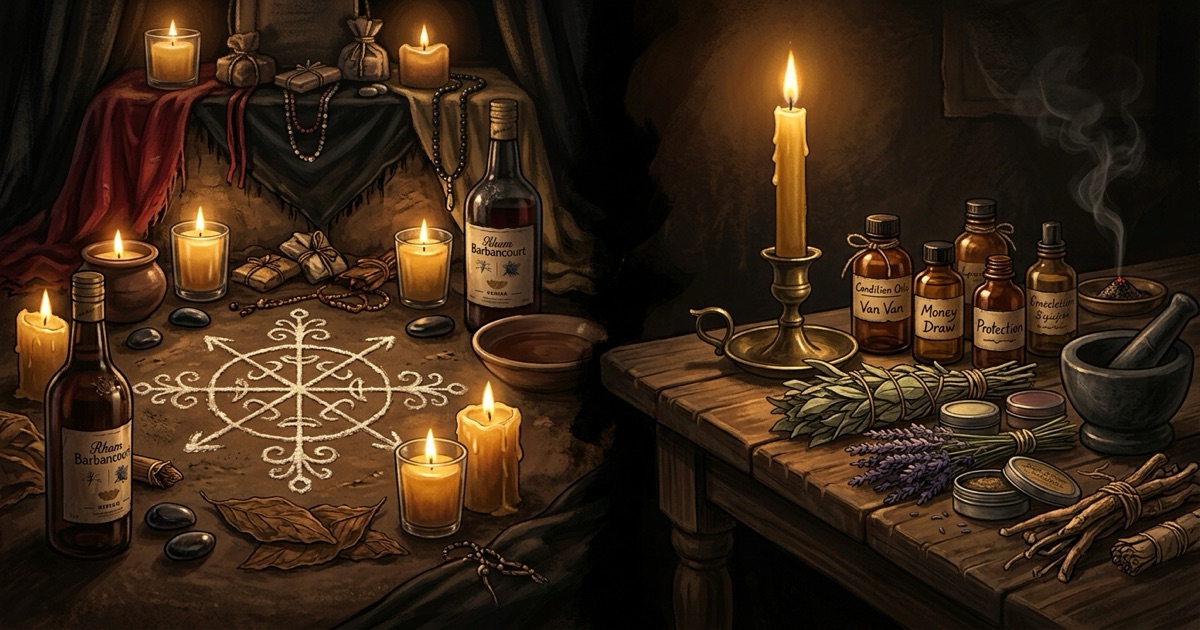
Hoodoo is a system of African-American folk magic — practical, results-focused, and operating through natural materials (roots, herbs, oils, candles) and the Bible, particularly the Psalms. It has no pantheon, no priesthood, no initiation, and no formal religious structure. Voodoo (properly Vodou, from the Fon word vodùn meaning "spirit") is a complete religion with a pantheon of spirits (Loa), ordained priests (Houngans and Mambos), codified ceremonies, spirit possession, and official recognition as a religion.
The simplest way to understand the difference: Hoodoo is magic you do. Vodou is a religion you belong to. A Hoodoo rootworker does not need to be initiated into a priesthood. They learn from an elder, from books, or from direct practice. A Vodou Houngan or Mambo undergoes years of training and formal initiation (kanzo) before they can serve their community. You can pick up a Hoodoo candle ritual and work it tonight. You cannot casually "try Vodou" — it requires relationship with a community and its spirits.
Origins: Two Branches of the Same African Root
Vodou: Born in Haiti, Forged in Revolution
Haitian Vodou crystallized in the French colony of Saint-Domingue during the 18th century. Enslaved Africans from diverse ethnic groups — Fon, Ewe, Yoruba, Kongo — were deliberately mixed by French slaveholders to prevent organized resistance. The unintended consequence: their spiritual traditions merged. Fon Vodun blended with Yoruba Orisha worship, Kongo cosmology, and Roman Catholicism (forced conversion created the syncretism — slaves disguised Loa behind Catholic saints).
Vodou was forged in the fire of the only slave revolt in history to produce an independent nation. The Haitian Revolution (1791–1804) began with a Vodou ceremony at Bois Caïman, where a Houngan named Dutty Boukman performed a ritual that galvanized the rebellion. Vodou and Haitian independence are inseparable — the religion that helped free a people became central to their national identity. For the full history of Vodou, its spirits, and how its curse traditions actually work, see our guide to the voodoo curse.
Hoodoo: Born in the American South, Forged in Isolation
Hoodoo developed under different conditions. In the American South, enslaved Africans were also separated from their ritual specialists and forced into Christianity — but the Protestant environment of the American colonies was far more hostile to African religious expression than French Catholic Saint-Domingue. Catholic saints provided a framework for Vodou syncretism — Loa could hide behind Saint Patrick, Saint Peter, the Virgin Mary. Protestantism offered no saints to hide behind. African spirits had no cover.
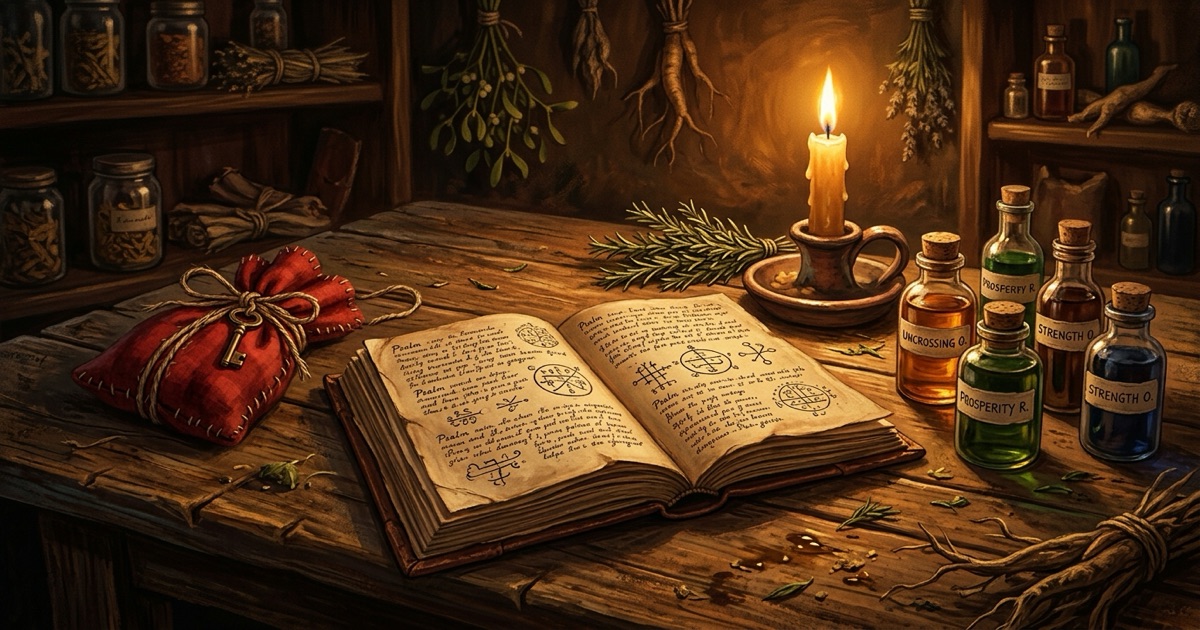
The result: Hoodoo shed its spirits. The Loa, Orisha, and Kongo ancestors that survived in Vodou did not survive in Hoodoo — at least not as named, petitioned beings. What remained was the practical technology: roots, herbs, personal concerns, spoken words, candle work. The Psalms replaced spirit invocation as the source of magical authority. Psalm 23 for protection. Psalm 37 for justice against enemies. Psalm 51 for uncrossing and cleansing. The Bible became the grimoire, and God — through Christ — became the sole spiritual power source.
Hoodoo also absorbed influences that Vodou did not. Native American plant knowledge — particularly Cherokee and Choctaw herbalism — entered Hoodoo through contact and intermarriage. European folk magic — particularly German braucherei (powwow) and English cunning-craft — contributed techniques through the same channels. Hoodoo is a creole tradition in the fullest sense: African structure, Native American herbs, European techniques, Protestant scripture, all operating within the specific experience of Black life in the American South.
Key Differences: Hoodoo vs Vodou
| Dimension | Vodou | Hoodoo |
|---|---|---|
| Type | Religion | Folk magic |
| Pantheon | Loa (spirits) — Rada, Petro, Ghede nations, each with named spirits and domains | None — practitioner works directly with God through prayer and psalm |
| Priesthood | Houngan (priest) and Mambo (priestess) — years of training, formal initiation (kanzo) | Rootworker, conjure doctor — learned from elder, books, or direct practice; no formal ordination |
| Ceremony | Structured communal ceremonies with drumming, veve drawing, offerings, spirit possession | Private ritual work — candle setting, floor washing, mojo bag making, doll work; no communal liturgy |
| Sacred text | Oral tradition — knowledge passed through initiation and community; no single written scripture | The Bible, especially Psalms — specific verses correspond to specific intentions |
| Geographic origin | Haiti (Saint-Domingue), with roots in Benin (Dahomey) | American South (Mississippi Delta, New Orleans, Carolina Lowcountry) |
| Spirit possession | Central — the Loa descend and "mount" participants during ceremony; possession is the point of contact | Absent — possession plays no role; the practitioner's body is not a vessel |
| Official status | Officially recognized as a religion in Haiti (2003) and Benin (1996) | No official recognition — folk practice, not institutional religion |
| Initiation required | Yes, for priesthood (kanzo). Lay practitioners participate without initiation but cannot lead ceremony | No — anyone can learn and practice. Knowledge passes informally |
The Practitioner Difference
A Houngan or Mambo serves a community. They lead ceremonies, perform healings, consult the Loa on behalf of clients, and — when the cause is just — petition Petro Loa for retribution against wrongdoers. Their authority comes from initiation, lineage, and demonstrated relationship with specific Loa. They cannot simply decide to be a priest — they must be called, trained, and recognized by their community.
A Hoodoo rootworker serves clients individually. They take cases: a woman who wants her ex to return, a man who needs protection from workplace enemies, a family that suspects they have been crossed. They prescribe specific workings — a mojo bag dressed with condition oil and carried in the left pocket, a seven-day candle fixed with herbs and burned on a name paper, a floor wash made from Chinese Wash and recited prayers. Their authority comes from results. If their workings produce outcomes, clients return. If not, they do not.
The distinction is not about which is more "powerful" or "authentic." Both traditions have served their communities for generations. The distinction is structural: priesthood vs solo practice, spirits vs direct action, community ceremony vs private client work.
Why Hoodoo and Voodoo Are Always Confused
The world's confusion between Hoodoo and Vodou is not random. It is the direct product of one city: New Orleans.
Louisiana was unique among American slaveholding states. Under French and Spanish colonial rule before the Louisiana Purchase (1803), it was Catholic — meaning the saint-based syncretism that protected Vodou in Haiti also functioned there. After the Haitian Revolution (1791–1804), thousands of white colonists and their enslaved people fled Saint-Domingue for New Orleans, bringing Haitian Vodou with them. At the same time, African-Americans in the Mississippi Delta were developing Hoodoo — a Protestant folk magic tradition with no spirits, no pantheon, no initiation.
In New Orleans, these two traditions met. They shared West African ancestry. They shared a client base. They shared practitioners — the most famous being Marie Laveau (1801–1881), a free woman of color who was simultaneously a Vodou priestess, a devout Catholic, and a Hoodoo rootworker. Laveau held public Vodou ceremonies on the shores of Lake Pontchartrain while also taking private Hoodoo clients. She blended the traditions because, in her world, they were not separate — they were two tools from the same toolbox, different in form but complementary in function.
Outsiders could not distinguish between what was Vodou and what was Hoodoo. They saw African-derived practice and labeled it all voodoo. The word became a catch-all — a brand, not a category. By the early 20th century, sensationalist journalists and pulp novelists had cemented the conflation. Hollywood inherited the brand and amplified it. The cinema "voodoo doll" is a mislabel — its real ancestors are the European poppet and the Hoodoo conjure doll, and it belongs to neither religion. Every "voodoo curse" in a horror film combines elements of both traditions with pure invention. The confusion is not the traditions' fault. It is the product of outsiders who did not care enough to distinguish them.
The Shared Mechanism: Sympathetic Magic Across Traditions
Despite their structural differences, Vodou and Hoodoo operate on the same fundamental magical principle — one found in curse traditions across the world:
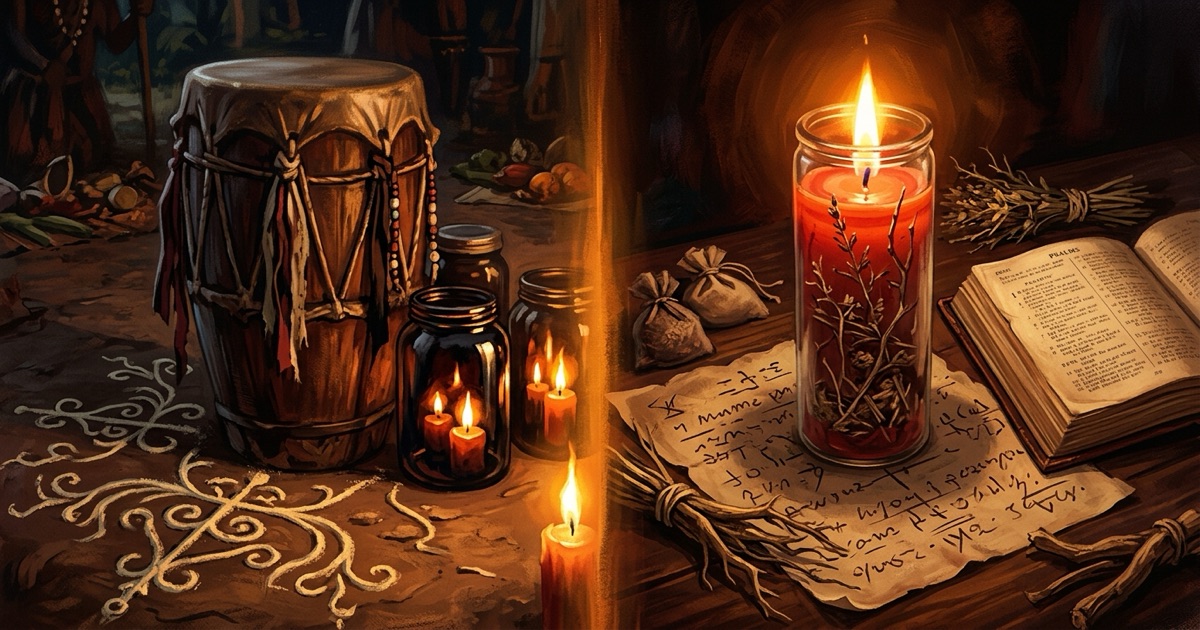
- Identify the target — In Vodou, the target is named before the Loa. In Hoodoo, the target's name is written on paper and placed under a candle or inside a doll
- Channel intent through ritual — In Vodou, the Houngan petitions the Loa through ceremony. In Hoodoo, the rootworker dresses a candle with oil, recites a Psalm, and focuses intent
- Involve a personal concern — In Vodou, a photograph or personal item links the working to the target. In Hoodoo, hair, nail clippings, or a name paper in special ink creates the magical link — the same sympathetic principle used across voodoo dolls and poppets
- Seal the working — In Vodou, the Loa's response (acceptance or refusal) determines whether the working is complete. In Hoodoo, the candle burns out, the mojo bag is carried or buried, the ritual is disposed of according to tradition — and the working is done
Hoodoo and Vodou vs Da Siu Yan
The Chinese Da Siu Yan (打小人) tradition provides an illuminating parallel. Like Vodou, it is a structured ritual with specific steps, materials, and an established cultural role. Like Hoodoo, it is accessible — anyone can perform it, no priesthood required. Unlike both, it is publicly practiced, government-recognized as intangible cultural heritage, and available online for free.
| Aspect | Vodou | Hoodoo | Da Siu Yan |
|---|---|---|---|
| Type | Religion | Folk magic | Folk ritual / cultural heritage |
| Origin | Haiti, via West Africa | American South, via West Africa | Southern China → Hong Kong |
| Age | crystallized 18th century (Haiti) | distinct system by the 19th century | origin unrecorded (ICH-listed 2014) |
| Practitioner | Houngan / Mambo (ordained) | Rootworker (self-taught or mentored) | 師婆 (ritual specialist) or self-performed |
| Spiritual intermediary | Loa (named, petitioned spirits) | None — God accessed through Psalms | None — practitioner acts directly |
| Mechanism | Spirit petition through ceremony | Sympathetic magic through materials | Sympathetic magic through effigy |
| Public visibility | Private, stigmatized | Private, practiced quietly | Public and culturally recognized |
| Modern access | Temple ceremonies | Rootworker consultation | Free online ritual → |
The Da Siu Yan tradition occupies a unique position: it combines the ritual structure of Vodou with the accessibility of Hoodoo — and adds public legitimacy that neither Western tradition enjoys. If the comparison intrigues you, experience the Eastern tradition yourself.
Ready to cast your curse?
Experience Hong Kong's heritage-listed curse ritual — 5 steps free, no signup required.
Cast a Curse Now →Can You Practice Hoodoo If You Are Not Black?
This is the most debated question in contemporary Hoodoo, and there is no single answer. The tradition itself contains the tension.
On one side: Hoodoo was born from the specific, brutal experience of enslaved Africans in the American South. Its herbs, its Psalms, its floor washes, and its conjuration dolls were survival technology — tools developed by people who had nothing else to protect themselves, draw love, attract money, and fight back against oppressors. To extract the tools while ignoring the history is, in this view, a form of cultural erasure — taking the magic while refusing to acknowledge whose suffering produced it.
On the other side: folk magic has never respected borders. European cunning-craft absorbed Arabic astrological magic during the Crusades. African-American Hoodoo absorbed Cherokee herbalism and German powwow. Traditions that survive are traditions that spread. Attempting to gatekeep a practice that historically spread through contact, necessity, and adaptation is, in this view, ahistorical.
The consensus position, articulated by many contemporary Hoodoo teachers: the practice is open to sincere students who acknowledge the tradition's roots in Black American experience and do not erase or replace that history. The line is not race. The line is respect. Buying a "voodoo doll kit" from a Halloween store and calling it Hoodoo is erasure. Studying the tradition, learning from Black teachers, understanding the Psalms and the roots and the history — that is engagement.
Further Reading
- What Is Voodoo: Magic, Curses & the Truth — Complete guide to the Vodou religion: history, Loa, ceremonies, and curse practices
- Voodoo Dolls — The truth behind voodoo dolls — from European poppets to Hoodoo conjuration dolls
- What Is Da Siu Yan — The Chinese curse ritual tradition and how it compares to African diasporic practices
- How to Curse Someone — The four-step curse framework across Western and Eastern traditions
- Hex Spells and Curses — Western hexing across Germanic and Pennsylvania Dutch traditions
- How to Remove a Curse — Five named curse-breaking methods including Hoodoo uncrossing techniques
Frequently Asked Questions
What is the difference between Hoodoo and Voodoo?
Hoodoo is a system of African-American folk magic — it has no pantheon, no priesthood, no initiation, and no formal religious structure. Vodou (Voodoo) is a complete religion with a pantheon of spirits called Loa, ordained priests (Houngans and Mambos), codified ceremonies, and recognized status as an official religion in Haiti (since 2003) and Benin (since 1996). Hoodoo is magic you do; Vodou is a religion you belong to.
Is Hoodoo the same as Voodoo?
No. Hoodoo and Voodoo are distinct traditions with different origins, structures, and purposes. Hoodoo developed in the American South as practical folk magic combining African, Native American, and European elements. Voodoo (properly Vodou) developed in Haiti as a structured religion with a pantheon, priesthood, and formal ceremonies. The confusion comes from their shared West African ancestry and the fact that both developed in proximity in New Orleans, where outsiders conflated them.
Which is older, Hoodoo or Voodoo?
The ancestral roots are the same age — both descend from West African spiritual traditions (Fon, Yoruba, Kongo) brought to the Americas through the slave trade. Haitian Vodou crystallized as a distinct religion in the 18th century during French colonial rule. Hoodoo took shape as a distinct folk-magic system in the American South over the 18th and 19th centuries. Neither is "older" — they are siblings from the same diaspora, shaped by different colonial contexts.
Do Hoodoo practitioners believe in the Loa?
Generally, no. Hoodoo is not spiritually dependent on Vodou's Loa pantheon. Most traditional Hoodoo practitioners are Protestant Christians who work with the Bible — particularly the Psalms — as a source of magical authority. The Loa belong specifically to Vodou religion. A Hoodoo rootworker may petition God directly through prayer and psalm-reading without any intermediary spirits.
Can you practice both Hoodoo and Voodoo?
Historically, yes — particularly in New Orleans, where the two traditions developed side by side. Marie Laveau, the most famous Vodou priestess in American history, also practiced Hoodoo rootwork. Some modern practitioners blend elements of both. But the traditions are distinct, and Vodou initiation (kanzo) is a serious religious commitment not to be undertaken casually alongside folk magic practice.
What is Hoodoo magic?
Hoodoo is a system of practical folk magic focused on tangible outcomes: love-drawing, money-attracting, protection, uncrossing (removing curses), and crossing (placing curses, though less common). It works through roots, herbs, oils, candles, personal concerns, and the Bible — particularly the Book of Psalms. Unlike Vodou, Hoodoo has no pantheon of spirits to petition. The practitioner works directly with natural materials and focused intent.
Why are Hoodoo and Voodoo always confused?
Three reasons: geography (both traditions developed alongside each other in New Orleans), terminology (outsiders used "voodoo" as a catch-all for anything African-derived), and Hollywood (cinema merged every African diasporic tradition into one sensational image). The confusion began with 19th-century sensationalist journalism and was cemented by 20th-century horror cinema. Neither tradition's actual practitioners confuse the two.
Is Hoodoo a closed practice?
This is debated within the Hoodoo community. Traditionalists argue that Hoodoo is an African-American birthright tradition, born from the specific experience of enslaved Africans in the American South, and should be respected as such — not commodified for mass consumption. Others maintain that folk magic, by its nature, spreads and adapts across communities. The consensus: anyone can learn about Hoodoo from books and teachers, but the tradition's roots in Black American experience must be acknowledged, not erased.
Does Hoodoo use voodoo dolls?
Hoodoo uses conjuration dolls — also called conjure dolls or fixed dolls — but these are not "voodoo dolls." The term "voodoo doll" is a Hollywood invention. Hoodoo dolls are sewn from specific fabrics (red flannel for love, black cloth for crossing), stuffed with personal concerns and herbs, and used for love, protection, money, and binding work. They belong to Hoodoo, not Vodou. For a complete guide, see our article on voodoo doll history and meaning.
What religion is associated with Hoodoo?
Hoodoo itself is not a religion — it is a system of folk magic. Most traditional Hoodoo practitioners are Protestant Christians who see no contradiction between church on Sunday and rootwork on Monday. The Bible is the primary magical text in Hoodoo: the Psalms are used as spells, specific verses correspond to specific intentions, and Jesus is understood as a healer and miracle-worker whose power can be accessed through rootwork. Some modern practitioners are not Christian, but the historical foundation is Protestant.
Related Curses
Voodoo Dolls: What They Are, How to Make One & the Myth
Voodoo dolls explained: what they are, how to make one, the real history of poppets and conjuration dolls, and the Holly...
18 min readVoodoo Curses: Meaning, the Petro Rite, and Are They Real?
Voodoo curses explained: what a voodoo curse is, the Petro rite, what "voodoo curse" really means, and whether voodoo cu...
18 min read