Voodoo Dolls: What They Are, How to Make One & the Myth
Voodoo Dolls: Meaning, History, and the Truth Behind the Myth
Voodoo dolls are the most recognized and most misunderstood magical tool in the world. Ask anyone to picture a curse ritual and they will describe a doll studded with pins — probably with a name paper pinned to its chest, probably in a dark room with candles. The image is universal. It is also wrong. The voodoo doll is not from Vodou. It does not work the way movies show. And the real history behind how dolls, pins, and sympathetic magic came together spans continents, centuries, and at least three distinct magical traditions that Hollywood flattened into one sensational image.
This guide traces the actual history — from European poppets to Kongo power figures to Hoodoo conjuration dolls — explains how sympathetic magic works, covers the materials and methods used across traditions, and connects the practice to the Chinese Da Siu Yan ritual tradition.
Key Takeaways:
- Voodoo dolls are not from Vodou. Haitian Vodou practitioners petition Loa spirits through ceremony and offerings — they do not use dolls with pins. The "voodoo doll" is a Hollywood invention combining European poppet magic, Hoodoo conjuration dolls, and Kongo power figures
- The mechanism is sympathetic magic. Across every tradition that uses dolls, the same principle applies: a representation of the target, linked through personal concerns, receives the action intended for the person. The doll is a stand-in, not a weapon
- Three real traditions use doll-like constructs. European poppet magic (with image-magic roots reaching back to ancient Greece), Hoodoo conjuration dolls (African-American folk magic), and Kongo minkisi (power figures for healing and oath-taking). None are Haitian Vodou
- The Da Siu Yan ritual uses paper effigies — not dolls — but operates on the same sympathetic principle. Name a target, externalize intent through physical action on the effigy, seal the working. The first five steps are free; a heritage-listed Chinese tradition
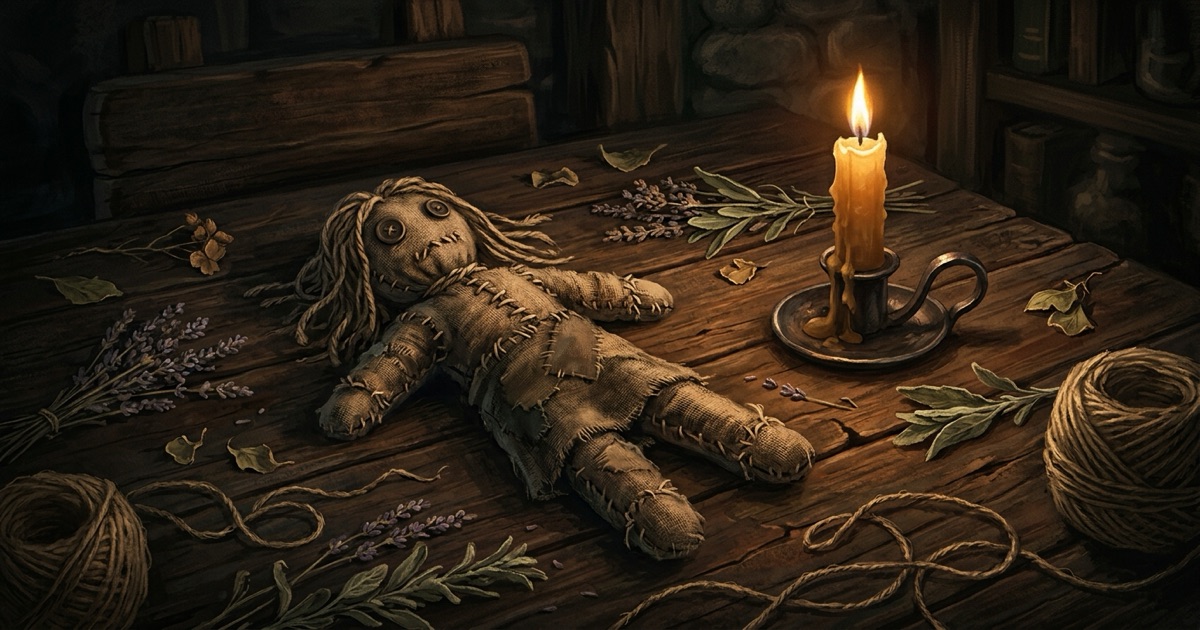
What Is a Voodoo Doll?
A voodoo doll is a figurine used in sympathetic magic to represent a person — actions performed on the doll are believed to transfer to the person it represents. The term is a Hollywood misnomer: actual Haitian Vodou does not use dolls for cursing. The real practice belongs to European poppet magic, African-American Hoodoo conjuration dolls, and Kongo nkisi power figures — three distinct traditions that popular culture collapsed into one image of pins and dark rooms. For the full story of how Vodou cursing actually works (through Loa petition and ceremony, not dolls), see our guide to the real voodoo curse.
The oldest known use of doll-like constructs for magical purposes predates both Vodou and Hoodoo by thousands of years. Archaeological evidence from Europe, Mesopotamia, and West Africa confirms that humans have been making representations of other humans for ritual purposes since at least the Bronze Age. The voodoo doll of Hollywood is a modern invention — but the idea behind it is ancient.
The Real History of Magical Dolls
European Poppet Magic: The Original "Voodoo Doll"
The practice of making a doll to represent a person for magical purposes is older than any of the traditions Hollywood attached the "voodoo" label to — the true voodoo doll history starts long before the name existed. In European folk magic, these dolls were called poppets — from the Latin pupa, meaning doll or little girl. Poppet magic was practiced across England, Germany, Scandinavia, and the Celtic regions for centuries before any European encountered Vodou — and the older family it belongs to, image magic against a named person, reaches back to the bound lead kolossoi of ancient Greece.
Archaeological finds tell the story. A poppet from ancient Egypt (circa 1,800 BCE) was made of clay and inscribed with the names of enemies — then ritually smashed. In ancient Greece, lead figurines called kolossoi were bound with cord and buried with curse tablets. In Windsor in 1579, accused witches were recorded shaping figures of red wax and pricking them with hawthorn thorns through the spot where the heart would be — targeted, specific, personal.
The medieval European grimoire tradition codified poppet construction. Instructions specified materials by intent: wax for love, clay for binding, cloth for healing. The poppet had to contain something of the target — hair, nail clippings, a drop of blood, a scrap of clothing. This is the critical concept: the personal concern. Without it, practitioners across every tradition agree, the poppet is just a doll. It has no link to the target. It is inert.
Kongo Minkisi: Power Figures, Not Cursing Tools
West and Central African traditions used figurines in ways that Hollywood would later misinterpret as "voodoo." The most significant are the minkisi (singular: nkisi) of the Kongo people — wooden or ceramic figures studded with nails, blades, and other metal objects.
These are not cursing tools. Minkisi are power figures used for oath-taking, dispute resolution, healing, and community protection. Each nail driven into an nkisi represents a specific oath, agreement, or petition — it is a record, not an attack. The figure serves as a witness between parties and a container for spiritual force. An nkisi activated through proper ritual channels by a nganga (ritual specialist) holds binding power — but the nails record commitments, not curses.
The visual similarity between a nail-studded nkisi and the Hollywood voodoo doll is striking and deliberate. Early 20th-century sensationalist writing — together with Western audiences misreading Kongo artifacts in museum displays — fused the European poppet image onto African ritual objects, a composite that cinema would later cement: the "voodoo doll" with pins.
Hoodoo Conjuration Dolls: The American Tradition
The tradition most commonly mistaken for "voodoo dolls" is Hoodoo — African-American folk magic developed in the American South. Hoodoo is not a religion. It has no pantheon, no priesthood, no initiation. It is a system of practical magical techniques, and one of its tools is the conjuration doll — also called a conjure doll, mojo doll, or fixed doll.
Hoodoo dolls are sewn by hand from specific fabrics — red flannel for love, black cloth for crossing (cursing), white muslin for healing. The doll is stuffed with personal concerns (the target's hair, a name paper written in special ink, graveyard dirt for certain workings) and charged through focused intent. The key difference from Hollywood: Hoodoo dolls are used for love, protection, uncrossing, and money work far more often than for harm. The pins-in-doll-for-revenge image is a tiny fraction of the actual practice.
Where did the confusion come from? New Orleans. Louisiana Voodoo and Hoodoo developed alongside each other in the same city, sharing practitioners, clients, and techniques. Marie Laveau herself blended traditions — Vodou ceremony, Catholic devotion, Hoodoo rootwork. Outsiders could not distinguish between what was Vodou and what was Hoodoo, so they called everything "voodoo." The doll practice, which was Hoodoo, got the wrong label. Hollywood did the rest.
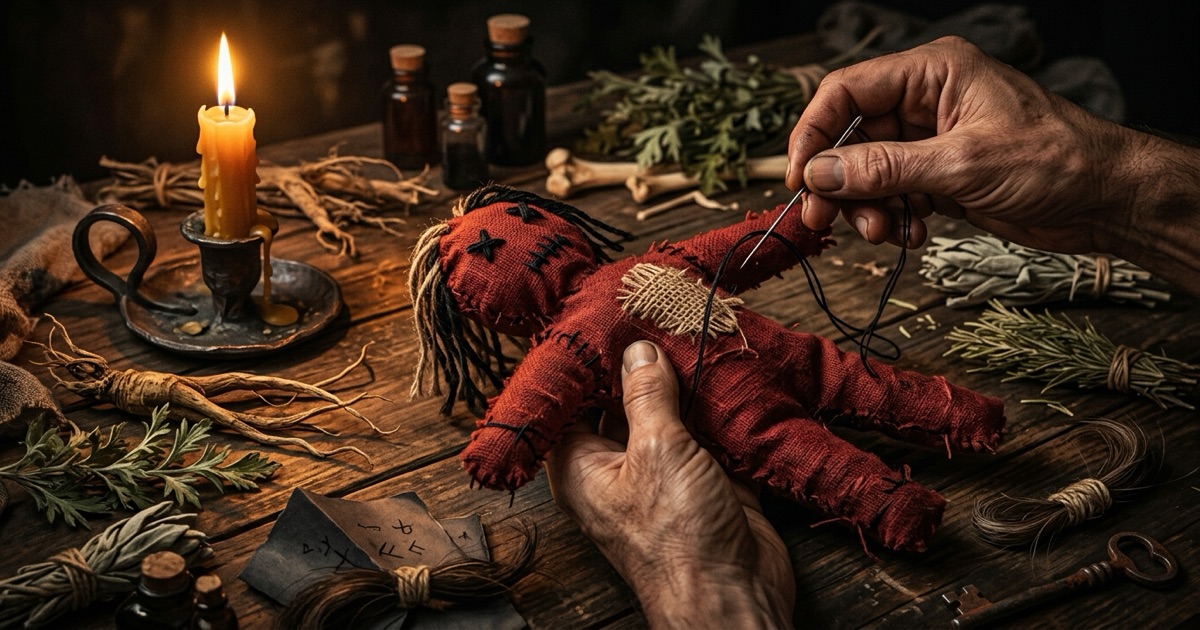
How Voodoo Dolls Work: Sympathetic Magic
How do voodoo dolls work? Every doll-based magical tradition operates on the same principle: sympathetic magic — the belief that a representation of a person, linked to that person through a personal item, transfers actions from the representation to the target. Sir James Frazer, in The Golden Bough (1890), identified this as the "law of similarity" — like produces like. The doll looks like the person, contains something of the person, and therefore is the person for magical purposes.
Sympathetic magic has two branches, and doll work uses both:
| Principle | Definition | Doll Application |
|---|---|---|
| Law of Similarity | Like produces like — the image equals the thing | The doll's form represents the target's body |
| Law of Contagion | Things once in contact remain connected | The personal concern (hair, nail, clothing) maintains the link |
Together, these two principles create what practitioners across traditions describe as a magical link — a conduit through which intention travels from practitioner to target. The doll is the representation (similarity). The personal concern is the connection (contagion). Both are required. One without the other, practitioners in these traditions consistently teach, produces nothing.
The mechanism — whether you interpret it as magic, psychology, or both — follows a recurring four-step structure found across many documented curse traditions:
- Identify the target — Name, image, personal concern. The link must be specific
- Create the representation — Construct the doll from appropriate materials for the intention
- Charge the working — Focused intent, ritual action (pinning, binding, burying), often with spoken words or prayer
- Seal and release — Complete the ritual, dispose of or keep the doll according to tradition, cut the practitioner's attachment
This four-step structure is identical in European poppet magic, Hoodoo doll work, and — across the Pacific — the Chinese Da Siu Yan tradition, where a paper effigy with the target's name is struck with a shoe. Different tools, same operating system.
How to Make a Voodoo Doll: Traditional Methods
The methods below are documented from Hoodoo, European poppet magic, and modern folk magic practice. They are presented as cultural and historical information — not as instruction. The decision to act on any ritual practice is yours alone.
Materials by Tradition
| Material | Hoodoo | European Poppet | Modern Folk Magic |
|---|---|---|---|
| Base fabric | Red flannel (love), black cloth (crossing), white muslin (healing) | Wax, clay, carved wood, or linen | Cotton, felt, or beeswax |
| Stuffing | Spanish moss, cotton, personal concerns | Hair, straw, wool | Cotton, paper, herbs |
| Fastener | Hand-sewn with cotton thread | Wire, twine, or none (wax/clay is self-supporting) | Thread, twine, or glue |
| Personal concern | Hair, nail clippings, name paper in special ink, graveyard dirt | Hair, nail clippings, blood, clothing scrap | Photograph, handwritten name, personal item |
| Charging agent | Condition oil, whiskey, or tobacco smoke | Spit, blood, or candle flame | Focused intent, spoken words |
Color Symbolism
The fabric color is not decoration — in Hoodoo especially, it is the first magical choice made and sets the entire working's direction:
| Color | Intention | Typical Use |
|---|---|---|
| Red | Love, passion, desire | Love-drawing doll, reconciliation work |
| Black | Binding, banishing, crossing | Protection-through-containment, severing ties |
| White | Healing, purification, blessing | Healing doll for sick person, protection for child |
| Green | Money, prosperity, growth | Money-drawing doll, business success |
| Blue | Protection, peace, truth | Warding doll, court case work |
| Purple | Power, mastery, spirit work | Domination work, spiritual authority |
The Construction Sequence
Across traditions, the sequence follows a consistent logic:
- Prepare the materials — Cleanse the fabric with smoke (frankincense or sage) or condition oil. Every item that touches the doll participates in the working
- Cut the fabric — Two identical human-shaped pieces. Some practitioners trace their own hand as a template; the doll represents the target, but the hand that makes it belongs to the practitioner
- Sew the body — Stitch the two pieces together, leaving the head open for stuffing. In Hoodoo, stitches should be uneven in number (7, 9, or 13) — even stitches are considered unlucky for magical work
- Insert the personal concern — Place the target's hair, name paper, or other concern into the doll's head or chest. The location matters: head for influence over thoughts, chest for emotional matters, stomach for binding
- Close the doll — Complete the stitching. Some practitioners sew a protective charm into the final stitch
- Dress and name — Anoint the doll with condition oil, speak the target's name over it, and declare the intention aloud. The naming is the moment the doll becomes the target for magical purposes — before naming, it is cloth and stuffing; after naming, it is linked
- Charge and deploy — Place the doll on an altar, wrap it in the target's clothing, or carry it on your person depending on the working's purpose
The critical distinction between this and the Hollywood image: the practitioner does not simply "stick pins and the person suffers." Every step — material selection, timing, personal concern, spoken word — is part of the working. The pin is the visible symbol; the invisible hours of preparation are the actual working.
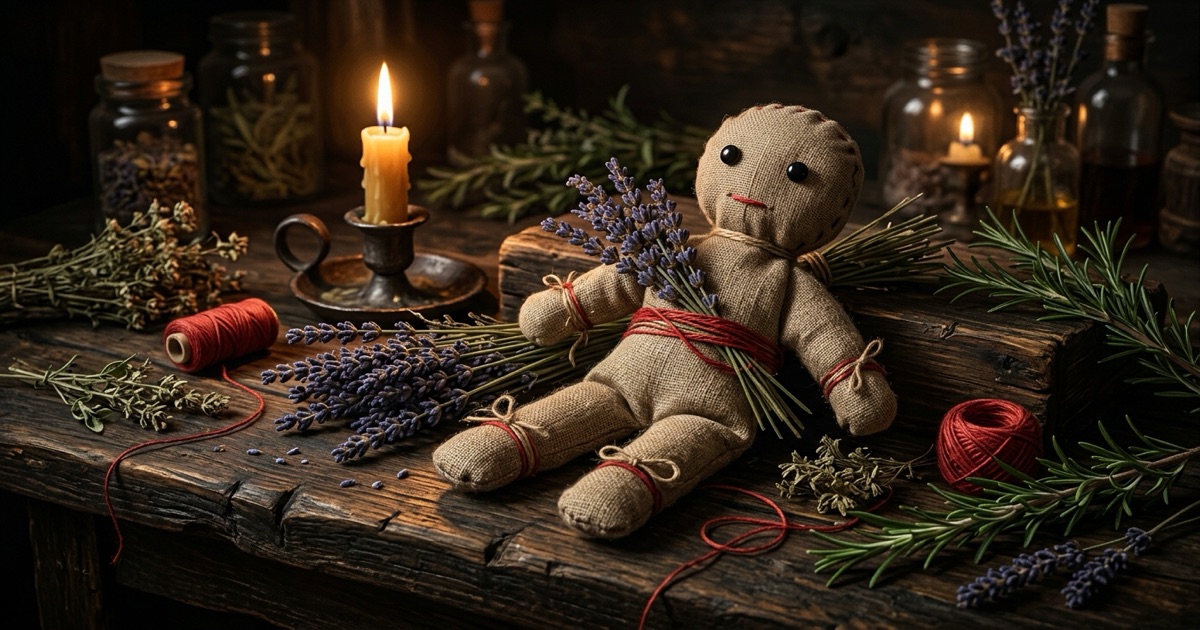
Voodoo Dolls in Popular Culture
Hollywood did not invent the voodoo doll — European poppets and Hoodoo conjuration dolls existed long before cinema — but Hollywood branded it. The sequence that fixed the "voodoo doll" in the Western imagination:
- 1910s-1920s: Sensationalist travel writing about Haiti and New Orleans introduced American readers to "voodoo" as exotic horror
- 1932: White Zombie — the first feature-length zombie film, set in Haiti, establishing Vodou as horror cinema's default "dark magic"
- 1940s-1950s: Pulp magazines and B-movies standardized the pins-in-doll image. Each repetition reinforced the association between dolls and Vodou
- 1970s-1980s: Live and Let Die (1973) and Angel Heart (1987) presented voodoo dolls as real Vodou tools — reaching audiences of millions
- 1990s-present: The image is self-sustaining. Every Halloween store sells "voodoo dolls." The brand is permanent
This matters because the cinematic distortion has real consequences. Actual Vodou practitioners face stigma rooted in images Hollywood invented. Real Hoodoo practitioners have had their tradition mislabeled for over a century. And the rich, distinct histories of European poppet magic, Kongo minkisi, and African-American conjuration are flattened into one image of a cloth doll with pins — historically inaccurate across all three traditions.
Poppet Magic Across Three Traditions
| Aspect | European Poppet | Hoodoo Conjuration Doll | Kongo Nkisi |
|---|---|---|---|
| Origin | England, Germany, Scandinavia | American South (African-American) | Kongo (Central Africa) |
| Age | Centuries of attested practice; ancient image-magic roots (Greek kolossoi) | 18th century to present | 500+ years |
| Materials | Wax, clay, cloth, wood, lead | Fabric (red flannel, black cloth, white muslin), Spanish moss, roots | Wood, ceramic, metal |
| Purpose | Healing, love, binding, cursing | Love, protection, money, uncrossing, crossing | Oath-taking, dispute resolution, healing, community protection |
| Practitioner | Folk magic practitioner, cunning person | Hoodoo rootworker | Nganga (ritual specialist) |
| Religious context | Folk Christianity, pre-Christian survival | Protestant Christianity (Hoodoo is magic, not religion) | Kongo religion |
| Nails/pins? | Yes — pins, thorns, or needles used for specific intent | Sometimes — pins used in crossing work only | Yes — but nails record oaths, not curses |
| Hollywood label | None (absorbed into "voodoo doll") | Mislabeled as "voodoo" | Misinterpreted as cursing tool |
All three traditions are real. All three are distinct. None of them are Haitian Vodou. The "voodoo doll" is a brand, not an anthropological category — and understanding the difference is the first step toward understanding any of the actual traditions behind the myth.
Voodoo Dolls and Da Siu Yan: Sympathetic Magic Across Oceans
The Chinese Da Siu Yan (打小人) tradition uses a paper effigy — not a cloth doll — but operates on the same sympathetic principle that powers poppets and conjuration dolls across the West. The parallels are not coincidental. They reflect a universal human mechanism: externalize intent onto a representation, act on the representation, seal the working.
| Aspect | Hoodoo Doll | Da Siu Yan Paper Effigy |
|---|---|---|
| Representation | Cloth doll, sewn by practitioner | Paper effigy (小人紙, the "petty person" paper) |
| Target link | Personal concern (hair, nail, name paper) | Target's name written on effigy |
| Action | Pinning, binding, burying | Striking with shoe, burning, scattering |
| Spiritual frame | Protestant Christianity + African spiritual influence | Chinese folk religion + Taoist elements |
| Practitioner | Rootworker or self-taught | 師婆 (ritual specialist) or self-performed |
| Public visibility | Private | Public and protected as cultural heritage |
| Cost | Low (fabric, herbs, thread) | Low (paper, shoe, incense) |
| Accessibility | Knowledge passed through community | Free online ritual available → |
The Da Siu Yan tradition is unusual in combining three things: it is publicly practiced, officially listed as intangible cultural heritage, and accessible online — a combination neither European poppet magic nor Hoodoo shares. If the sympathetic mechanism interests you, experience it yourself.
Ready to cast your curse?
Experience Hong Kong's heritage-listed curse ritual — 5 steps free, no signup required.
Cast a Curse Now →Common Misconceptions About Voodoo Dolls
Seven myths that persist despite the evidence:
- "Voodoo dolls come from Haitian Vodou." False. Vodou does not use dolls. The practice belongs to European poppet magic, Hoodoo, and Kongo traditions — each mislabeled by outsiders
- "You just stick pins and the person suffers." False. Pins are one specific technique within a multi-step ritual process requiring material preparation, personal concerns, focused intent, and ritual sealing
- "Any doll with pins is a voodoo doll." False. A poppet is a European folk magic tool. A conjuration doll is a Hoodoo tool. An nkisi is a Kongo ritual object. "Voodoo doll" is a brand name, not a category
- "Voodoo dolls are only for cursing." False. Across all three traditions, dolls are used more often for healing, protection, love, and blessing than for harm. The curse application is the smallest fraction of actual practice
- "You need to be initiated to make one." False for poppets and Hoodoo dolls. True for actual Vodou curse work (which does not use dolls). True for activating an nkisi (requires a nganga)
- "The doll must look like the target." False. The magical link comes from the personal concern and the naming, not from visual resemblance. A crude cloth figure with the target's hair is more effective, in practitioner consensus, than a photorealistic sculpture without it
- "This is all superstition — no one actually practices this." False. Hoodoo is a living tradition. Poppet magic is practiced in modern witchcraft communities. Kongo minkisi are still made and used. The persistence of doll-based sympathetic magic across continents and millennia is itself evidence that practitioners find it meaningful
Is It Safe to Make a Voodoo Doll?
Practitioners across traditions offer consistent warnings:
- Do not make a doll of someone without a clear, justified reason. Across Hoodoo, poppet magic, and Vodou, unjustified curse work is believed to rebound on the sender. The ethical framework varies by tradition, but the principle is universal — the working must have cause
- Protect yourself first. Cleanse your space, ground your energy, and know the reversal and uncrossing methods before attempting any binding or crossing work. In the Da Siu Yan tradition, the ritual includes a built-in sealing step — the working is closed after completion
- Do not leave a charged doll where others can find it. A doll linked to a specific person, if discovered, transfers its effect to the finder — or breaks the working entirely
- Know the laws. Threatening someone with a doll may constitute harassment. Creating a doll of someone without their knowledge for malicious purposes may violate stalking or intimidation statutes in some jurisdictions
The consistent thread: doll-based magic is treated as serious work across every tradition that practices it. It is not a party trick. It is not a joke. It is a tool that practitioners believe carries real consequences, and the respect with which they approach it reflects that belief.
Further Reading
- What Is Voodoo: Magic, Curses & the Truth — The Vodou religion explained: real history, Loa spirits, how voodoo curses actually work
- How to Curse Someone — The four-step curse framework
- What Is Da Siu Yan — The Chinese curse ritual and how it compares to Western traditions
- Hex Spells and Curses — Western hexing across the Germanic and Pennsylvania Dutch traditions
- What Is Black Magic — Black magic defined: the dark art across traditions worldwide
- How to Remove a Curse — Curse removal methods spanning five named traditions
Frequently Asked Questions
What is a voodoo doll?
A voodoo doll is a figurine used in sympathetic magic — the belief that actions performed on a representation of a person affect that person directly. Despite the name, actual Haitian Vodou does not use dolls for cursing; the practice belongs to European poppet magic and African-American Hoodoo. The "voodoo doll" is a Hollywood creation that merged multiple folk traditions into one sensational image.
Are voodoo dolls real?
The dolls exist — people make them, sell them, and use them in magical practice. But they are not part of authentic Haitian Vodou. The real magical traditions that use doll-like constructs are European poppet magic (found across medieval England, Germany, and Scandinavia), Hoodoo conjuration dolls (African-American folk practice), and various West African nkisi figures from Kongo traditions. The pins-in-dolls image is a Hollywood amalgam, not accurate ethnography.
How do you make a voodoo doll?
A traditional poppet is made from natural materials — cloth, twine, moss, wax, or carved wood — and stuffed with something personal to the target: hair, nail clippings, a photograph, or a handwritten name. The doll is then charged through focused intent and ritual action: binding with cord, pinning to a specific body area, or burying at a crossroads. The material matters less than the link to the target — without a personal concern, practitioners consider the doll inert.
What is the difference between voodoo dolls and poppets?
A poppet is the older, broader term — a magical doll used in European folk magic since at least the medieval period. A "voodoo doll" is the Hollywood-invented name for the same concept, incorrectly attributed to Haitian Vodou. The mechanics are identical (sympathetic magic via representation), but the cultural origin differs: poppets come from English, German, and Scandinavian folk traditions; conjuration dolls come from Hoodoo; nkisi figures come from Kongo religion. None of them are Vodou.
What colors are used for voodoo dolls?
Practitioners choose doll colors by magical intent: red for love and passion, black for binding and banishing, white for healing and purification, green for money and prosperity, and blue for protection. In Hoodoo tradition, the fabric color is the first magical choice made before a single stitch is sewn — it sets the working's entire energetic direction. Some practitioners sew in a lock of the target's hair using thread matching the intention color.
Do voodoo dolls actually work?
Whether poppets "work" depends on your framework. Within magical practice, the mechanism is sympathetic magic — the doll represents the target, and actions on the doll transfer to the person. Psychologically, the practitioner gives their intent a physical form through ritual. The target, if they know about the working, may experience real anxiety through the nocebo effect. Practitioners across traditions report results; skeptics attribute those results to coincidence and psychology. The mechanism is debated; the persistence of the practice across continents and centuries is not.
Where did voodoo dolls originate?
The concept of using a doll or figurine to affect a person magically appears independently in multiple cultures — European poppet magic (whose image-magic roots reach back to the *kolossoi* of ancient Greece), Kongo minkisi (power figures used for healing and oath-taking), and Hoodoo conjuration dolls (American South, 18th-19th century). The name "voodoo doll" was invented by Hollywood and sensationalist journalism in the early 20th century, incorrectly linking the doll practice to Haitian Vodou.
What is a Chinese voodoo doll?
The Chinese Da Siu Yan ritual — "beating the petty person" — uses a paper effigy instead of a cloth doll: the target's name goes on a paper figure that is struck with a shoe and burned. It is a real, living tradition rather than a Hollywood invention; see our guide to Da Siu Yan.
What is a Hoodoo doll?
A Hoodoo doll — also called a conjuration doll, conjure doll, or mojo doll — is a doll used in African-American Hoodoo practice for love, protection, binding, or crossing (cursing). Unlike Hollywood voodoo dolls, Hoodoo dolls are typically sewn by the practitioner from specific fabrics and stuffed with personal concerns: the target's hair, a name paper written in special ink, roots and herbs matched to the intention. Hoodoo is a living folk magic tradition distinct from Vodou religion.
How do you use a voodoo doll for protection?
A protective doll is made from white or blue fabric and stuffed with protective herbs — rosemary, bay leaf, or agrimony — plus a written prayer or petition. The doll is named for the person it protects (not a target), dressed in a small piece of their clothing, and kept in a safe place or carried. Some practitioners sew protective charms into the doll's chest. This is not cursing — it is warding, using the same sympathetic mechanism in the opposite direction.
Can anyone make a voodoo doll, or do you need training?
In European poppet magic and modern witchcraft, no formal training is required — the practice is accessible and the tradition is largely self-taught through grimoires and community knowledge. In Hoodoo, traditionally the knowledge passes from elder to student within the community, though modern practitioners learn from books and teachers. In Vodou, which does not use dolls, curse work requires an initiated Houngan or Mambo. The Hollywood "anyone can curse with a doll" narrative comes from poppet magic's accessibility, not from Vodou.
Related Curses
Hoodoo vs Voodoo: Differences, Origins & Complete Guide
Hoodoo vs voodoo explained — key differences between Hoodoo folk magic and Vodou religion: origins, practices, beliefs, ...
14 min readVoodoo Curses: Meaning, the Petro Rite, and Are They Real?
Voodoo curses explained: what a voodoo curse is, the Petro rite, what "voodoo curse" really means, and whether voodoo cu...
18 min read