Evil Eye Symbols: The Nazar, Hamsa & Their Lookalikes
Evil Eye Symbols: The Marks That Watch Back
Evil eye symbols are the oldest defensive marks humankind ever drew. A blue glass eye, an open hand, a twisted red horn — each is a different answer to the same fear: that an envious glance can carry real harm. But not every eye symbol is an evil eye symbol. The Eye of Horus, the eye on the dollar bill, the third eye of the meditator — all look alike, and all mean something completely different. This is the field guide.
Evil eye symbols are protective marks worn to ward off the harm of an envious or malicious gaze. The most famous is the nazar — the blue-and-white glass eye — but the family is larger and stranger than most people realize, spanning the Mediterranean hand of the hamsa, the twisted Italian horn, and a Roman charm most people would never guess. This guide catalogs the real evil eye symbols, explains what each one means, and — crucially — separates them from the lookalike eyes they are constantly confused with.
Key Takeaways:
- The core evil eye symbols are the nazar (the blue eye), the hamsa (the protective hand), and the Italian charms (cornicello, cimaruta, fascinus)
- The "evil eye" means both the curse and the amulet against it — the symbol is an eye because it fights the envious gaze with an eye that looks back
- The Eye of Horus and the all-seeing Eye of Providence are NOT evil eye symbols — they are separate traditions; this guide sets them straight below, and the full evil eye guide places them in context
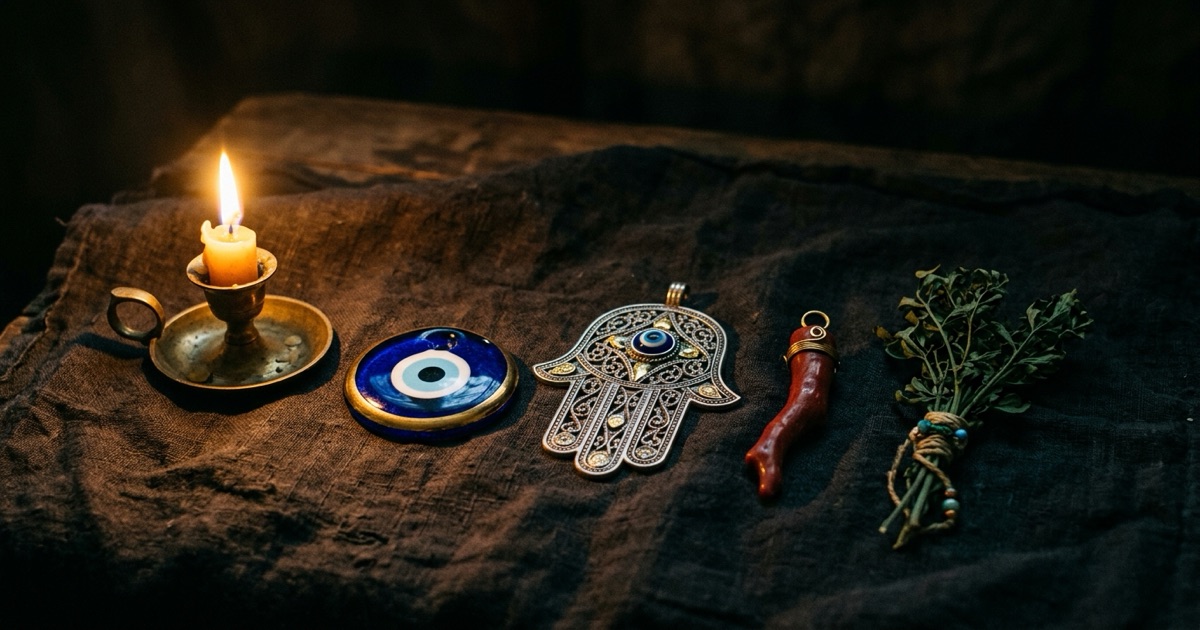
What Are Evil Eye Symbols?
Before the catalog, one distinction clears up most of the confusion: the "evil eye" means two things at once. It is the curse — a harmful glance born of envy — and it is the amulet worn to guard against that curse. When people say "an evil eye symbol," they almost always mean the second: the protective mark.
And the protective marks fall into two shapes: eyes and non-eyes. Some symbols answer the eye with an eye (the nazar). Others answer it with a different form entirely — a hand, a horn, a plant. The table below is your quick reference.
| Symbol | Form | Origin | What It Does |
|---|---|---|---|
| Nazar | Blue glass eye | Greece / Mesopotamia | Reflects the envious gaze |
| Hamsa | Open hand + eye | North Africa / Near East | Blocks all evil, invites blessing |
| Cornicello | Red twisted horn | Italy (Roman roots) | Dispels envy (malocchio) |
| Cimaruta | Silver rue sprig | Southern Italy | Multi-charm protection |
| Fascinus | Phallic charm | Ancient Rome | Earliest Italian ward |
| Mano cornuta | Horned-hand gesture | Italy | Instant, object-free defense |
Why the Protective Symbol Is Itself an Eye
There is a strange logic at the heart of the whole tradition: to guard against a harmful eye, you wear an eye. Most protective symbols hide, deflect, or disguise the thing they fear. The evil eye amulet does the opposite — it meets the gaze head-on and mirrors it. The nazar does not turn away from the envious stare; it stares back. The hamsa raises an open palm with an eye at its center, as if to say I see you seeing me.
This is why the eye shape recurs across every culture that fears envy, from the Turkish bead to the Egyptian wedjat to the painted eyes on ancient Greek cups. An eye is the one image that returns a look. The symbol works not by shutting the threat out, but by refusing to look away first — a small act of defiance worn on the wrist, the throat, or the doorframe.
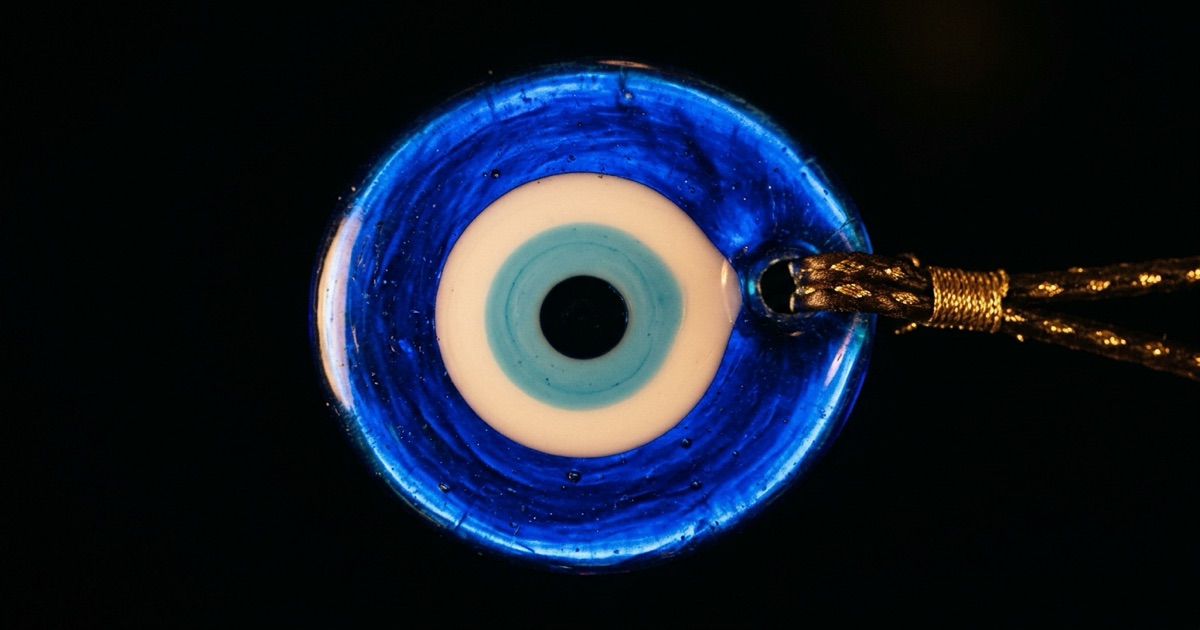
The Nazar: The Eye That Reflects
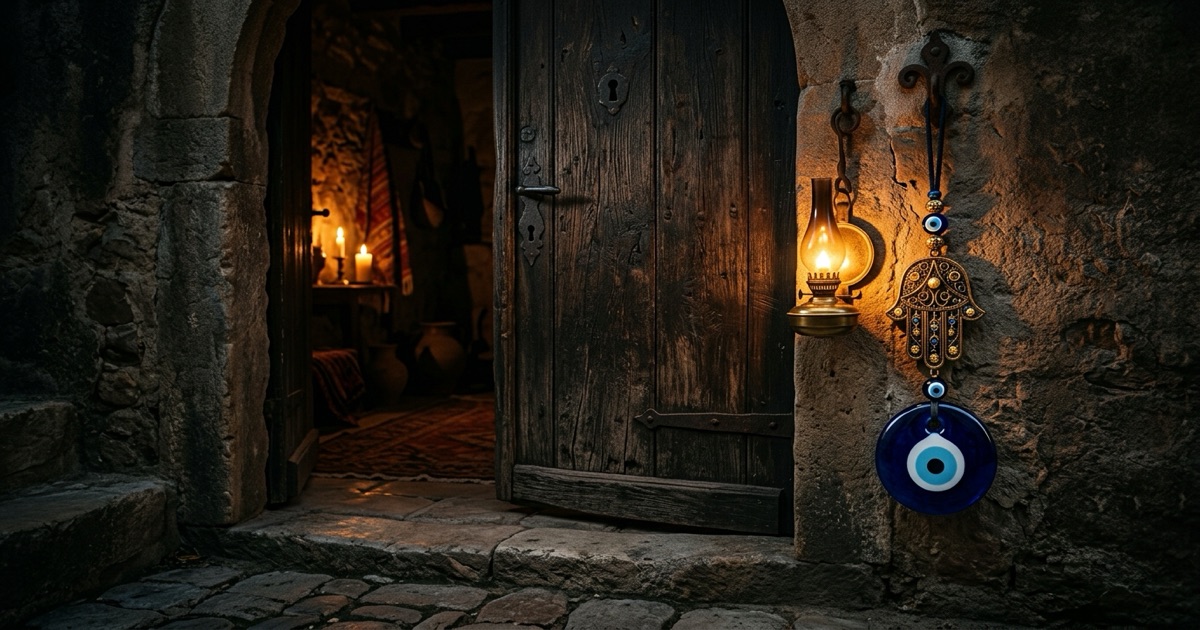
The nazar is the symbol most people picture when they hear "evil eye" — the cobalt-blue disc with concentric rings of white, light blue, and a black pupil. Its origins trace back through ancient Greece and Mesopotamia, and it has been in continuous use across the Mediterranean, Middle East, and South Asia for thousands of years.
Its logic is pure reflection. Blue was chosen because, in old Mediterranean belief, blue is the color that absorbs and throws back the malicious glance — the color of the sky and sea, which see everything. The eye shape completes the idea: you defend against a hostile look by wearing a look that stares straight back. For what each color of the eye protects against, see the evil eye color meanings guide.
The Hamsa: The Hand That Shields
The hamsa answers the same fear with a different shape: an open right hand, palm outward, often with an eye set in the center. Its name means "five" in Arabic. Muslims call it the Hand of Fatima and Jews the Hand of Miriam, and its roots run back through North Africa and the ancient Near East.
Unlike the nazar's targeted defense, the hamsa is a complete protection system — it blocks all negative energy while inviting blessings, prosperity, and luck. Its orientation matters:
- Facing up — a shield against evil and malicious intent
- Facing down — an invitation to abundance, fertility, and answered prayers
The hamsa-with-an-eye is the single most powerful combination in the family, uniting the hand's broad protection with the eye's targeted reflection.
Feeling the gaze? Begin the ritual →
The Cornicello, Cimaruta & Fascinus: Italy's Symbols
Southern Italy, where the evil eye is the malocchio, developed its own distinct family of symbols — none of them eyes.
The Cornicello
The cornicello (or cornetto) is a twisted horn charm, traditionally carved from red coral or painted red, since red itself is thought to repel the malocchio. The horn draws bad luck onto itself and away from the wearer, and it is traditionally given as a gift rather than bought for oneself.
The Cimaruta
The cimaruta is a far more elaborate silver amulet shaped like a sprig of rue, the ancient protective herb. What sets it apart is its complexity: it is hung with smaller charms, each with its own protective power — commonly a key, a fish, an owl, a vervain blossom, a hand holding a sword, a crescent moon, a rooster, and an eagle. It is protection stacked upon protection.
The Fascinus
The fascinus is the oldest attested of them all — the ancient Roman phallic charm used against the evil eye in antiquity, long before the cornicello's earliest records. It is a reminder that the impulse to ward off the envious gaze is older than any of the symbols we recognize today.
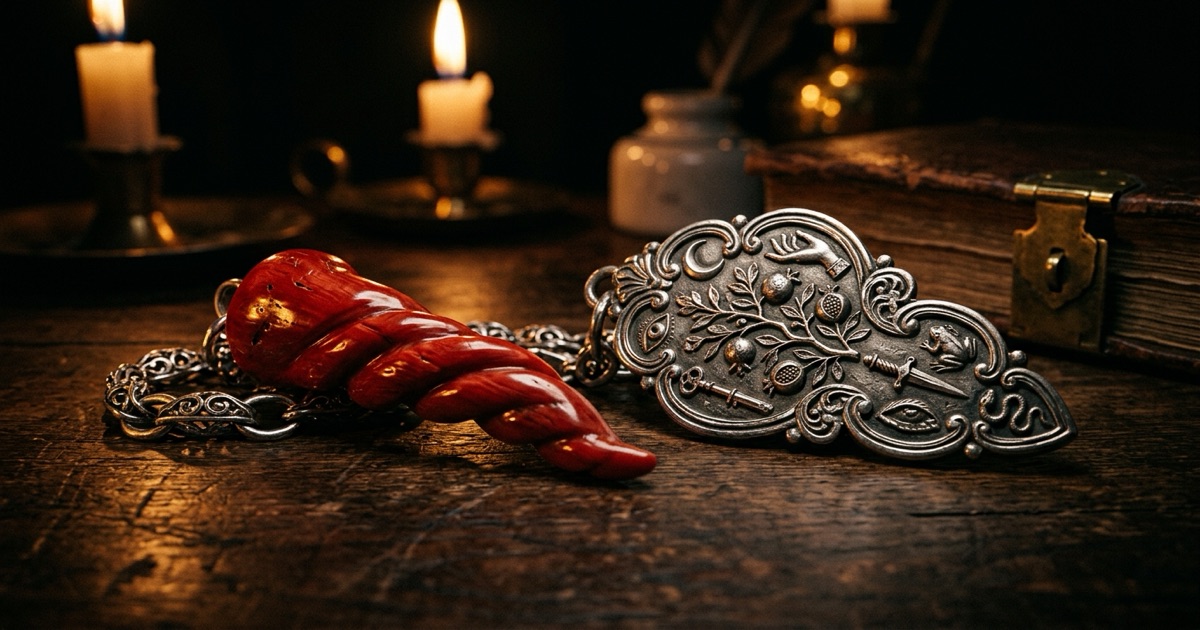
More Evil Eye Symbols: Beyond the Big Three
The nazar, hamsa, and Italian charms are the headline symbols, but the family runs deeper. Several more marks and objects carry the same protective charge across cultures:
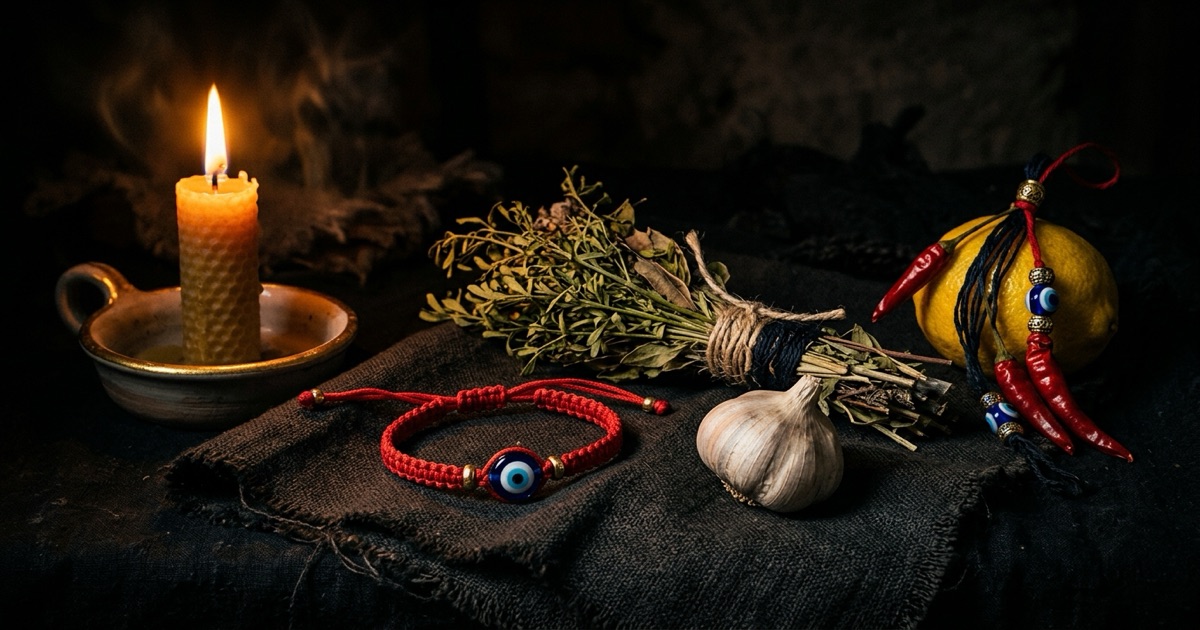
- The red thread — a thin red string tied on the left wrist, drawn from Kabbalistic and Latin American practice, worn especially by infants to catch the first envious gaze.
- Esfand (wild rue) — in Persian tradition, rue seeds are burned over hot coals and the smoke passed over a person; the seeds' popping is said to be the evil eye breaking apart, the ritual complete when the smoke smells sweet.
- The kohl dot — a black mark placed on a baby's forehead or behind the ear in South Asian custom, a deliberate "flaw" that makes the child appear less perfect and so less likely to attract envy.
- The mano fico and mano cornuta — Italian hand gestures (the "fig" and the "horns") that throw off a hostile look with the fingers alone, no object required.
- Garlic and the lemon-and-chili string — pungent, sharp household wards hung in doorways and on vehicles, their bitterness believed to "cut" the eye's effect.
What unites them with the nazar and hamsa is intent: each is a deliberate object or gesture aimed at intercepting envy before it lands. Which culture each one belongs to is mapped in the evil eye traditions guide.
Evil Eye Lookalikes: Symbols People Confuse
Several famous eye symbols look like evil eye symbols but come from entirely separate traditions, and mistaking one for another is common. Knowing the difference matters: a symbol used without understanding what it is does not do the job you think it does.
| Symbol | Origin | What It Actually Means | An Evil Eye Symbol? |
|---|---|---|---|
| Nazar | Greece / Mesopotamia | Reflects envy | ✅ Yes |
| Eye of Horus | Ancient Egypt | Healing, power, safe travel | ❌ No |
| Eye of Providence | Renaissance Christianity | Watchful eye of God | ❌ No |
| Third Eye | Hindu / Buddhist | Inner vision, enlightenment | ❌ No |
The Eye of Horus
The Eye of Horus is an ancient Egyptian symbol — a stylized falcon's eye with two lines beneath it. In myth, the sky god Horus lost the eye in a struggle for his father Osiris's throne and had it magically restored, making it a symbol of power, protection, and healing. Egyptians placed it on amulets and on the bows of ships to ensure safe travel. It protects — but it is Egyptian healing magic, not the Mediterranean anti-envy nazar.
The Eye of Providence (The All-Seeing Eye)
The Eye of Providence — an eye inside a triangle, surrounded by rays of light — is the one most often mistaken for something ancient and Egyptian. In reality it was developed in Renaissance-era Christianity to represent the watchful eye of God and the Holy Trinity, and its most famous appearance is on the reverse of the Great Seal of the United States, printed on the one-dollar bill. It represents divine oversight, not protection against envy. It is not an evil eye symbol at all — its later association with Freemasonry and conspiracy lore is a modern overlay on what began as a simple Christian emblem of God's watchful eye.
The Third Eye
In Hindu and Buddhist tradition, the third eye — often depicted on the forehead — represents inner vision, intuition, and spiritual enlightenment. It looks inward toward higher perception. The evil eye looks outward to deflect harm. Same shape, opposite direction.
Evil Eye Symbols in Jewelry, Tattoos & the Home
Evil eye symbols live wherever protection is needed. As jewelry, the nazar and hamsa appear on bracelets, necklaces, and rings — the evil eye bracelet meaning guide covers how to wear them. As tattoos, they become permanent wards — see the evil eye tattoo meaning guide. In the home, a blue nazar hangs by the door, a hamsa guards the entryway, and a cornicello is tucked near the threshold. For the full range of active and passive defenses, the evil eye protection guide brings the symbols together with the rituals that use them.
Choosing an Authentic Evil Eye Symbol
With so many symbols — and so many lookalikes — how do you choose?
- For targeted defense against envy → the nazar. Simple, direct, unmistakable.
- For broad protection plus blessings → the hamsa, ideally with an eye in the palm.
- For Italian heritage or the malocchio specifically → the cornicello.
- For layered, maximal protection → the cimaruta, or a combination.
- Avoid by mistake → the Eye of Providence and Eye of Horus, if what you actually want is anti-envy protection. They are beautiful, but they do a different job.
No single culture owns these symbols — the evil eye appears independently across dozens of cultures, which is why wearing one is generally not appropriation. What matters is understanding what you wear.
Materials and Colors of Evil Eye Symbols
The material a symbol is made from carries its own meaning. Traditional nazar beads are glass, prized because glass can be reheated and reshaped — a fitting medium for an eye meant to absorb and transform malice. Silver, the metal of the hamsa and the cimaruta, is tied to the moon and to purity and is believed to reflect negativity. Red coral, the classic material of the cornicello, doubles the protection: coral was itself an ancient ward, and red is the color thought to repel the evil eye most strongly.
Color matters as much as material. The dominant blue of the nazar is not decorative — in Mediterranean belief, blue is the color that sees and reflects the envious gaze. But the full palette carries specific meanings, from black for absorbing severe curses to red for courage, each mapped in the evil eye color meanings guide.
The Chinese Counter-Symbol: The Paper Villain
Every symbol in this guide is built to last — worn, hung, or inked so it can keep watch for years. One tradition builds its central symbol for the opposite fate: to be unmade. Its symbol is not an amulet at all, but an effigy.
In Da Siu Yan (打小人), or "villain hitting,", a paper figure carries the name of the person harming you, and the entire point is to destroy it — striking and burning the figure until the villain's power lifts away with the smoke, the same instinct behind older curse-removal rites. Set beside the nazar and the hamsa, it is the inverse symbol: not a mark that guards you forever, but one you make, use once, and turn to ash. When a symbol worn for defense is not enough, the ritual offers one built for attack.
Ready to cast your curse?
Experience Hong Kong's heritage-listed curse ritual — 5 steps free, no signup required.
Cast a Curse Now →Evil Eye Symbols: Summary
| Symbol | Family | Use It For |
|---|---|---|
| Nazar | Eye amulet | Targeted anti-envy defense |
| Hamsa | Hand amulet | Broad protection + blessings |
| Cornicello | Italian horn | Malocchio, personal luck |
| Cimaruta | Italian silver sprig | Layered, maximal protection |
| Fascinus | Roman charm | Historical root of the tradition |
| Eye of Horus | Egyptian (NOT evil eye) | Healing, safe travel |
| Eye of Providence | Christian (NOT evil eye) | Divine watchfulness |
| Third Eye | Hindu/Buddhist (NOT evil eye) | Inner vision |
Learn the real symbols, know the lookalikes, and you will never again wear the wrong eye for the job.
Turn the gaze back — begin the ritual →
Further Reading
- Evil Eye Meaning: The Complete Guide — The full history behind every symbol in this guide
- Evil Eye Traditions Around the World — Which culture each symbol comes from
- Evil Eye Protection — The rituals that put these symbols to work
- Evil Eye Color Meanings — What each color of the nazar protects against
- Evil Eye Tattoo Meaning — The symbols worn permanently in ink
- What Is Da Siu Yan — The Chinese counter-symbol you destroy instead of wear
Frequently Asked Questions
What are the different evil eye symbols?
The main evil eye symbols are the nazar (the blue glass eye), the hamsa (an open hand, often with an eye in the palm), and the Italian charms — the cornicello horn, the cimaruta silver sprig, and the ancient fascinus. All of them share one purpose: to ward off the harm of an envious gaze. The nazar is the most recognizable, while the hamsa offers the broadest protection.
What is the most common evil eye symbol?
The nazar — the concentric blue-and-white glass eye — is by far the most common and recognizable evil eye symbol worldwide. It appears on bracelets, wall hangings, car mirrors, and doorways from Turkey and Greece across the Middle East and South Asia. Its blue color and staring-eye shape make it instantly readable as protection.
What is the difference between the evil eye and the Eye of Horus?
The evil eye (nazar) is a Mediterranean and Middle Eastern amulet that reflects an envious gaze back at its sender. The Eye of Horus is an ancient Egyptian symbol representing healing, power, and personal protection, rooted in the myth of the sky god Horus losing and regaining his eye. They look related but come from entirely different traditions and serve different purposes.
Is the all-seeing eye the same as the evil eye?
No. The all-seeing eye, or Eye of Providence, is an eye enclosed in a triangle with rays of light, invented in Renaissance-era Christianity to represent the watchful eye of God and the Holy Trinity. It is most famous from the US dollar bill. It has nothing to do with the evil eye, which is a protective amulet against envy — the two are frequently confused but entirely separate.
What does the hamsa symbol mean?
The hamsa is an open, palm-out hand whose name means "five" in Arabic. It is called the Hand of Fatima in Islam and the Hand of Miriam in Judaism, and it represents protection against all negative energy while inviting blessings and good fortune. A hamsa facing up is a shield against evil; one facing down invites abundance. It often includes a small eye in the palm.
Is the evil eye symbol the curse or the protection?
The term "evil eye" refers to both at once, which causes endless confusion. The evil eye is the curse — a harmful glance born of envy. The evil eye symbol, or nazar, is the amulet worn to guard against that curse. The amulet is an eye precisely because it fights like with like: to defend against a harmful look, you wear an eye that looks back.
What are the Italian evil eye symbols?
Italy has three main symbols against the malocchio (evil eye): the cornicello, a twisted red horn charm; the cimaruta, an elaborate silver amulet shaped like a sprig of rue and hung with smaller protective charms; and the fascinus, the ancient Roman phallic symbol that was the earliest Italian protection. The horned-hand gesture, the mano cornuta, is the gestural version.
Which evil eye symbol is the most powerful?
No single symbol is universally "strongest" — they serve different roles. The nazar is the most targeted defense against envy specifically. The hamsa offers the broadest protection and adds blessings. Many people combine them, wearing a hamsa with an eye in the palm, precisely to get both the targeted and the broad protection in one symbol.
Can you combine evil eye symbols?
Yes, and combining is traditional rather than contradictory. The most common combination is the hamsa with a nazar eye set in the palm, uniting the hand's broad protection with the eye's targeted deflection. In Italy, the cornicello is often worn alongside the horned-hand gesture. Symbols from the same protective family reinforce one another.
Is the third eye the same as the evil eye?
No. In Hindu and Buddhist tradition, the third eye represents inner vision, intuition, and spiritual enlightenment — a gateway to higher perception. The evil eye is about protection against external envy. They share the eye shape but mean opposite things: one looks inward toward wisdom, the other looks outward to deflect harm.
Related Curses
Evil Eye Traditions: Greek Mati to Mexican Mal de Ojo
Evil eye traditions around the world — the Greek mati, Turkish nazar, Italian malocchio, Jewish ayin hara, and Mexican m...
15 min readEvil Eye Tattoo Meaning: Designs, Placement & Protection
Evil eye tattoo meaning explained — what the design symbolizes, the meaning behind each placement, whether it's bad luck...
13 min readEvil Eye Protection: Amulets, Rituals & Cleansing Methods
Evil eye protection explained — the amulets, cleansing rituals, and daily habits that shield you from the envious gaze, ...
17 min read