Evil Eye Tattoo Meaning: Designs, Placement & Protection
Evil Eye Tattoo Meaning: Protection Worn in Ink
An evil eye tattoo is one of humanity's oldest protective symbols made permanent. A bead can be lost, a bracelet can break, a charm can be left on the nightstand — but an eye inked into the skin never leaves your side. It watches outward from your wrist, your finger, the back of your neck, meeting every envious glance and throwing it back. This is protection you cannot take off.
The evil eye tattoo meaning is, at its core, protection — the same protection carried for three thousand years by blue glass eye beads, now worn permanently in ink. It guards against envy, jealousy, and the harm of a malicious gaze, and it carries deeper layers too: perception, intuition, and spiritual awareness. This guide covers what each design and placement means, whether an evil eye tattoo is bad luck, and how to choose one with genuine intent rather than as empty decoration.
Key Takeaways:
- An evil eye tattoo is a permanent protective amulet — it means protection from envy and the malicious gaze, plus perception, intuition, and awareness
- Design and placement both carry meaning: blue for general protection, the hand for active warding, behind the ear for private protection
- Whether it is "bad luck" is a minority belief, not the norm — the evil eye is a protective symbol across dozens of cultures
What Does an Evil Eye Tattoo Mean?
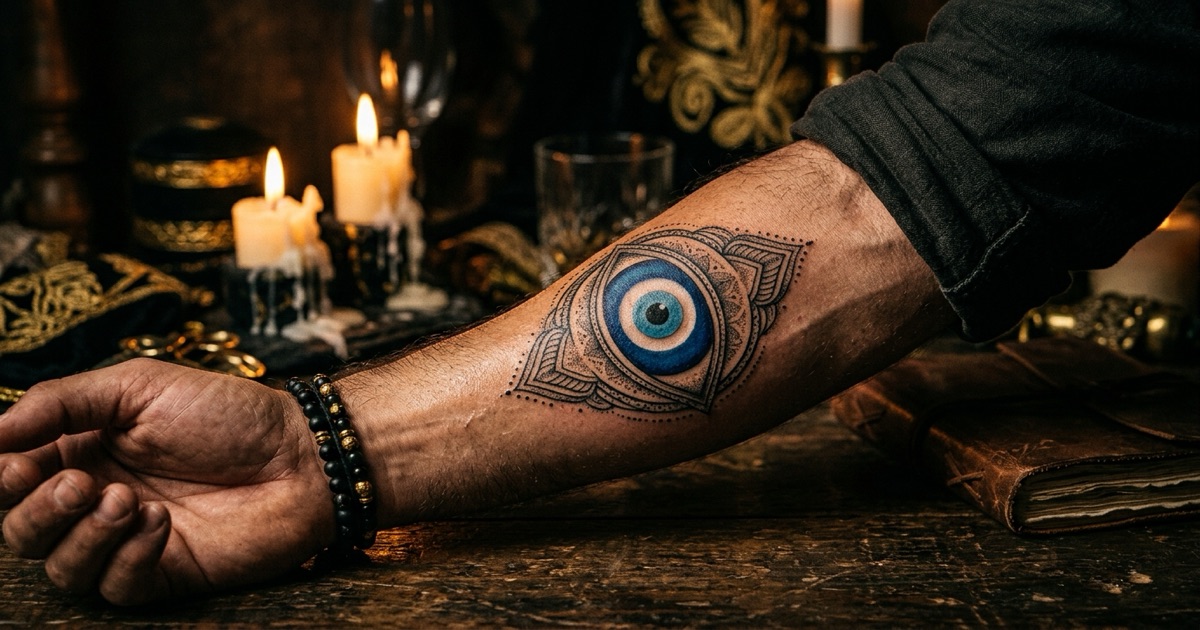
An evil eye tattoo means you carry your protection on your body, permanently. In the tradition of the nazar, the eye works by reflection: you answer a harmful look with a look of your own — an eye that stares back and returns the malice to its sender. A tattoo simply makes that ward permanent.
But the eye has never meant only one thing. Across cultures it also stands for:
- Perception and intuition — the ability to see clearly, including what others try to hide
- Spiritual awareness — seeing beyond the physical, the mark of watchfulness
- Self-protection and self-care — a visible commitment to guarding your own energy
There is a quiet paradox in tattooing the evil eye. A traditional nazar bead is meant to break — when it cracks, it has absorbed an attack and is replaced. A tattoo cannot break. For some, that permanence is the whole appeal: an amulet that never needs replacing. For others, it raises a question we return to below — whether a protection designed to be replaceable should be made permanent at all.
Designs and What They Mean
The evil eye tattoo comes in many forms, and each design shifts the meaning. The table below maps the most common designs; the sections beneath explain the ones worth understanding in depth.
| Design | Meaning | Best For |
|---|---|---|
| Classic nazar | General protection, karmic balance | First-timers, traditionalists |
| Hamsa with eye | Total protection + blessings | Broad, whole-life warding |
| Eye with teardrop | Protection through grief or loss | Marking a hard chapter survived |
| Red string + eye | Bound protection, fate-tie | Connection to a person or vow |
| Minimalist fine-line | Discreet, personal protection | Finger, behind the ear |
| Ornamental Greek/Turkish | Rooted, cultural protection | Larger placements, heritage |
The Classic Nazar Eye
The concentric blue-and-white eye is the original and most recognizable design. It reads instantly as protection and needs no explanation. In blue, it means general defense against the evil eye — the safest, most traditional choice.
The Hamsa with an Eye
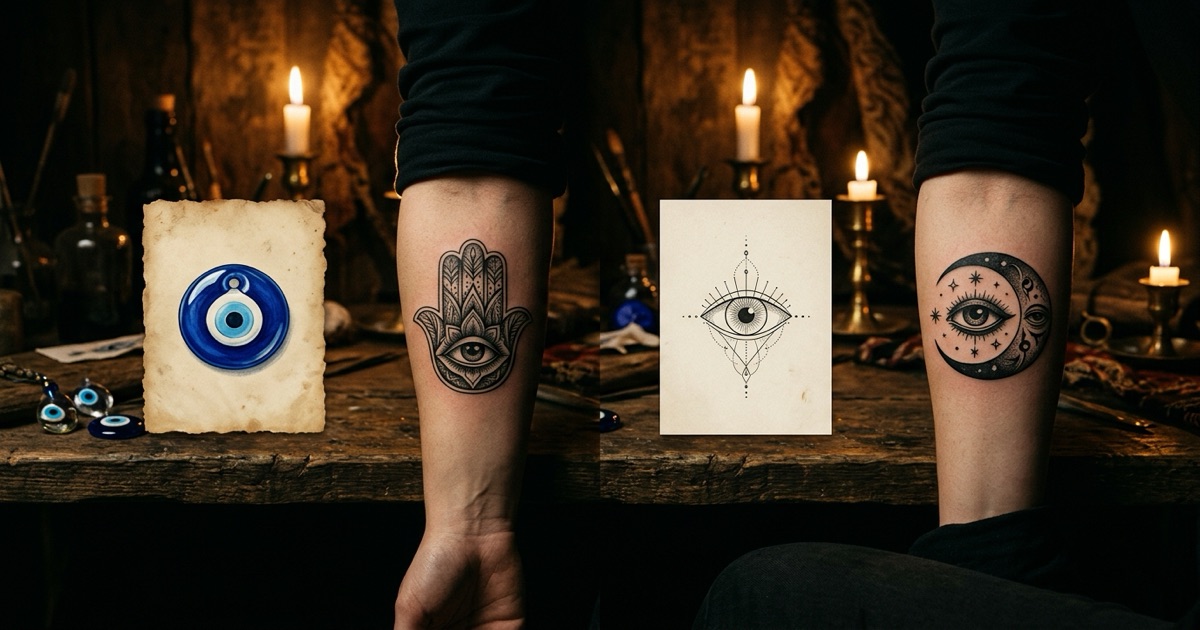
The hamsa — an open hand with an eye set in the palm — combines two protections in one image. The hand blocks all negative energy and invites blessings; the eye deflects the specific envious gaze. Together they form a complete protective system, which is why the hamsa-with-eye is one of the most popular designs of all.
Eye with Lashes, Teardrop, or Flowers
Modern designs often add elements that personalize the meaning. Lashes soften the eye into something watchful but gentle. A teardrop can mark protection carried through grief. Flowers, snakes, or moons weave the eye into a larger personal story — but the protective core remains the same.
The Eye with a Snake, Moon, or Dagger
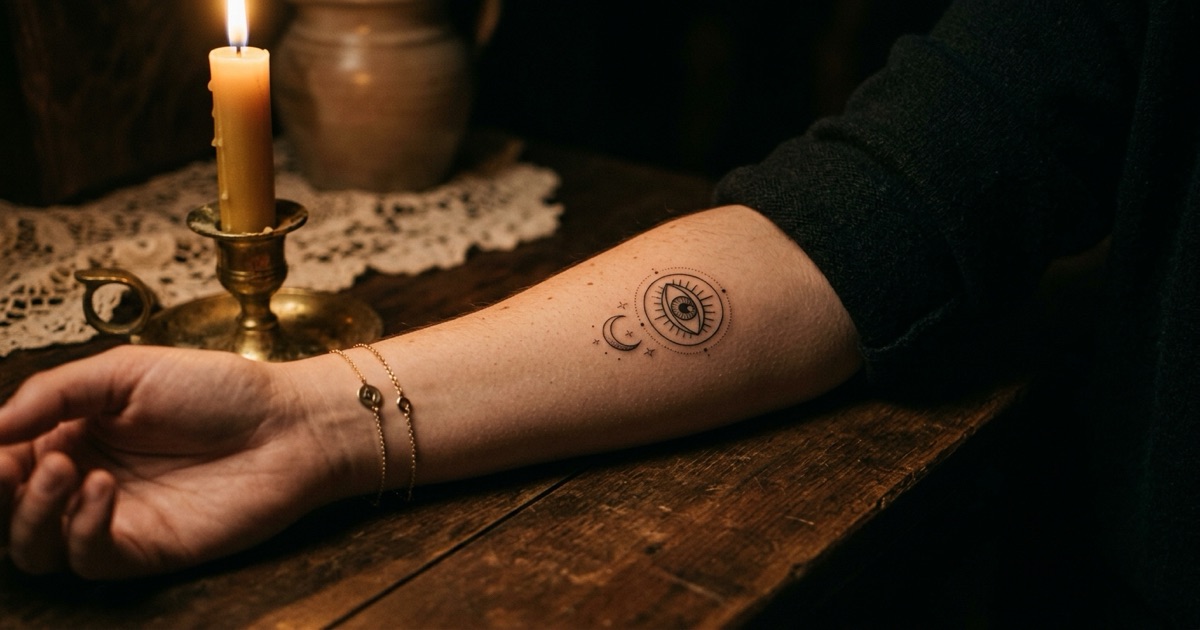
Pairing the eye with a second symbol layers the meaning. A snake coiled around the eye adds transformation and the shedding of enemies; a crescent moon ties the protection to intuition and the feminine; a dagger or sword beneath the eye turns passive warding into a warning — I see you, and I will act. These composites are popular precisely because they let the wearer state not only that they are protected, but how they intend to respond to a threat.
Minimalist and Geometric Eyes
Fine-line and geometric interpretations strip the eye to its essence — a single lash-lined almond, a triangle-framed iris, a dotwork mandala radiating from a central pupil. They read as modern jewelry rather than folk amulet, and they suit readers who want the protection without the traditional cobalt-and-white palette.
Matching and Memorial Evil Eyes
Because the eye is a symbol of watching over someone, it is a natural choice for matching tattoos between partners, siblings, or close friends — each carrying an eye that "watches" the other from afar. In the same spirit, an evil eye inked in memory of someone lost casts the departed as a permanent guardian, still keeping the envious gaze off the living.
Choosing Your Color
Color changes what your tattoo protects against, exactly as it does on a glass bead. Blue is by far the most common and means general protection and inner peace. The full spectrum is covered in the evil eye color meanings guide, but in brief:
- Blue — general protection, calm, karmic balance (the default)
- Turquoise — health and overall safety
- Black — absorbing severe negativity; power and wisdom
- Red — courage and strength against fear
Most fine-line and blackwork evil eye tattoos use black by necessity of the medium — which, conveniently, also carries the meaning of absorbing and neutralizing the heaviest negativity.
Marked for a reason? Begin the ritual →
Placement Meanings: Where to Wear It
Where you place the tattoo is as meaningful as the design. Placement decides whether your protection is visible or private, active or quiet.
| Placement | Meaning | Note |
|---|---|---|
| Hand / finger | Active, visible warding | The hand that gestures becomes a ward |
| Wrist | Everyday protection, always in view | Popular first tattoo |
| Forearm | Bold, declared protection | Room for detailed designs |
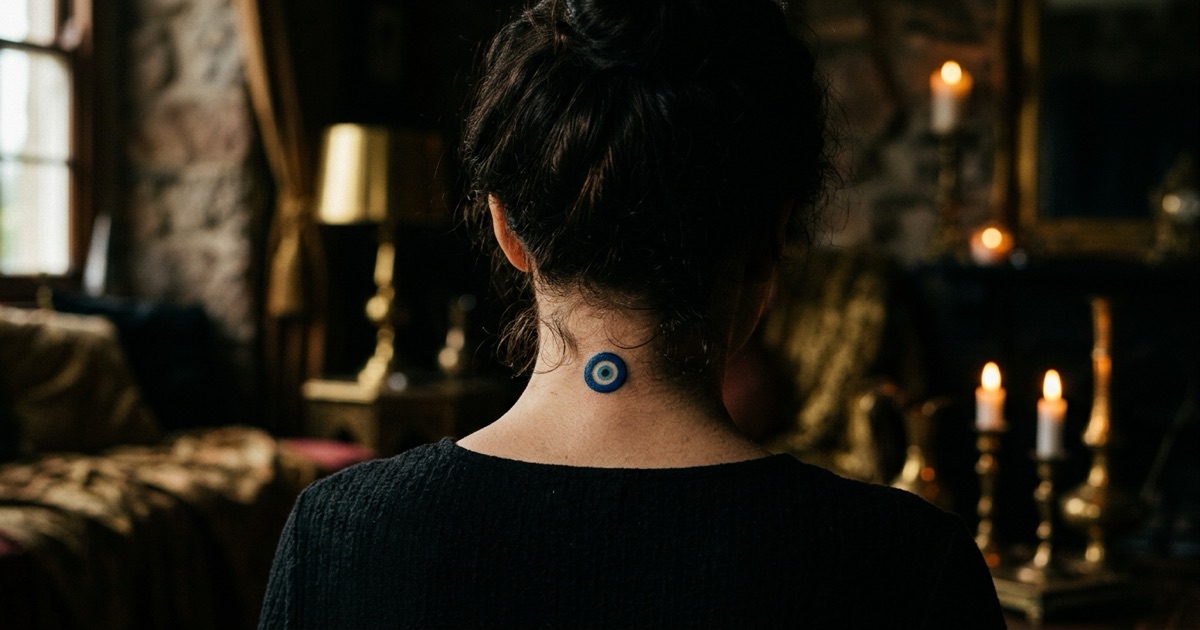
| Back of neck / nape | Guarding your blind spot | Watches what you cannot see |
| Behind the ear | Private, personal protection | Discreet, minimalist |
| Ankle | Grounded protection, low-key | Easy to conceal |
| Chest / sternum | Guarding the heart | Emotional protection |
| Spine | Protecting the whole body's core | Larger, ornamental pieces |
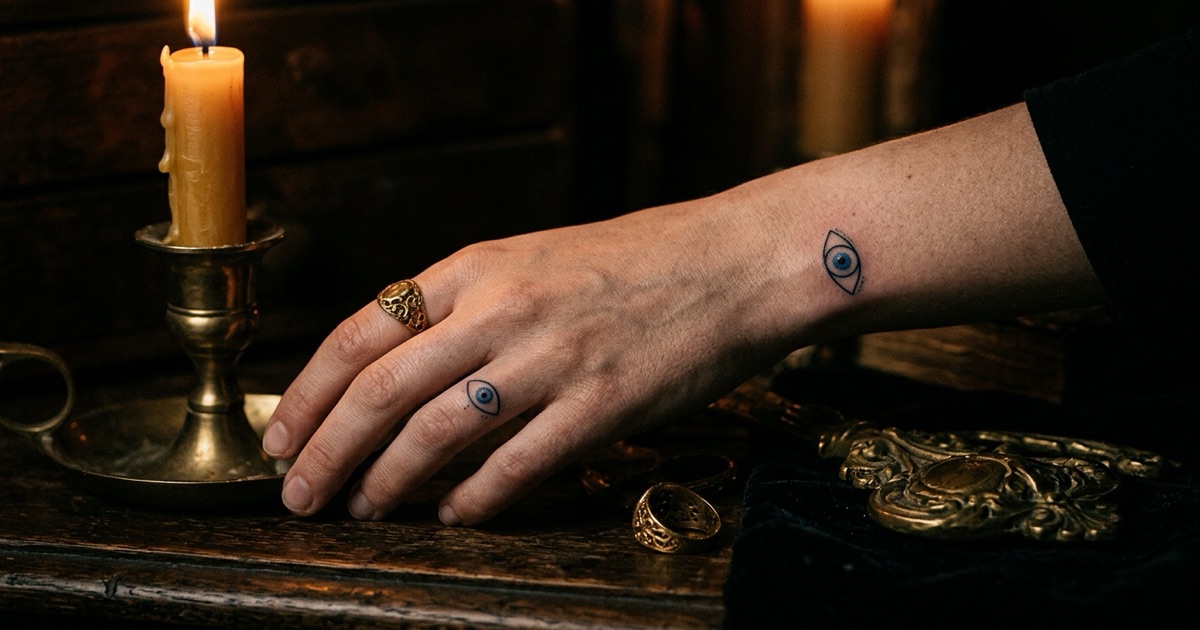
Two placements carry especially rich meaning. The hand or finger doubles the symbolism: in cultures that throw a protective hand gesture at an envious look, marking the hand turns it into a permanent ward — the eye watches outward while the hand itself repels. The back of the neck guards your blind spot: an eye placed where you cannot see watches the direction from which envy most often arrives unnoticed.
Is an Evil Eye Tattoo Bad Luck?
It is the question most people arrive with, and the honest answer is that it depends on who you ask. The overwhelming consensus is that an evil eye tattoo is a protective, good-luck symbol — that is the entire point of the eye. But two dissenting views exist and deserve a fair hearing.
The permanence concern. A small number of practitioners believe that because a traditional nazar is meant to break and be replaced once it absorbs an attack, tattooing it permanently could "trap" the absorbed negativity with no way to discard it — reversing the protection. This is a minority belief, not a widespread rule, but it is the most common objection you will encounter.
The religious view. In Islamic tradition, the evil eye (al-ayn) is affirmed as real, yet many scholars hold that tattooing itself is prohibited. For observant Muslims, the issue is not that an eye tattoo is unlucky — it is that tattoos of any kind are discouraged, so the protection is better carried as a bead, jewelry, or the recitation of protective duas.
The verdict. For most people, in most traditions, an evil eye tattoo is protective and auspicious. If the permanence concern troubles you, a bracelet or pendant that can be replaced when it breaks may suit you better — see the evil eye bracelet meaning guide. If it does not, the tattoo is a permanent guardian that can never be lost.
The Tattoo Across Cultures
How an evil eye tattoo is received depends heavily on where you stand. In Greece, Turkey, and much of the Mediterranean, the eye is such a familiar guardian that wearing it — in ink or in glass — reads as ordinary good sense rather than an exotic statement. In these cultures the tattoo is simply the amulet made permanent.
The Islamic position, noted above, is the more complex one — the evil eye is affirmed as real, yet tattooing is widely discouraged, so the protection tends to be carried in a form other than ink. Elsewhere, because the symbol appears independently across dozens of cultures, from the Levant to Latin America, no single group owns it — which is why an evil eye tattoo is generally not considered appropriation, provided it is worn with understanding rather than as borrowed decoration.
Before You Get Inked
Protection worn permanently deserves a moment of thought. Before you get inked:
- Name the threat. An amulet chosen with intent carries more weight than one chosen for aesthetics. Decide what — or who — you want protection from.
- Match color to purpose. Blue for general defense, black for heavy negativity, red for courage. Let meaning guide the palette, not just the design.
- Match size to placement. Fine detail needs a larger canvas to age well; keep finger and behind-the-ear pieces simple.
- Respect the source. The eye is a shared human symbol, but wearing it with understanding rather than as empty decoration is what makes it meaningful.
- Choose an experienced artist. The concentric rings of a clean nazar are harder to execute well than they look — find someone who has done them before.
- Plan to renew the intent. A tattoo cannot break and be replaced the way a bead can, so re-name what it guards against from time to time — or pair it with a replaceable bracelet that takes the hits.
Ideas by Intention
If you are still deciding, let your reason for the tattoo choose the design:
- General protection → a classic blue nazar, the safest and most traditional choice.
- A fresh start after a hard chapter → an eye with a lotus or a rising sun, marking protection carried into a new beginning.
- Guarding someone you love → matching eyes with a partner or child, or a memorial eye that keeps watch on their behalf.
- After a betrayal → an eye paired with a dagger or serpent, turning quiet warding into a stated warning.
- Discreet, everyday defense → a fine-line eye behind the ear or on the inner wrist, protection only you need to see.
The design is the vessel; the intention is what fills it. Choose the image that matches the reason you are marking your skin — and if that reason is a specific person who has wronged you, read on.
Ink vs Ritual: The Permanent Mark and the One-Time Strike
An evil eye tattoo is protection you commit to for life. It never comes off, never breaks, never needs replacing — but it also never moves. It is a guard that stands still. Some situations call for the opposite: a single, deliberate act aimed at one specific person.
That is what Da Siu Yan (打小人), or "villain hitting," offers. It is neither worn nor permanent — it is performed once. A paper likeness stands in for the enemy, is struck with a slipper, and burned away, settling the matter in a single sitting. The tattoo watches your back for decades; Da Siu Yan settles one score in an afternoon. When a mark on the skin no longer feels like enough, the ritual is the move it cannot make.
Ready to cast your curse?
Experience Hong Kong's heritage-listed curse ritual — 5 steps free, no signup required.
Cast a Curse Now →Evil Eye Tattoo Meaning: Summary
| Element | Choice | Meaning |
|---|---|---|
| Design | Classic nazar | General protection |
| Hamsa + eye | Total protection + blessings | |
| Color | Blue | Calm, karmic balance (default) |
| Black | Absorbing heavy negativity | |
| Red | Courage against fear | |
| Placement | Hand / finger | Active, visible warding |
| Behind ear | Private protection | |
| Nape of neck | Guarding the blind spot |
An evil eye tattoo is the intersection of art and amulet. Choose the design for meaning, the color for the threat, and the placement for how openly you want to be protected — and you carry a guardian that never leaves.
Name your enemy and begin the ritual →
Further Reading
- Evil Eye Meaning: The Complete Guide — The full history and symbolism behind the mark you are considering
- Evil Eye Symbols — The nazar, hamsa, and the lookalikes people confuse them with
- Evil Eye Color Meanings — Choosing the right color for your tattoo
- Evil Eye Protection — Amulets and rituals beyond the tattoo
- Evil Eye Bracelet Meaning — The replaceable amulet, if permanence gives you pause
- What Is Da Siu Yan — The Chinese ritual that strikes back at the source
Frequently Asked Questions
What does an evil eye tattoo mean?
An evil eye tattoo means protection worn permanently on the skin — a shield against envy, jealousy, and the harm of a malicious gaze. Beyond protection, the eye also symbolizes perception, intuition, and spiritual awareness. For most people who choose it, the tattoo is a permanent amulet: a mark that watches back at anyone who wishes them harm.
Is it bad luck to get an evil eye tattoo?
For the overwhelming majority of traditions, an evil eye tattoo is a protective, good-luck symbol, not bad luck. A minority belief holds that tattooing a protective symbol permanently can reverse its power, but this is far from universal. Whether you consider it bad luck ultimately comes down to your personal and cultural interpretation — the symbol itself is designed to protect.
Where is the best place to get an evil eye tattoo?
There is no single "best" placement — it depends on whether you want the protection visible or private. The wrist, hand, and finger keep the eye outward-facing and visible; behind the ear, the nape of the neck, and the ankle are more discreet. Smaller, minimalist designs suit the finger and behind the ear, while detailed designs need a larger area like the forearm or back.
What does an evil eye tattoo on the hand mean?
An evil eye tattoo on the hand or finger places the protection where it is most visible and most active — the hand that gestures, greets, and points. In cultures that use protective hand gestures against the evil eye, marking the hand doubles the symbolism: the eye watches outward while the hand itself becomes a ward. It is a bold, openly protective placement.
What color should an evil eye tattoo be?
Blue is the traditional and most popular color for an evil eye tattoo — it carries the meaning of general protection and karmic balance, the same as the original nazar bead. Other colors shift the meaning: black for absorbing severe negativity and power, red for courage, turquoise for health and safety. Choose the color that matches the threat you most want to guard against.
Do evil eye tattoos actually protect you?
Within the tradition, the evil eye tattoo protects the same way any evil eye amulet does: by reflecting the envious gaze back at its source. The belief is that an eye worn openly meets and returns malice before it can settle. Whether it "works" is a matter of faith — but a tattoo carries one advantage over a bead: it can never be lost, removed, or left at home.
Is an evil eye tattoo cultural appropriation?
The evil eye is one of the most widely shared symbols on earth, appearing independently across dozens of cultures — Greek, Turkish, Jewish, Islamic, Italian, South Asian, and Latin American among them. Because no single culture owns it, it is generally not considered appropriation. The respectful approach is to understand its meaning and wear it with genuine protective intent rather than as empty decoration.
What is the difference between an evil eye and a hamsa tattoo?
An evil eye tattoo depicts the eye itself — a targeted shield that deflects the envious gaze. A hamsa tattoo depicts an open hand, often with an eye in the palm, and represents broader protection against all negativity plus blessings and good fortune. Many people combine them in a single tattoo, since the eye and the hand work together rather than in competition.
Does an evil eye tattoo need to be a specific size?
No — evil eye tattoos work at any size, from a tiny fine-line eye on a finger to a large ornamental piece on the back. The rule is practical, not spiritual: intricate designs with fine detail need a larger canvas to age well, while simple designs stay crisp even when small. Match the size to the placement and the level of detail you want.
Should Muslims get an evil eye tattoo?
This is a personal and religious question with no single answer. Islamic tradition affirms that the evil eye (al-ayn) is real, but many Islamic scholars also hold that tattooing itself is prohibited. Muslims who wish to carry the protection most often turn to the recitation of protective duas; some communities also use a nazar bead or jewelry, though scholars differ on amulets as well — and a tattoo, being permanent, sits differently with those who hold that tattooing itself is prohibited.