Evil Eye Bracelet Meaning: What Breaking and Wearing Means
Evil Eye Bracelet Meaning
The evil eye bracelet is a protective talisman worn to guard against the nazar — the curse of envy transmitted through a malevolent glance. It works by absorbing or deflecting the negative energy directed at you, sacrificing itself in the process if the attack is strong enough. Wearing one is an act of spiritual self-defense, not decoration.
An evil eye bracelet is the most personal form of the ancient apotropaic symbol. Unlike a wall hanging or a piece of home decor, a bracelet stays on your body — it is the shield you carry through every interaction, every crowded street, every room where someone might envy what you have. The purpose of an evil eye bracelet is simple: to intercept the glance before it reaches you.
The belief in the evil eye (nazar, mati, mal de ojo, ayin harsha, cheshm-e-zakhm) spans over 3,000 years and every culture around the Mediterranean, the Middle East, and South Asia. The earliest recorded references appear on Sumerian clay tablets from roughly 2500 BCE. Greek philosophers wrote about it. Roman emperors wore protective amulets against it. The evil eye bracelet is the modern descendant of those ancient protections — a tradition so persistent that it has survived the rise and fall of empires and emerged as a global phenomenon in the 21st century — see our full guide on evil eye meaning for the complete history.
This article covers what an evil eye bracelet actually is, which wrist to wear it on for maximum protection, what happens when it breaks, and the deeper evil eye jewelry meaning that extends beyond the bracelet form.
Key Takeaways:
- An evil eye bracelet protects by absorbing or deflecting envious energy before it reaches you — when it breaks, tradition says it sacrificed itself to absorb a curse
- The left wrist draws protection inward (closer to the heart); the right wrist projects protection outward as you engage with the world — choose based on your intent, not fashion
- Evil eye jewelry extends far beyond bracelets — necklaces, earrings, anklets, and rings all carry the same protective function with different symbolic emphases
What Is an Evil Eye Bracelet and How Does It Work?
An evil eye bracelet is a wearable talisman designed to protect the wearer from the nazar — the supernatural harm caused by envious stares. The mechanism is straightforward in folk tradition: the bracelet acts as a decoy. When someone directs envious or malicious energy toward you, the bracelet intercepts it, absorbing the impact so you do not have to.
The classic evil eye bracelet meaning centers on this absorption principle. The bracelet is not a barrier that deflects all negativity — it is a shield that takes the hit for you. This is why, across Greek, Turkish, Italian, and Middle Eastern traditions, a broken evil eye bracelet is never treated as an accident. It is interpreted as evidence that the bracelet did its job.
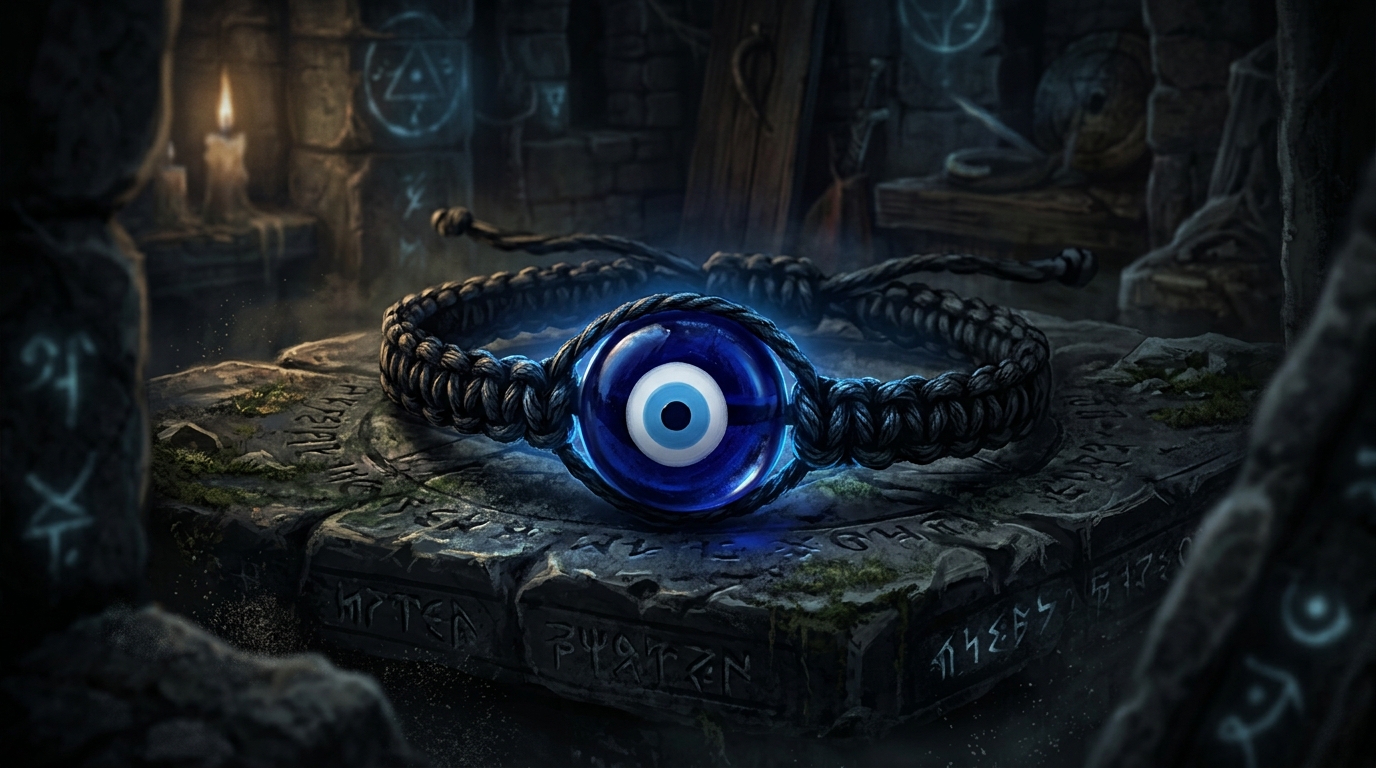
The most recognizable form is the nazar boncuğu bead — a round blue-and-white glass disc with concentric circles representing an eye. When strung on a bracelet, the bead keeps constant watch, scanning for envious glances directed at the wearer. Other designs use the Hamsa hand (khamsa), a single eye motif, or abstract protective symbols — the full family of evil eye symbols decodes each one. Each is a variation on the same principle: something is watching over you.
The purpose of an evil eye bracelet extends beyond passive protection. It also signals to others, consciously or unconsciously, that you are protected. In cultures where the evil eye is a living belief — Greece, Turkey, Israel, India, Pakistan, the Arab world — wearing a nazar bracelet communicates that you are not an easy target. The bracelet is both armor and warning.
Which Wrist to Wear an Evil Eye Bracelet
One of the most common questions about evil eye bracelet meaning is the wrist question. Which hand offers the strongest protection? The answer depends on the tradition — and on your intent.
Left Wrist — Receiving Protection
The left wrist is the traditional choice for evil eye bracelet placement in most Mediterranean and Middle Eastern cultures. The reasoning is consistent across traditions: the left side of the body is the receiving side — closer to the heart, the seat of the soul in several belief systems.
Wearing the bracelet on your left wrist means you are receiving protection. The bracelet guards you from incoming envy, absorbing the glance before it reaches your heart. This is the passive, defensive position — the bracelet stays between you and the world, filtering the energy that comes toward you.
In kabbalistic (Jewish mystical) tradition, the red string worn on the left wrist follows the same logic: the left side is the receiving side, associated with the sephirah of gevurah (judgment) — the string is tied there to intercept harsh energy before it enters.
Right Wrist — Projecting Protection
The right wrist is less common in tradition but equally valid depending on your intent. The right hand is the giving hand, the active hand, the hand that greets, touches, and interacts with the world. Wearing an evil eye bracelet on the right wrist positions it as an active protector — one that projects protective energy outward as you engage with your environment.
This placement suits people who face public-facing situations: customer service workers, performers, public speakers, salespeople — anyone whose day involves exchanging energy with strangers who may envy what they have or express hostility without cause. The bracelet on the right wrist protects you during the interaction rather than waiting for the glance to reach you.
Which Wrist Should You Wear It On?
| Placement | Meaning | Best For |
|---|---|---|
| Left wrist | Receiving protection — draws protective energy inward | General daily protection, spiritual sensitivity, emotional work |
| Right wrist | Projecting protection — guards you during active engagement | Public-facing work, high-conflict environments, competitive situations |
| Both wrists | Double protection — receives and projects simultaneously | Active magical practitioners, people recovering from a curse or hex |
There is no wrong answer. The bracelet works because you believe it works. Choose the wrist that aligns with your daily needs. If you spend your day receiving energy from others (left wrist). If you spend your day projecting energy outward (right wrist). If you are uncertain, the left wrist is the safer traditional choice.
What Happens When an Evil Eye Bracelet Breaks
This is the most misunderstood aspect of evil eye bracelet meaning — and the most important to get right.
In folk tradition across every culture that uses evil eye jewelry, a broken bracelet is never a coincidence. It is not a manufacturing defect. It is not wear and tear. It is the bracelet sacrificing itself to absorb a concentrated burst of envy or a curse aimed at you.
The evil eye bracelet breaking meaning is a service record. The bracelet did exactly what it was supposed to do — it took the hit so you did not have to. The sudden snap of a cord, the crack across a glass nazar bead, or a knot that inexplicably comes undone — these are interpreted as the moment the bracelet intercepted a genuine attack.
What to Do When Your Evil Eye Bracelet Breaks
The protocol is consistent across traditions:
-
Do not ignore it. A broken bracelet that you continue wearing is no longer protective. It may even be dangerous — some traditions say a cracked bead can leak the negative energy it absorbed.
-
Thank the bracelet. Acknowledge that it fulfilled its purpose. Speak aloud or silently — the gratitude is for the service, not the object.
-
Dispose of it properly. Never throw an evil eye bracelet in the trash. Bury it in earth, throw it into running water (a river or the sea), or burn it if the material allows. The disposal releases the absorbed energy.
-
Replace it immediately. Do not go unprotected. The attack that broke the first bracelet may be followed by another. Wear a new bracelet as soon as possible.
This belief is why people who wear evil eye bracelets often buy them in pairs or threes. When one breaks, they have a replacement ready. It is not superstition in the pejorative sense — it is practical readiness. The bracelet is a consumable protective item, not a permanent accessory — for protection that never needs replacing, some choose a permanent evil eye tattoo instead.
A broken evil eye bracelet is not bad luck. It is evidence that the bracelet saved you from bad luck. The bad luck would have reached you if the bracelet had not been there.

Evil Eye Bracelet Meaning for Men
The evil eye bracelet has no gender, but the designs men prefer differ from the multicolored charm styles marketed to women — and this has created a misconception that the evil eye is a feminine symbol. It is not. Greek fishermen, Turkish taxi drivers, Italian businessmen, and Israeli soldiers all wear evil eye protection. The purpose of an evil eye bracelet applies equally to everyone.
Male-oriented evil eye bracelet designs typically follow three patterns:
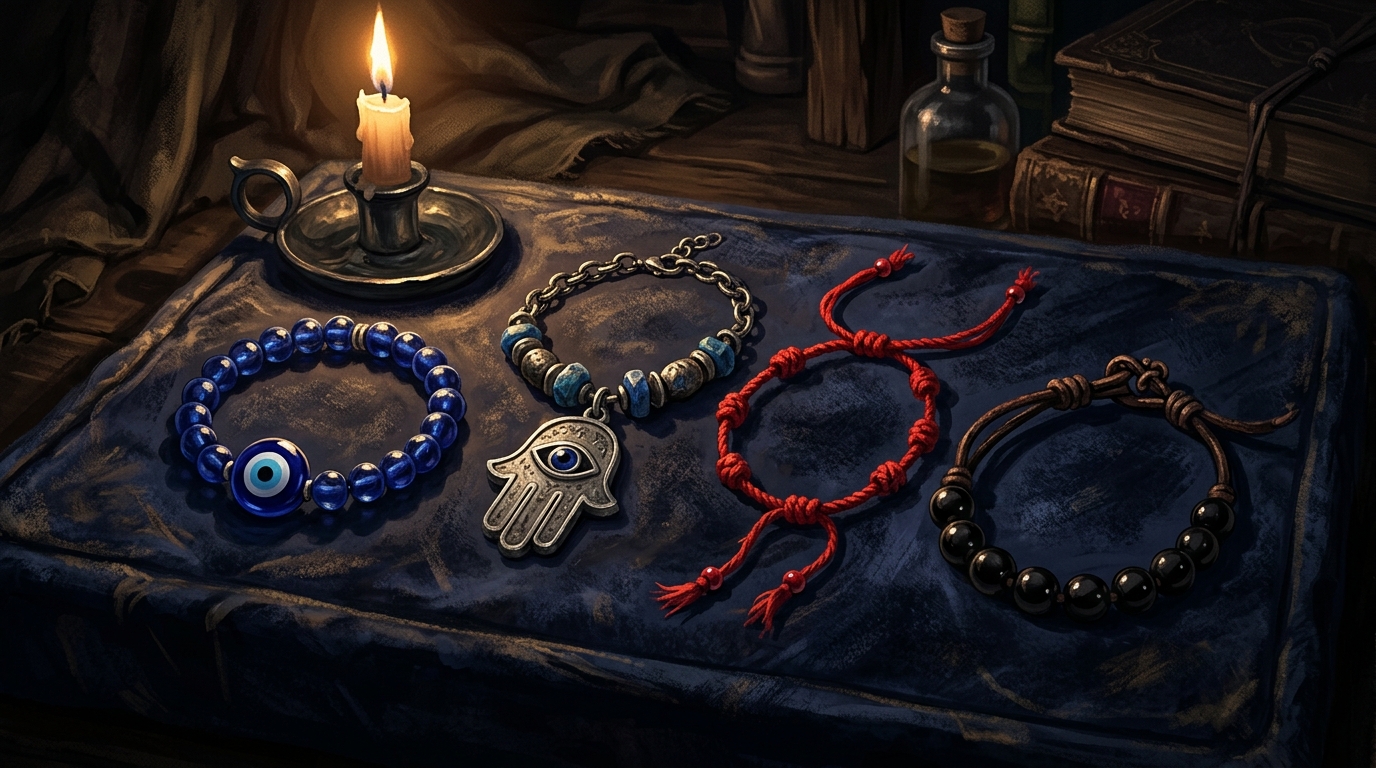
- Single bead on leather cord — a single large nazar bead (blue glass or black obsidian) threaded on a simple black or brown leather cord. Minimalist, rugged, and clearly protective rather than decorative.
- Beaded strand in dark tones — a series of small evil eye beads in dark blue, black, or grey tones, sometimes alternating with hematite or lava stone beads. Masculine by color palette, the protective function unchanged.
- Metal talisman — a silver or gold pendant bead engraved with an eye motif or the Hamsa hand, worn on a metal chain bracelet or leather wrap. More expensive, more discreet, but carrying the same meaning.
The evil eye bracelet meaning for men is identical to its meaning for anyone else: protection against envy. The only difference is presentation. In Greece, it is common to see men wearing a single blue bead on a string around the wrist or tucked into a pocket. In Turkey, men wear nazar beads on keychains, in cars, and on bracelets without stigma. The evil eye does not discriminate by gender, and neither should the protection.
Evil Eye Bracelet for Children
In Mediterranean and Middle Eastern cultures, infants and young children are considered especially vulnerable to the evil eye. Babies attract admiration — and admiration, in evil eye belief, is the most dangerous form of attention because it is unintentional. A well-meaning compliment from a stranger can deliver the nazar as effectively as deliberate malice.
The traditional response is a protective talisman pinned to the child's clothing or worn as a bracelet. An evil eye bracelet for a baby or toddler typically uses:
- A single small nazar bead on a soft cord or string
- A safety pin with a nazar bead attached to the inside of the clothing
- A red-and-white cotton string (the kabbalistic red string variant) tied around the wrist
The placement matters. Young children's evil eye bracelets are usually pinned to the shoulder, the back of the shirt, or the inside of the collar rather than worn openly on the wrist — this prevents the child from pulling it off, chewing it, or losing it (and prevents choking hazards from small beads).
In Turkish tradition, a mother will pin a nazar bead to her baby's clothing before leaving the house. In Greece, grandmothers tie a blue bead bracelet to the infant's wrist. In Italy, a corno (horn-shaped amulet) is often placed near the baby rather than worn directly. The emphasis is always on the same principle: the child has not yet learned to protect themselves, so the talisman must do it for them.
See our guide on evil eye colors meaning for more on choosing the right protection for children and vulnerable individuals against the nazar.

Evil Eye Jewelry Meaning: Beyond the Bracelet
Evil eye jewelry meaning extends across every form of wearable talisman. The bracelet is the most common, but necklaces, earrings, rings, and anklets each carry a slightly different protective emphasis. This section covers the broader landscape of evil eye jewelry meaning as it applies to each form.
Folk tradition does not assign strict rules to each form — the associations below reflect how modern wearers and practitioners commonly interpret them.
Evil Eye Necklace — The Visible Guardian
An evil eye necklace sits at the throat or chest — the center of communication and vulnerability in many traditions. The evil eye jewelry meaning for a necklace emphasizes protection of the voice, the heart, and the self as you present it to the world. Necklaces are more visible than bracelets, which means they serve the warning function more strongly: the double meaning of "I am protected" and "do not test that protection."
Evil Eye Earrings — Guarding the Senses
Earrings protect the ears and the mind — the channels through which words enter and affect you. In evil eye jewelry meaning, earrings are less about general protection and more about guarding against the specific harm of slander, gossip, and spoken curses. The belief is that malicious words enter through the ears as effectively as envious glances enter through the eyes.
Evil Eye Ring — Concentrated Intent
Rings carry emphasis and focus. An evil eye ring worn on the index finger directs protective energy outward — it is the pointing form, the active ward. Worn on the middle finger, it grounds and stabilizes. Worn on the dominant hand, it projects. Worn on the receiving hand, it draws in protection. Rings are the most intentional form of evil eye jewelry because the hand is the most deliberate part of the body.
Evil Eye Anklet — Grounded Protection
Anklets are the least common form but carry a distinct evil eye jewelry meaning: they protect the connection between you and the earth. In some South Asian interpretations, wearing an anklet with an eye motif or protective beads grounds spiritual energy while warding off envy directed at your stability, home, or foundation. Anklets are discreet — worn under clothing, they protect without announcing themselves.
Evil Eye Jewelry Comparison
| Form | Placement | Protective Focus | Visibility |
|---|---|---|---|
| Bracelet | Wrist | General protection, daily wear | Moderate |
| Necklace | Throat/chest | Voice, heart, self-presentation | High |
| Earrings | Ears | Slander, gossip, verbal attacks | High |
| Ring | Finger | Active intent, focused warding | Moderate |
| Anklet | Ankle | Grounding, home, stability | Low (discreet) |
Evil Eye Bracelet Materials: Does the Material Matter?
Not all evil eye bracelets are created equal — and in folk tradition, the material matters as much as the symbol itself.
Glass Nazar Bead — The Original
The classic blue glass nazar boncuğu is the gold standard of evil eye bracelet protection. Glass has a specific significance in evil eye belief: it can shatter on impact. When a glass bead breaks, it has visibly and undeniably sacrificed itself. There is no ambiguity. Glass is the preferred material because its fragility is proof of its function.
Silver and Gold — Precious Protection
Silver and gold evil eye bracelets carry an additional layer of meaning: the metal itself is protective in several traditions. Silver is associated with the moon, purity, and the defense against spiritual attack in Islamic and Christian folk practice. Gold represents the sun, authority, and the active projection of power. A precious metal bracelet combines the protective function of the evil eye with the natural warding properties of the metal.
String and Cord — The Simple Guardian
A simple knotted string — red, black, or white — is the most ancient form of the protective bracelet. The kabbalistic red string is the most famous example: a thin red wool string tied around the left wrist with seven knots, each representing a different protective blessing. In Greek and Cypriot tradition, a white string with a single blue bead is tied on by an elder or a spiritual authority figure. The simplicity of the cord emphasizes the intention rather than the object — the power is in the tying and the blessing, not the material.
Does the Material Change the Meaning?
The purpose of an evil eye bracelet remains the same regardless of material: protection against envy. But the material affects how the protection works:
- Glass — sacrificial, visibly breaks when it absorbs an attack
- Metal — durable, reflects negative energy rather than absorbing it
- String — intentional, requires activation through tying and blessing
- Stone (obsidian, onyx, turquoise) — combines natural stone properties with eye protection
Choose the material that matches your lifestyle and your belief. A glass bead bracelet is traditional but fragile. A silver bracelet is permanent but expensive. A knotted string is authentic but not durable. There is no wrong choice — the bracelet's power comes from your belief in it, not from the material it is made of.
How to Bless and Activate an Evil Eye Bracelet
An evil eye bracelet is not automatically protective the moment you put it on. In folk tradition across all cultures, the bracelet must be activated — charged with protective intention before it can function. The activation ritual is what transforms a piece of jewelry into a working talisman.
The activation process is simple and follows the same structure across traditions:
-
Cleanse the bracelet. Pass it through incense smoke, hold it under running water, or leave it in moonlight overnight. This removes any residual energy it absorbed during manufacturing, shipping, and handling.
-
State your intention aloud. Hold the bracelet in your receiving hand (usually the left) and speak the protection you seek. "This bracelet guards me against envy, malice, and the evil eye. It absorbs what is meant to harm me and breaks before I break."
-
Tie the bracelet on. If it is a knotted cord bracelet, have someone who wishes you well tie it on your wrist. The act of tying seals the protection. If you are alone, tie it yourself with focused intention.
-
Wear it continuously. The bracelet's protective power accumulates with wear. Taking it off at night breaks the connection — in many traditions, the bracelet should only be removed when it has broken or when it is being ritually replaced.
Some traditions say an evil eye bracelet gifted by someone who genuinely loves and protects you is stronger than one you buy for yourself. The giver's protective intention charges the bracelet before you even wear it.
The bracelet defends. But sometimes defense is not enough. If someone has already wounded you with their envy — if the damage is done and the bracelet alone cannot undo it — the Chinese Da Siu Yan tradition offers a more direct response. Cast a curse against the envious →
For a comprehensive guide to evil eye warding practices across different traditions, see our article on evil eye colors meaning — each color carries a specific protective function.
Evil Eye Bracelet Meaning: Summary
| Aspect | Meaning |
|---|---|
| Primary function | Absorbs or deflects the nazar — envious glances and malicious attention |
| Left wrist | Receives protection inward, closer to the heart |
| Right wrist | Projects protection outward during active engagement |
| Breaking | Evidence that the bracelet sacrificed itself to absorb an attack |
| For men | Same protection, masculine designs (single bead, leather, dark metal) |
| For children | Especially vulnerable — pinned to clothing, worn as soft bracelet |
| Jewelry forms | Bracelets (general), necklaces (voice/heart), earrings (slander), rings (focused), anklets (grounding) |
| Materials | Glass (sacrificial), metal (reflective), string (intentional), stone (combined properties) |
| Activation | Required — cleansing, intention-speaking, and sealing transform jewelry into talisman |
Ready to cast your curse?
Experience Hong Kong's heritage-listed curse ritual — 5 steps free, no signup required.
Cast a Curse Now →Further Reading
- Evil Eye Meaning — The complete guide to the nazar: history, beliefs, and protection methods across cultures
- Evil Eye Colors Meaning — What each color of evil eye represents and which one you need
- How to Remove a Curse — If the evil eye has already reached you, here is how to break its hold
- What Is Da Siu Yan — The Chinese answer to the evil eye: a heritage-listed curse-breaking ritual
- How to Get Rid of Bad Luck — Cleansing rituals that address the aftermath of envy and spiritual attack
- What Is Black Magic — Understanding the darker traditions that the evil eye bracelet guards against
Frequently Asked Questions
What does wearing an evil eye bracelet mean?
Wearing an evil eye bracelet means you are actively protecting yourself against the nazar — the curse of envious glances. The bracelet acts as a guardian, absorbing or deflecting the malevolent energy directed at you by jealous people. In Mediterranean, Middle Eastern, and South Asian traditions, it is one of the most common protective talismans worn daily.
Which wrist should you wear an evil eye bracelet on?
The left wrist is for receiving protection — it is closer to the heart and draws protective energy inward. The right wrist is for projecting protection outward as you interact with the world. Tradition says the receiving hand (left, the hand that receives offerings in many cultures) is the stronger choice for personal protection, but both wrists work depending on your intent.
What happens when an evil eye bracelet breaks?
When an evil eye bracelet breaks, tradition holds that it has absorbed a curse or a concentrated burst of envy aimed at you. The bracelet sacrificed itself to protect you. You should thank it, bury it respectfully, and replace it immediately. Wearing a broken evil eye bracelet is considered dangerous — it can no longer protect you and may leak the negative energy it absorbed.
What does a black evil eye bracelet mean?
A black evil eye bracelet represents power, protection, and the absorption of dense negative energy. Black is the color of spiritual authority in several traditions — it guards against severe curses rather than casual envy. Black evil eye bracelets are popular among those who face direct magical attacks or work in high-conflict environments.
What does a blue evil eye bracelet mean?
A blue evil eye bracelet is the most traditional form — deep blue represents the original nazar bead color from ancient Mediterranean cultures. Blue is believed to be the most effective color for deflecting the evil eye because it mirrors the sky and the divine gaze. Light blue promotes peace and general protection, while dark blue offers stronger warding against deliberate malice.
What does a red evil eye bracelet mean?
A red evil eye bracelet combines the protective function of the nazar with the energetic properties of red — courage, vitality, and determination. Red is worn when you need active defense rather than passive protection: during conflict, competitive situations, or when facing a specific threat. In kabbalistic tradition, a red string is tied around the left wrist for protection.
What do the colors of evil eye bracelets mean?
Each color of an evil eye bracelet carries a distinct protective meaning: dark blue wards fate and karma, light blue offers general protection, red provides courage and active defense, green attracts luck and success, black absorbs severe negative energy, white promotes purity and clarity, yellow boosts creativity and confidence, pink nurtures emotional protection and self-love. The blue nazar bead is the universal classic, but any color works when worn with intention.
Can men wear evil eye bracelets?
Yes — evil eye bracelets for men are common across Mediterranean and Middle Eastern cultures. Masculine designs typically feature single large beads, dark colored cords, or matte metals rather than the multicolored charm styles popular with women. Greek and Turkish men commonly wear a single blue nazar bead on a leather cord. There is no gender restriction — the evil eye affects everyone.
Is it okay to gift an evil eye bracelet?
Yes — giving an evil eye bracelet as a gift is considered especially powerful because it means someone else is actively wishing for your protection. In Mediterranean tradition, a bracelet gifted by someone who genuinely cares about you carries stronger protective energy than one you buy for yourself. The key is the sincerity of the giver's intention, not the bracelet's monetary value.
Do evil eye bracelets really work?
Whether an evil eye bracelet works depends on your belief system. In folk tradition across Greece, Turkey, Italy, the Middle East, and South Asia, the bracelet is considered genuinely effective at deflecting the nazar — and these cultures have tested the belief for over 3,000 years. Psychologically, a protective symbol may simply make you feel safer — and feeling safer can change how you carry yourself.
Related Curses
Evil Eye Traditions: Greek Mati to Mexican Mal de Ojo
Evil eye traditions around the world — the Greek mati, Turkish nazar, Italian malocchio, Jewish ayin hara, and Mexican m...
15 min readEvil Eye Tattoo Meaning: Designs, Placement & Protection
Evil eye tattoo meaning explained — what the design symbolizes, the meaning behind each placement, whether it's bad luck...
13 min readEvil Eye Symbols: The Nazar, Hamsa & Their Lookalikes
Evil eye symbols explained — the nazar, hamsa, and cornicello, and how they differ from lookalikes like the Eye of Horus...
14 min read