Evil Eye Meaning: History, Symbolism, and Complete Guide
What Is the Evil Eye?
The evil eye is a supernatural belief spanning 5,000 years and dozens of cultures — the conviction that a person can cause harm to another simply through a look of envy. The evil eye meaning shifts across cultures, but the core remains the same: a malicious glare, fueled by jealousy, transmits misfortune, illness, or loss to its target.
The evil eye meaning has haunted human civilization since the ancient world. It is not a myth that died with the Greeks or a superstition confined to rural villages. It is a living belief — practiced, feared, and warded against across the Mediterranean, the Middle East, North Africa, South Asia, and Latin America. Every culture that believes in it also builds defenses against it. That universal response tells you something about the depth of the fear.
This is the complete guide. Where the belief came from. What it actually means. The amulets designed to fight it. The rituals that break its hold. And how the fear of the envious gaze connects to one of the most direct curse traditions still practiced today — the Chinese Da Siu Yan ritual.
Key Takeaways:
- The evil eye is not a curse you cast — it is harm transmitted through envy, often unintentionally, and the belief spans every culture around the Mediterranean and across the Middle East
- Protective symbols like the nazar (blue eye bead) and the hamsa hand work by deflecting the envious gaze — they are shields, not cures
- The Chinese Da Siu Yan tradition offers a different approach to the same problem: instead of warding off envy, it strikes back against the envious person directly — try the ritual
The belief is simple: someone who envies you — your success, your health, your beauty, your child — can harm you through a single glance. The harm may be immediate — a sudden headache, a fainting spell — or it may unfold over days and weeks — illness, financial loss, relationship breakdown. The mechanism is envy. The delivery system is the eye.
This is not a metaphor. In the cultures where evil eye belief is strongest, people do not say "I feel like someone cursed me" as a figure of speech. They mean it literally. They know who looked at them. They know when. They know the symptoms that followed. And they know what to do about it.

The Ancient Origins of the Evil Eye
The earliest documented references to the evil eye appear in ancient Mesopotamia, approximately 5,000 years ago. Sumerian texts describe the igi hul — the "evil eye" — as a force that could wither crops, sicken livestock, and kill children. The Assyrians and Babylonians inherited this belief and developed elaborate apotropaic rituals — ceremonies designed to avert the eye's power.
The evil eye appears in the written records of civilizations across the ancient Near East and Mediterranean. The ancient Egyptians painted eyes on their boats to ward off envious glances. The Greeks wrote about it in the works of Plato and Plutarch. The Romans were so convinced of its power that they criminalised poisoning and harmful magic — the Lex Cornelia de sicariis et veneficis (81 BCE) — though the evil eye itself was feared rather than legislated, warded off with amulets instead of lawsuits.
The belief traveled along trade routes. From Mesopotamia to the Levant. From the Levant to Greece and Rome. From Greece and Rome across the Mediterranean to North Africa and Europe. Wherever humans traded goods, they also traded fears — and the fear of the evil eye was among the most durable exports in human history.
Mesopotamia: The First Written Records
The Sumerian word igi hul appears in cuneiform tablets dating to approximately 3000 BCE. These tablets describe rituals to counteract the evil eye — incantations recited by priests, amulets worn by the vulnerable, and offerings made to the gods to deflect envy. The Mesopotamians understood the evil eye as a spiritual force that operated independently of the person who possessed it — someone could give you the evil eye without knowing they had the power.
This is a crucial distinction. In Mesopotamian belief, the evil eye was not always intentional. It could be a property of the person — something they carried without wanting it, like a physical deformity or a spiritual defect. The harm came from their nature, not their will.
The Greco-Roman World: The Eye That Wounds
The Greeks called it baskania — a supernatural power that projected harmful energy through the eyes. The philosopher Plutarch devoted a full question of his Table Talk (Quaestiones Convivales 5.7) — the longest surviving ancient discussion of the evil eye — to explaining how it worked through what we would now call extramission theory: the human eye emits invisible rays, and when a person looks with intense envy, their eyes project a spiritual poison that enters the target through the air.
The Romans added intellectual weight instead of statutes. Pliny the Elder, citing earlier writers, records whole families and tribes believed able to bewitch and even kill with a prolonged, angry stare (Natural History 7.16–18) — and reports Cicero's remark that the glance of any woman with double pupils was harmful. Romans wore phallic amulets (fascinum) to protect against envious stares — the origin of the word "fascination," which originally meant "to be struck by the evil eye."
Evil Eye Meaning Across Cultures
The evil eye significance changes name and form across cultures, but the core meaning repeats with striking consistency. Every culture that believes in it also has amulets, rituals, and remedies to fight it.
| Culture | Name for Evil Eye | Meaning | Protection Method |
|---|---|---|---|
| Greek | μάτι (mati) | "Eye" — the gaze itself | Blue eye charm (mati), spit ritual (ftou ftou ftou), priest's blessing |
| Turkish | Nazar | "Sight" or "looking" | Nazar boncuk (blue eye bead) — the most recognized symbol worldwide |
| Italian | Malocchio | "Bad eye" | Horn-shaped amulet (cornicello), olive oil and water divination |
| Jewish | Ayin hara | "Evil eye" — Hebrew | Red thread, prayer, saying "bli ayin hara" (without the evil eye) |
| Arabic | عين الحسد (ayn al-hasad) | "Eye of envy" | Blue beads, Quranic verses (ayat al-kursi), burning rue (sadab) |
| Spanish | Mal de ojo | "Bad eye" | Red bracelet, prayer, egg cleansing ritual (limpia con huevo) |
| Persian | چشم زخم (cheshm zakhm) | "Eye wound" | Esfand (wild rue) burning, blue beads |
| Indian | نظر (nazar) / दृष्टि (drishti) | "Sight" / "gaze" | Black dot on child's face, lemon-and-chili charm, salt circling |
Every one of these cultures believes the same thing: envy is dangerous. The person who envies you does not need to perform a ritual. They do not need to be a witch or a sorcerer. They only need to look at you with jealousy — and the harm follows.
This universal belief — spanning continents, languages, and religions — suggests the evil eye addresses something fundamental about the human experience: the knowledge that others resent our good fortune, and that this resentment has consequences.

The Envy Mechanism: How the Evil Eye "Works"
What does the evil eye mean in practical terms? The mechanism, according to traditional belief, is elegant in its simplicity.
Envy is the fuel. The eye is the delivery system. When a person sees something they covet — a healthy baby, a beautiful woman, a prosperous man, a successful business — and their heart tightens with jealousy, the emotional intensity of that envy becomes a projectile. It exits through the eyes and strikes the target.
The Role of Compliments
In many evil eye traditions, giving a compliment is considered dangerous — particularly to children, pregnant women, and successful people. A compliment given without the protective phrase — "mashallah" in Arabic, "bli ayin hara" in Hebrew, "ftou ftou ftou" in Greek — carries the risk of transmitting the evil eye.
This creates a fascinating social dynamic. In cultures with strong evil eye belief, praising someone openly is a form of threat. The person receiving the compliment knows that the praise might attract envy. The person giving the compliment knows they must immediately say the protective words to neutralize their own admiration.
This is why you see grandmothers across the Mediterranean and Middle East murmuring protective phrases after every compliment. It is not superstition performed mechanically. It is a social ritual with a specific function — to remove the danger from admiration.
The Vulnerability of Infants
Across virtually every evil eye culture, infants are considered the most vulnerable targets. A baby is new, pure, and unprotected. A stranger's admiring glance — even a glance without hostile intent — can cause colic, sleeplessness, or illness.
The response is universal: newborns are given amulets immediately. Blue beads pinned to their clothing. Black kohl smeared behind their ears. Red bracelets on their wrists. The protection is applied before the baby leaves the house because the danger begins the moment the infant is seen by someone outside the family.
In Latin American mal de ojo tradition, babies who cry persistently without a medical cause are taken to a curandera for an egg cleansing — the limpia — which is believed to draw the harmful energy out of the child's body.
Unintentional vs. Intentional Evil Eye
One of the most misunderstood aspects of what is evil eye belief is the distinction between unintentional and intentional harm. In most traditions, the evil eye does not require the gazer to want to harm. Envy itself — even unconscious envy — is sufficient.
This means someone can give you the evil eye without knowing they have done it. A friend who admires your new promotion too intensely. A neighbor who compliments your child's beauty. A stranger who stares at your car in traffic. None of them means you harm. But their envy — even the mild, harmless kind — can still strike you.
This is why protective amulets are so widespread. You cannot control who envies you. You cannot read people's hearts to know who admires you too much. The only defense is to wear the shield at all times.
The Nazar: The Blue Eye That Fights Back
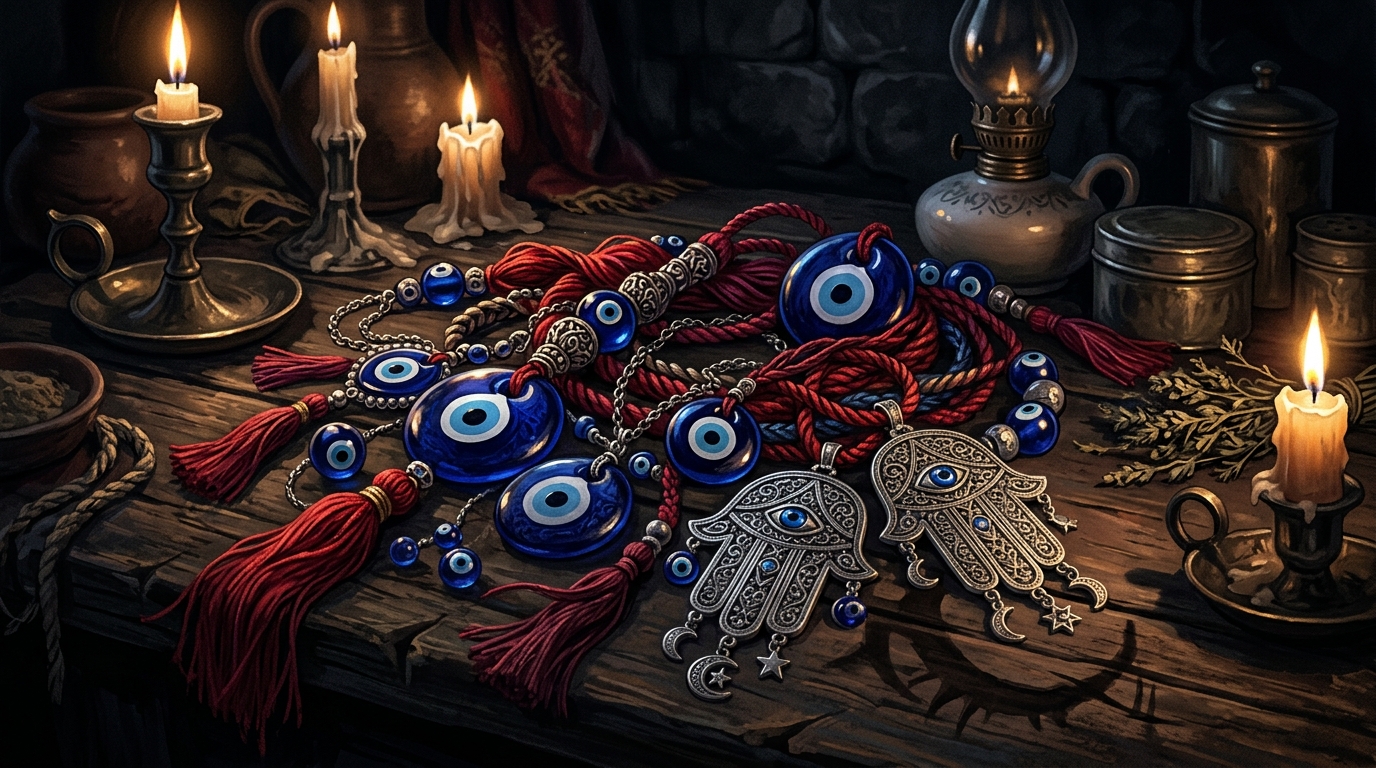
The nazar — the iconic blue-and-white glass bead with concentric circles representing an eye — is the most recognized evil eye amulet in the world. Its roots are in the eastern Mediterranean's ancient eye-amulet and glass-bead craft; the modern bead is still fired in the kilns of İzmir's bead villages, and it is now found everywhere from Turkish souvenir shops to global fashion runways.
But the nazar is not a decoration. Its purpose is specific and dark.
How the Nazar Works
The nazar operates on the principle of sympathetic deflection. The amulet is shaped like an eye because it is meant to look back. When an envious gaze falls upon a nazar, the amulet catches that gaze and returns it to the source — or absorbs it into the glass, where the harmful energy dissipates.
The blue color is not arbitrary. In ancient tradition, blue eyes were considered rare in the Middle East and Mediterranean, and the rarity made them suspect. People with blue eyes were sometimes believed to be natural carriers of the evil eye — their unusual gaze carried more power. The blue nazar, therefore, serves as a mirror: if blue eyes are the most dangerous, then a blue eye is also the most effective defense.
Traditional nazar beads are made from molten glass, hand-shaped, and cooled slowly to create the characteristic concentric pattern. Each layer has meaning: the dark center pupil represents the eye of truth; the blue rings represent the protective heavens; the white rim represents purity. When the bead cracks — which traditional believers say happens when it has absorbed too much envy — it must be replaced.
The Nazar in Modern Culture
The nazar has transcended its cultural origins. It appears on jewelry, home decor, keychains, car accessories, and clothing. In Turkey, the nazar boncuk hangs in nearly every home, business, and taxi — a cultural fixture so common that it functions almost as a national symbol.
This global spread has created tension between the amulet's protective function and its aesthetic appeal. When someone wears a nazar necklace without knowing its meaning, are they benefiting from its protection or reducing it to fashion? Traditional practitioners would say the protection works regardless of the wearer's knowledge — the nazar's power is in its form, not the wearer's belief. For a deeper understanding of how protective symbols relate to curse traditions, see our article on how to get rid of bad luck.
The Hamsa Hand and Other Symbols
The evil eye meaning cannot be fully understood without its most common companion symbol: the hamsa hand.
The Hamsa: A Hand Against the Eye
The hamsa — also called the Hand of Fatima in Islamic tradition and the Hand of Miriam in Jewish tradition — is an open right hand with an eye or palm pattern at its center. It predates both Judaism and Islam — the most commonly cited ancestor is ancient Carthage, where open-hand carvings appear on stone stelae dedicated to the goddess Tanit.
The hand represents protection, blessing, and strength. The five fingers are sometimes associated with the Five Pillars of Islam, the five books of the Torah, or simply the protective power of the human hand raised against danger. The eye in the palm gives the hamsa its specific function: the hand sees the evil eye coming and blocks it.
The hamsa and the nazar serve the same purpose through different forms. The nazar catches the gaze with its own eye. The hamsa blocks the gaze with an open hand. Both are shields. Neither is a cure — they prevent harm, they do not undo it after it has struck.
Other Protective Symbols
The evil eye has spawned more protective symbols than almost any other supernatural belief:
- The cornicello (Italian) — A small red horn-shaped amulet, often worn as a necklace. The horn represents fertility and strength, and its phallic shape is believed to repel the evil eye by offering a shocking or absurd target for envy.
- The red thread (Jewish/Latin American) — A thin red string tied around the wrist, often by a specific ritual. Associated with Rachel's tomb in Jewish tradition; also worn in Latin America as a general protective charm.
- Lemon and chili (Indian/Persian) — A lemon impaled with red chilies, hung in doorways or on vehicles. The sharpness of the chili and the sourness of the lemon are believed to "cut" the evil eye's effect.
- The black dot (Indian/Persian) — A small black mark (kohl) applied to an infant's cheek or behind the ear. The black color is believed to make the child less attractive to envious eyes — a deliberate imperfection to ward off admiration.
- Esfand (Persian) — Wild rue seeds tossed onto hot coals. The smoke is passed over the person being cleansed, and the cracking of the seeds absorbs the evil eye. The ritual ends when the smoke smells sweet — indicating the danger has passed.
For the complete catalog of evil eye symbols — the nazar, hamsa, cornicello, and how to tell the real ones apart from lookalikes like the Eye of Horus and the all-seeing Eye of Providence — see the evil eye symbols guide. For an exploration of how different curse and protection traditions compare globally, see our voodoo magic curses article.
Is the Evil Eye Good or Bad?
This is a central question — and one with a deceptive answer.
The evil eye itself is neither good nor bad. It is a mechanism. A force. Like fire, it is not virtuous or wicked — it simply burns. The morality lies in the intent behind the gaze, not in the gaze itself.
The question "is the evil eye good or bad" misses the point. The evil eye is not a person making a choice. It is a natural phenomenon, like gravity or disease. You do not ask whether a hurricane is good or bad. You ask whether you are in its path and whether you have shelter.
However, the belief in the evil eye produces both good and bad effects:
The protective side: Evil eye belief creates community practices that protect the vulnerable. Infants are watched more carefully. Compliments are offered with humility. The jealous are reminded that their envy has consequences. In this sense, the belief functions as a social regulator — keeping envy in check and encouraging generosity.
The harmful side: Fear of the evil eye can produce genuine anxiety and paranoia. In communities where the belief is strong, any misfortune can trigger suspicion of the neighbors, the in-laws, the jealous coworker. The nocebo effect is real — people who believe they have received the evil eye often develop genuine symptoms of stress, insomnia, and depression.
The honest answer: the evil eye is not good. It is not bad. It is a belief about how envy works — and like any powerful belief, its effects depend on how it is used.
Among the world's curse and protection traditions, the evil eye occupies a unique position: it is one of the few where the "curse" can be cast unintentionally. Compare this with the deliberate targeting of Chinese Da Siu Yan, where the practitioner must name their enemy and strike their effigy with focused intent. The evil eye is envy weaponized by accident. Da Siu Yan is justice weaponized by choice.
Evil Eye Beliefs by Culture
What is evil eye belief in practice? The same fear wears a different name in every culture — the Greek mati, the Turkish nazar, the Italian malocchio, the Jewish ayin hara, the Islamic al-ayn, and the Latin American mal de ojo — each with its own charm and its own ritual for driving the curse out.
| Culture | Name | Signature protection |
|---|---|---|
| Greek | Mati | The blue eye + the xematiasma prayer |
| Turkish | Nazar | The blue glass bead, trusted enough to pin even to new aircraft |
| Italian | Malocchio | The cornicello horn + the olive-oil diagnosis |
| Jewish | Ayin hara | The hamsa + the phrase bli ayin hara |
| Islamic | Al-ayn | The blessing Mashallah + Quranic ruqyah |
| Latin American | Mal de ojo | The curandero's egg cleanse |
The full country-by-country guide — how each tradition diagnoses the curse, removes it, and wards it off — lives in evil eye traditions around the world.

For those seeking a more direct approach to dealing with the people behind the envious gaze, consider the Da Siu Yan curse ritual — the Chinese tradition of striking back at petty persons who wish you harm.
The Da Siu Yan Connection: Evil Eye Meets Chinese Curse Tradition
The evil eye and the Chinese Da Siu Yan tradition approach the same problem from opposite directions.
The evil eye tradition is defensive. It assumes envy is inevitable and builds shields against it — amulets, prayers, rituals to deflect the gaze. The practitioner of evil eye protection is a guardian, someone who fortifies themselves and their loved ones against the envy of strangers.
Da Siu Yan — beating the petty person — is offensive. It identifies the envious person directly and strikes at them through a paper effigy, a slipper, and fire. The practitioner of Da Siu Yan is a hunter, someone who names their enemy and takes action against them.
Both traditions recognize the same truth: envy is dangerous. They diverge on what to do about it. The evil eye tradition says: protect yourself. Da Siu Yan says: destroy the threat at its source.
Which approach is right depends on the situation. If you do not know who envies you, the evil eye's protective amulets are your only option. If you know exactly who has wronged you — if you can name the petty person who covets what you have and wishes you harm — then the curse tradition of Da Siu Yan gives you a weapon.
This is the connection between two of humanity's oldest supernatural beliefs. They are siblings — different strategies for the same war. You can wear a nazar on your wrist while you strike a paper effigy with a shoe. The traditions are not contradictory. They are complementary.
For a broader framework on curse traditions and their methods, see our guide to black magic across world cultures. And if you know your enemy's name, experience the ritual directly.
The Evil Eye in the Modern World
The evil eye has not faded with modernization. If anything, it has become more visible.
Fashion and Commercialization
The nazar appears on necklaces, bracelets, earrings, phone cases, clothing, and home decor sold by global brands ranging from small Etsy shops to luxury fashion houses. The hamsa hand is a staple of bohemian jewelry. Celebrities wear evil eye charms on red carpets. The symbol has become a fashion statement — a "cool" accessory with mystical overtones.
This commercialization raises questions. When a symbol that has protected against supernatural harm for 5,000 years becomes a trend, does it lose its power? Traditional practitioners offer different answers. Some say the symbol's power is intrinsic — the eye shape works whether you believe in it or not. Others say wearing the nazar without understanding its meaning is empty — the protection requires intent.
The Cultural Appropriation Debate
Unlike many sacred symbols that have been appropriated by Western fashion, the nazar and hamsa have been traded across cultures for millennia. They appear in Phoenician, Carthaginian, Roman, Jewish, Christian, Muslim, and Hindu contexts. They belong to no single ethnic group. This cross-cultural history makes the appropriation question less clear-cut than it is for other sacred symbols.
The more significant issue is meaning erosion. When the nazar is worn worldwide as a fashion accessory without knowing it is meant to protect them from supernatural harm, the symbol's original function is diluted. Future generations may only see it as a pattern — a pretty design with no teeth.
The question to ask yourself: are you wearing the evil eye because it looks good, or are you wearing it because you understand what it means? The answer changes the relationship between you and the symbol.
What the Evil Eye Means Today
The evil eye meaning in the 21st century has expanded beyond its supernatural origins. For many people, the nazar or hamsa represents:
- Protection — Traditional belief, maintained across generations
- Cultural identity — A connection to Mediterranean, Middle Eastern, or South Asian heritage
- Spiritual awareness — An acknowledgment that envy is real and harmful
- Fashion — An aesthetic choice, sometimes without deeper meaning
- Solidarity — A statement against the "evil eye" of systemic forces
All of these meanings coexist. The belief has survived 5,000 years precisely because it is adaptable. It means different things to different people, but the core — envy is dangerous — remains remarkably stable.
For those who take the belief seriously, the modern world offers an abundance of protective options. Nazar beads are easier to find than ever. Hamsa pendants are available in any material. And for those who want to go beyond passive protection to active response, the digital Da Siu Yan ritual is available at any time. For understanding when a curse has taken hold, our guide on how to remove a curse covers the signs and methods.
Evil eye meaning is not a relic. It is a living belief, practiced by millions, reinterpreted by each generation. The envy that drives it has not disappeared. The methods of protection vary — a nazar bead or a paper effigy struck beneath a Hong Kong bridge. Both are valid. The nazar has guarded against the envious gaze for thousands of years; the effigy rite's own beginning, scholars concede, cannot be traced at all.
What if it works?
Ready to cast your curse?
Experience Hong Kong's heritage-listed curse ritual — 5 steps free, no signup required.
Cast a Curse Now →Further Reading
- Evil Eye Protection — Amulets, cleansing rituals, and how to tell if you've been struck
- Evil Eye Symbols — The nazar, hamsa, and the lookalikes people confuse them with
- Evil Eye Traditions Around the World — The mati, nazar, malocchio, and mal de ojo, culture by culture
- Evil Eye Color Meanings — What each shade of the nazar protects against
- Evil Eye Bracelet Meaning — Which wrist to wear it, and what it means when it breaks
- Evil Eye Tattoo Meaning — The symbols worn permanently in ink
- Duas for the Evil Eye — The Islamic prayers against al-ayn
- What Is Da Siu Yan — The Chinese tradition that strikes back at the petty person who wishes you harm
- How to Remove a Curse — Breaking curses when protection has failed and the harm has already struck
Frequently Asked Questions
What does the evil eye mean?
The evil eye is a supernatural belief found across Mediterranean, Middle Eastern, and North African cultures — the idea that a person can cause harm to another through a malicious glare fueled by envy. The victim may experience sudden misfortune, illness, or loss. It is neither good nor bad; the eye itself is neutral, but the intent behind the glance determines its effect.
Is the evil eye good or bad?
The evil eye is neither inherently good nor bad. It is a mechanism — envy directed at someone through a look. What matters is intent. Malicious envy causes harm. Protective symbols like the nazar and hamsa are designed to deflect this harm. The belief itself is neutral; the cultural response to it is protective.
How do you know if someone gave you the evil eye?
Traditional belief holds that the evil eye causes sudden, unexplained misfortune — a headache that appears from nowhere, a string of bad luck with no natural cause, fatigue that sleep cannot fix. Symptoms typically appear shortly after an encounter with someone who may have envied you, especially after receiving a compliment or experiencing a success that someone witnessed.
What does a nazar (evil eye amulet) mean?
The nazar — a blue-and-white glass bead shaped like an eye — is a protective amulet that originated in the Middle East and spread across the Mediterranean. It works by drawing the envious gaze toward itself, absorbing the harmful energy before it can reach the wearer. The blue color is traditionally associated with the evil eye itself, creating a mirror-like deflection.
What is the difference between the hamsa hand and the evil eye?
The evil eye is the threat — the harmful glare caused by envy. The hamsa hand is a protective symbol (an open right hand with an eye in the palm) used to ward off the evil eye. Think of the hamsa as a shield and the evil eye as the arrow. They are complementary — the hamsa exists because the evil eye is considered a real threat.
What cultures believe in the evil eye?
Evil eye belief spans dozens of cultures across the Mediterranean, Middle East, North Africa, South Asia, and Latin America. It is known as mati in Greece, malocchio in Italy, nazar in Turkey and the Arab world, ayin hara in Jewish tradition, and mal de ojo in Spanish-speaking cultures. Each tradition has its own rituals of protection and remedy.
How do you protect yourself from the evil eye?
Protection methods vary by culture but share common principles: wearing an amulet (nazar, hamsa), avoiding public displays of good fortune, spilling a drop of salt into fire, or reciting specific prayers. The Quran includes protective passages (Ayat al-Kursi and the Mu'awwidhat) used for nazar protection. In Greek tradition, the practitioner makes the sign of the cross while spitting — a ritual called ftou ftou ftou.
Is the evil eye in the Bible?
Yes — the evil eye appears in the Bible, though the meaning differs from modern folk belief. In Proverbs 28:22, "a man with an evil eye hastens after wealth." In the Gospels, Jesus uses the phrase "evil eye" to describe how darkness fills the body when the eye is unhealthy (Matthew 6:22-23). These references describe stinginess and moral corruption, not supernatural harm through a glare.
Is wearing an evil eye charm cultural appropriation?
The nazar and hamsa have been traded across Mediterranean and Middle Eastern cultures for thousands of years — they belong to no single ethnic group. Wearing one as a fashion accessory is generally not considered appropriation when done with basic awareness of the symbol's meaning. The more significant concern is reducing a 5,000-year-old belief to a decoration without understanding its protective function.
Can the evil eye cause death in traditional belief?
Yes — in many traditional cultures, the evil eye is believed capable of causing severe harm, including death, particularly in vulnerable people like infants. This belief is most intense in Mediterranean and South Asian traditions. The seriousness of the belief is why protective rituals and amulets are taken so seriously — this is not superstition about bad luck, but about genuine danger to life and health.
Related Curses
Evil Eye Traditions: Greek Mati to Mexican Mal de Ojo
Evil eye traditions around the world — the Greek mati, Turkish nazar, Italian malocchio, Jewish ayin hara, and Mexican m...
15 min readEvil Eye Tattoo Meaning: Designs, Placement & Protection
Evil eye tattoo meaning explained — what the design symbolizes, the meaning behind each placement, whether it's bad luck...
13 min readEvil Eye Symbols: The Nazar, Hamsa & Their Lookalikes
Evil eye symbols explained — the nazar, hamsa, and cornicello, and how they differ from lookalikes like the Eye of Horus...
14 min read