Breaking Generational Curses: End Bloodline Curse Patterns
Breaking Generational Curses
If patterns of suffering repeat across three generations of your family — the same kind of marriage failure, the same specific illness, the same financial collapse at the same age — you may be dealing with something far older and darker than coincidence. Breaking generational curses is the work of severing a hex or spiritual contamination that has attached itself to your bloodline, passing from parent to child like a disease written into your family's spiritual DNA.
A generational curse is distinct from ordinary bad luck or even a single curse cast against you. An ordinary curse targets one person for one reason. A generational curse targets your bloodline. It follows your family's children across continents, across generations, across decades of effort and therapy and fresh starts. It finds them anyway.
This article covers what a generational curse actually is, how to recognize its signature across your family tree, and the methods for breaking generational curses drawn from multiple traditions — Christian deliverance, African diaspora religions, Chinese folk ritual, and European folk magic. The methods differ, but the goal is the same: to end the pattern so your children's children do not inherit what you inherited.
Key Takeaways:
- Breaking generational curses requires first recognizing the pattern — the same specific misfortune repeating across three or more generations in unrelated family branches, not just coincidental bad luck
- Christian deliverance, African ancestral work, and Chinese Da Siu Yan all offer methods traditionally used against curses that pass through bloodlines, each addressing a different aspect of the family curse
- The sealing step after breaking is what determines whether the curse returns to the next generation — protection must be established for your children, not just yourself
What Is a Generational Curse?
Breaking generational curses starts with understanding what they are. A generational curse is a hex, spiritual contamination, or negative supernatural pattern that passes through bloodlines — from parent to child to grandchild — carrying the same specific misfortune across generations that may never meet each other.
A generational curse is not simply "family dysfunction" dressed in occult language. The psychological interpretation is valid — trauma patterns, attachment styles, and learned behaviors do pass through families — but the traditions that recognize generational curses treat them as something more: an active spiritual mechanism that continues to operate independently of psychology.
In African diaspora traditions, the curse is understood as a debt owed to a spiritual power that an ancestor failed to pay. In Christian deliverance theology, it is a legal right given to an enemy spirit through ancestral sin. In Chinese folk religion, it is a contamination of the family's fate — an ancestral grievance that the living inherited, whether they know its origin or not — a notion echoed in the Daoist doctrine of chengfu (承負, "inherited burden").
The key distinction is specificity. A vague sense that "my family is unlucky" is not necessarily a generational curse. But if your great-grandfather lost everything to gambling, your grandfather gambled away his business, your father bankrupted the family twice, and you feel the pull of the same compulsion — that is not coincidence. That is a pattern with a spiritual architecture.
Generational Curse vs. Ordinary Bad Luck
| Characteristic | Ordinary Bad Luck | Generational Curse |
|---|---|---|
| Duration | Temporary, resolves on its own | Persistent across generations |
| Scope | Affects one person in one period | Affects multiple family members across time |
| Pattern | Random, varied misfortune | Same specific misfortune repeating |
| Geography | Follows the individual | Follows the bloodline across continents |
| Response to effort | Improves with effort | Persists despite effort |
| Psychological cause | Often identifiable and treatable | Roots may predate living memory |
A streak of bad luck hits your career; you change jobs and it passes. A generational curse hits your career in exactly the same way at exactly the same age your father's and grandfather's careers collapsed — regardless of which industry you enter or how carefully you plan.
Signs You Are Dealing With a Generational Curse
Before you can begin breaking generational curses, you must confirm that you are in fact dealing with one. Not every family pattern is a curse. Some are psychological, some are cultural, some are simply statistical misfortune amplified by the human tendency to see patterns where none exist. But generational curses leave a distinct signature.
The Three-Generation Rule
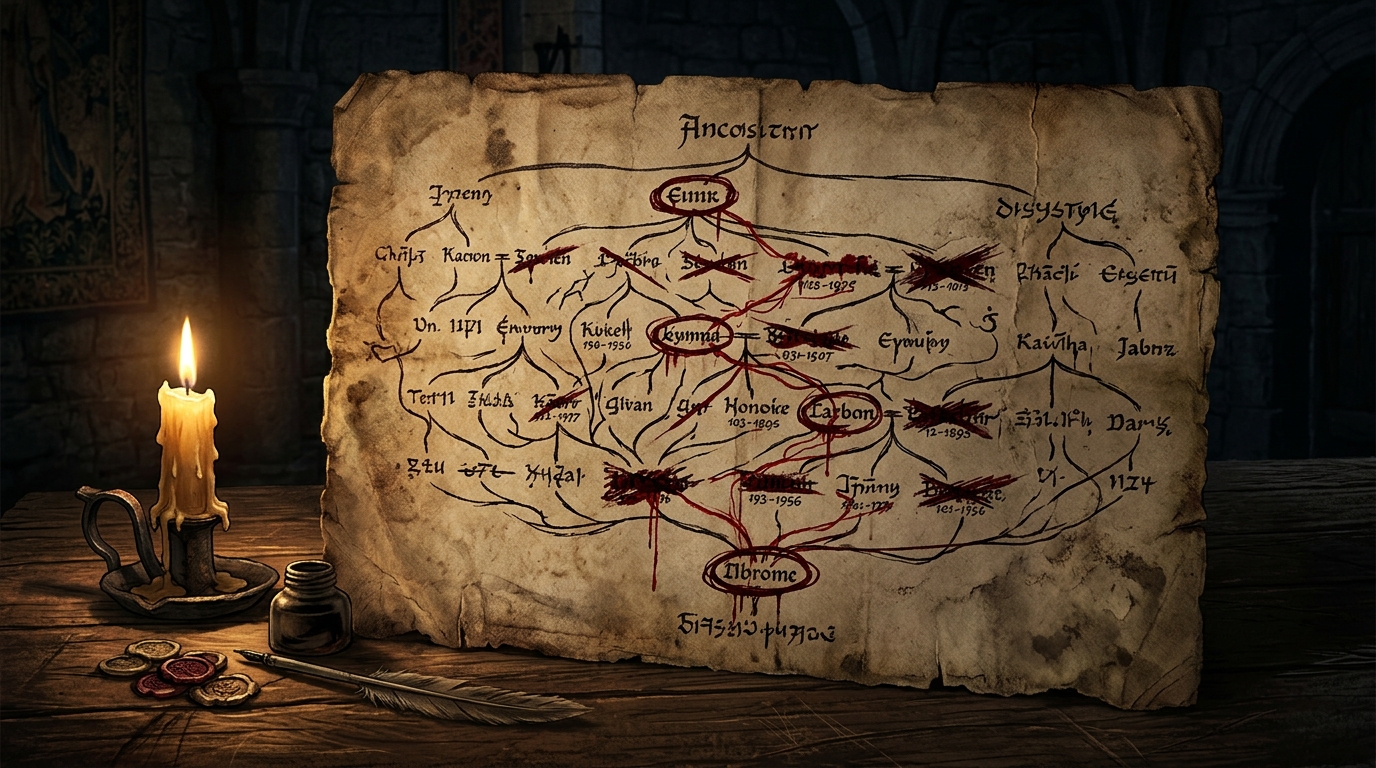
A recurring folk rule of thumb: a pattern that appears in three or more generations warrants serious investigation. One suicide in a family is tragedy. Three suicides by the same method across three generations, in branches of the family that barely know each other — that is a curse signature.
Ask these questions across your family tree:
- Does the same misfortune repeat? Not different kinds of trouble, but the same specific kind — always money, always marriage, always the same disease, always at the same age
- Are unrelated branches affected? The curse should appear in the families of siblings, not just direct parent-child lines. If one uncle's children are fine and another's are not, this tells you something about the curse's reach
- Has anyone in the family broken the pattern before? If one relative escaped the family fate, how? Did they move far away, cut contact, convert to a new religion, perform a ritual? Their escape may hold the key to yours
- Does the pattern persist despite conscious effort? Your father and grandfather knew they had the same problem. They tried to avoid it. It still found them. This is the curse's strongest confirmation — it overrides conscious intention
Specific Curse Signatures
Different family curses produce different observable signs. These are the most common patterns documented across multiple traditions:
Poverty curses — Generations of financial struggle despite education, intelligence, and hard work. Money comes and goes as if there is a hole in the family's hands. Every venture starts promising and collapses at the same stage. The family has never owned anything that was not lost.
Relationship curses — Marriage after marriage fails at the same point. Betrayal follows the family like a script. Partners share different names but the same destructive behaviors. Children of cursed marriages grow up to repeat the same pattern.
Death and illness curses — The same cause of death appears at the same age across generations. Heart failure at forty-five. Cancer at fifty. The age is precise, the mechanism consistent, and it appears in family members who lived completely different lifestyles.
Addiction curses — Alcohol, gambling, drugs — the substance changes, the addiction does not. The pattern appears in cousins who grew up in different households, suggesting something beyond environment.
How a Family Gets Cursed
Understanding the origin of a generational curse is essential for how to break generational curses. Different origins respond to different methods. The origin also determines whether the curse can be broken in one session or requires sustained work.
Ancestral Pacts
In the traditions that recognize them, the most severe generational curses are said to originate from an ancestor who made a deliberate pact — with a spiritual entity, a secret society, a dark practitioner. In exchange for power, wealth, or protection in their lifetime, the ancestor pledged something that did not belong to them: their descendants.
This is why some families thrive for one generation and collapse in the next. The pact brought the ancestor fortune, but the debt falls on the children. The curse is the bill coming due.
Betrayal of a Spiritual Tradition
A curse can also enter a bloodline when an ancestor betrayed an initiation or spiritual lineage. Walking away from certain traditions — particularly those that involve binding oaths — carries consequences. In West African Yoruba tradition, an initiated priest who abandons their calling without proper closure is believed to leave a spiritual debt that can pass to their descendants.
A Curse Cast on an Ancestor
Sometimes the family is not the perpetrator but the target. A powerful curse was cast against an ancestor and never removed. The original caster may be long dead, but in curse lore the curse — like any well-crafted spell — continues to operate independently. It does not need a caster to sustain it. It only needs the bloodline connection to survive.
This type of curse is particularly insidious because the family did nothing to deserve it. An ancestor angered someone powerful, a professional curse was hired against them, or they simply happened to be in the path of someone with spiritual reach.
Stolen Land and Wealth
Several traditions hold that wealth or land acquired through violence, theft, or deception carries a spiritual contamination that passes to the heirs who benefit from it. Anthropologists have documented the same intuition in Africa itself: among the Luo of Kenya, money gained from wrongful or forbidden transactions is called "bitter money" — wealth believed to bring misfortune to whoever holds it.
A family fortune built on exploitation may come with a built-in curse: the descendants who inherit the wealth also inherit the spiritual debt of how it was acquired. The curse is said to manifest as the family losing everything in exactly the way the original victims were dispossessed.
Biblical Perspective — Generational Curses in Christianity
Christianity provides one of the most widely recognized frameworks for understanding and breaking generational curses. The key verse is Exodus 20:5, where God describes himself as "visiting the iniquity of the fathers on the children to the third and fourth generation of those who hate me."
This verse has fed Christian debate about inherited sin since the early church — and it is the text modern deliverance ministry builds its generational-curse doctrine on. Christian deliverance ministry — the practice of freeing people from demonic influence — takes this pattern seriously. The theological interpretation is that ancestral sin creates a "legal right" for demonic spirits to afflict a family line. Breaking the curse requires removing that legal right through specific acts.
The Christian Deliverance Method
Christian deliverance prayer for generational curses follows a structured process:
Step 1: Identification — The person identifies the specific pattern of sin or suffering in their family line. This may involve researching family history, talking to older relatives, and recognizing which sins or curses have repeated across generations.
Step 2: Renunciation — The person verbally renounces the sin of their ancestors. This is not a confession of someone else's sin — Christian theology holds that each person is responsible for their own choices — but a formal disavowal of the pattern. "I renounce the spirit of poverty that has followed my family for four generations."
Step 3: Prayer of Breaking — The person prays specifically to break the curse. A typical prayer invokes the authority of Christ's death and resurrection, commands the curse to be broken, and declares freedom from ancestral bondage.
Step 4: Receiving the New — The person specifically invites a positive spiritual inheritance to replace the curse. Where there was poverty, they declare provision. Where there was addiction, they declare sobriety. Where there was death, they declare life.
Step 5: Sealing — The person continues in prayer, community support, and spiritual disciplines to prevent the curse from reattaching. This may involve ongoing accountability, regular prayer against spiritual attack, and avoiding situations that gave the curse access in the first place.
The Christian method is one of the most accessible approaches to breaking generational curses because it requires no materials, no ritual tools, and no special training — only faith, intention, and the willingness to name the pattern out loud.
African and Caribbean Traditions — Ancestral Work
While Christian deliverance often bypasses the ancestor entirely — addressing the curse through direct prayer — African diaspora traditions take the opposite approach. In Yoruba, Akan, and Vodou traditions, you cannot break a generational curse without facing the ancestor who started it.
Why Ancestral Work Is Essential
The logic is straightforward: the curse passes through the bloodline, and the bloodline exists because of the ancestors. Ignoring the ancestor while trying to break the curse is like removing a weed without pulling the root. The weed will grow back.
The ancestor who caused the curse — whether through their own actions or as the target of someone else's curse — holds a spiritual position in the family line. Even if the ancestor was a victim, their unresolved situation continues to affect their descendants. The ancestor must be acknowledged, named, and separated from their negative legacy.
The Acknowledgment Ritual
A common form of ancestral acknowledgment in diaspora practice runs like this:
- Create an ancestral altar — A small space with a photograph or object connected to the ancestor. A white candle (the color of spiritual clarity), a glass of water, and a piece of white fabric.
- Name the ancestor aloud — Speak their full name, their relationship to you, and the specific pattern that began with them. You do not need to know every detail. You need only to acknowledge that they are the source.
- Honor them — Acknowledge that they were a human being who lived, struggled, and died. You are not cursing them. You are separating their influence from your life.
- State the separation — "I honor you as my ancestor. I am grateful for the life you passed to me. But I do not carry your curse. Your debts end with you. I separate my path from your pattern."
- Remove the altar — After seven days, dismantle the altar. Throw the water into running water. Bury the candle remains. Return the space to ordinary use.
In the logic of ancestral work, this succeeds because it does what the curse relies on no living descendant doing: naming the origin and declaring independence from it. The acknowledgment satisfies the ancestor's spiritual claim. The separation severs the curse's hold.

Breaking Methods Across Traditions
Beyond Christian deliverance and African ancestral work, there are additional methods for breaking generational curses drawn from Chinese folk religion and European folk magic. Each addresses a different aspect of the family curse.
Salt-and-Fire Generational Cleansing
The European folk tradition of salt-and-fire cleansing extends to the entire family line when dealing with generational curses. The method is the same as standard curse-breaking — salt lines across thresholds, a black candle burning through every room — but with an extended intention.
The generational variation:
- Speak the bloodline — Before you begin, name your ancestors aloud, working backward from your parents through as many generations as you know. "I clean this house for myself, for my father [name], for his father [name], for her father [name]." Each name extends the cleansing further back into the family line.
- Salt across every threshold — Place salt lines not only at your exterior doors but at every interior doorway. Each threshold represents a boundary between generations. The salt says: the curse stops here.
- The generational verdict — When you blow out or snuff the black candle, say aloud: "The curse that ran through my bloodline ends with me. My children will not carry what I carried. This is the last generation."
- The child's seal — If you have children, pass them through the smoke of the snuffed candle. If you do not have children, speak the names of any future children you may have. Seal them from the curse before they are born.
This method is physically demanding — walking through every room, naming every known ancestor, placing salt at every boundary — but it can produce a real sense of a line being drawn. You have drawn a line that your ancestors could not draw.
Da Siu Yan Directed at Ancestral Grievances
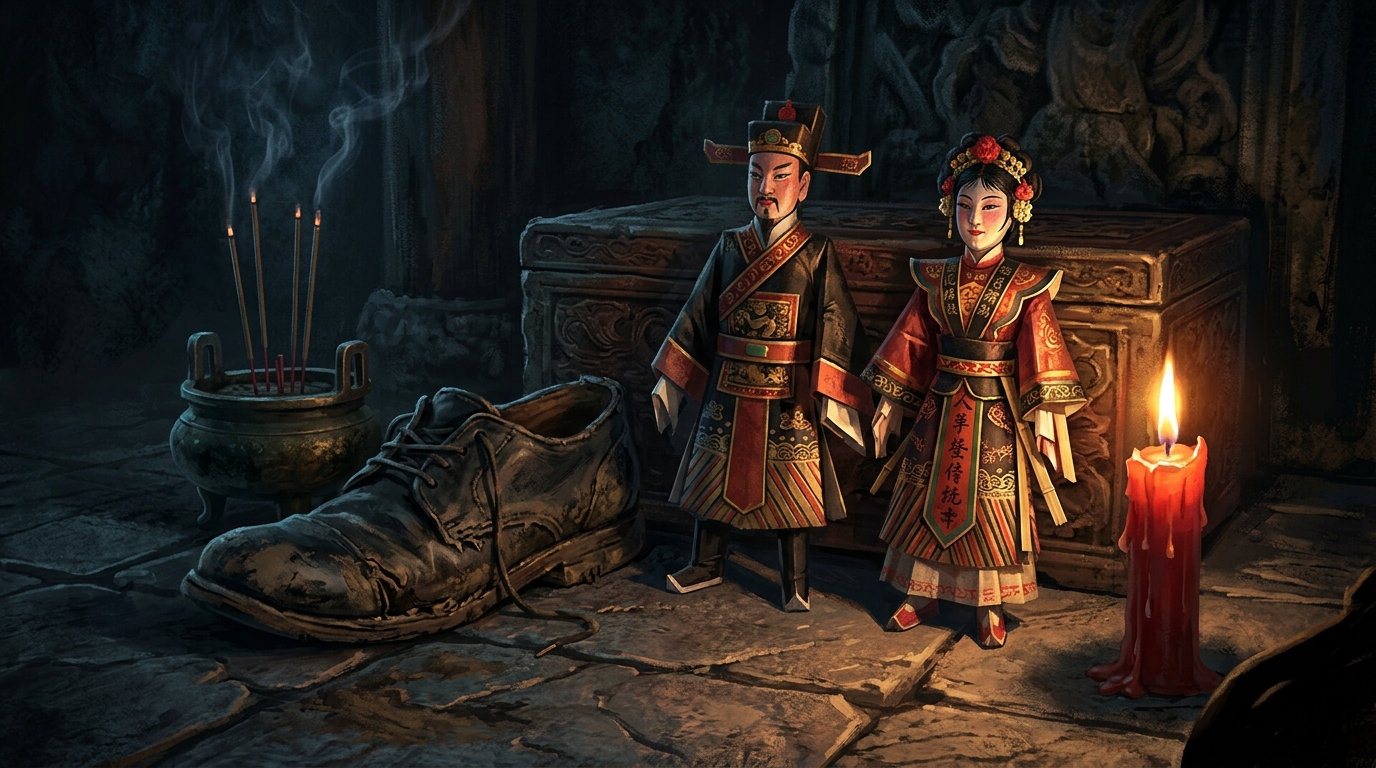
Chinese folk practice offers an unexpected tool for breaking generational curses. Da Siu Yan (打小人) — the ritual of beating the petty person — can be redirected from living enemies to ancestral grievances.
The ritual's eight-step ceremony — inviting the deities, registering the complaint, passing through fire, striking the effigy, the White Tiger sacrifice, dispelling misfortune, praying for blessings, and confirming with divination — provides a complete framework for dealing with an enemy long dead but whose curse is still active.
When the target of a generational curse was an enemy who cursed an ancestor, Da Siu Yan externalizes that ancient conflict into physical form. The paper effigy represents the original curser. The striking and burning carry the same power as a modern curse-breaking — the curse is destroyed symbolically, and the divination blocks confirm that the severance is complete.
For generational curses, step 6 (化解 — dispelling misfortune) becomes especially important. The scattering of rice and five-color beans represents not just the current curse dissolving but the ancestral pattern dispersing. Each grain falls away from the family line.
Cord-Cutting for Multiple Generations
The cord-cutting spell — commonly used for individual curses — can be extended to generational curses by connecting not one but multiple cords to the ancestral source.
The generational cord-cutting method:
- Take a long cord or chain of thread. Tie knots at intervals representing each affected generation — one knot for your great-grandfather, one for your grandfather, one for your father, one for yourself.
- Tie the cord between two black candles — one representing the original source of the curse (the ancestor who caused or received it), the other representing the current generation.
- Over seven nights, cut one knot per night. Each cut frees one generation from the curse's hold.
- On the seventh night, all knots are gone. The cord is one clean line — the bloodline without the curse.
- Burn the cord. Scatter the ash. The pattern is broken.
This dramatizes what psychological healing alone cannot: the physical act of cutting, generation by generation, until the chain is severed.
Comparison of Breaking Methods
| Method | Tradition | Core Principle | Best For | Time Required |
|---|---|---|---|---|
| Christian Deliverance Prayer | Christianity | Renunciation of ancestral sin, receiving freedom | Hidden family sins, religious backgrounds | One session + ongoing |
| Ancestral Acknowledgment | Yoruba/Akan/Vodou | Name, honor, separate from ancestor | Curses requiring ancestral facing | 7 days |
| Salt-and-Fire Generational Cleansing | European folk magic | Household cleansing extended to bloodline | Household-wide family curses | One session |
| Da Siu Yan for Ancestral Grievances | Chinese folk religion | Externalize enemy into effigy, destroy it | Curses from an ancestor's enemy | One session |
| Generational Cord-Cutting | Western occult | Cut each generation's knot individually | Multi-generational curses with clear timeline | 7 nights |
The Sealing — How to Ensure the Curse Does Not Return
The single most common reason breaking generational curses fails is the sealing. People perform the break — the prayer, the ritual, the cord-cutting — and then assume the work is done. It is not. The sealing is what makes the breaking permanent.
Why Sealing Matters for Generational Curses
A generational curse has had years, sometimes generations, to root itself in your family line. Cutting it in a single session is like cutting a vine — you can sever the stem, but if the root remains in the ground, it will grow back. The sealing is the removal of the root.
In every tradition that recognizes generational curses, the sealing takes a specific form:
In Christian deliverance — The sealing is ongoing prayer, community accountability, and active rejection of the pattern whenever it attempts to reassert itself. Some traditions recommend a period of fasting or extended prayer following the initial break.
In African diaspora traditions — The sealing involves ongoing ancestral maintenance. The ancestor is acknowledged but kept in their proper place. Regular offerings (water, white candles) maintain the boundary between the ancestor's influence and the living descendant's life.
In Chinese folk practice — The sealing comes from the divination confirmation (step 8: 擲筊). The divination blocks provide a yes-or-no answer from the spirit world that the break is complete. Without this confirmation, the ritual is unfinished, and neither the practitioner nor the client knows whether the curse is truly broken.
In European folk magic — The sealing is a verbal verdict, spoken with finality and witnessed. "The curse that followed my bloodline for [number] generations ends here, in this place, on this day. It does not continue through me. It does not continue through my children. It is broken and sealed."
Protection — Keeping It Broken for the Next Generation
Once you have succeeded in breaking generational curses in your own life, the next concern is protecting your children — or any children you may have in the future. The curse may have run through your bloodline for generations, but you are the generation that stops it.
Protection for Your Children
Naming — In Christian deliverance tradition, the act of naming your children with intention — declaring over them that they are free from the family curse — carries power. This is not about their legal name but about the spiritual declaration made in their presence.
Boundaries with the extended family — One of the most painful but necessary steps: you may need to limit contact with family members who remain under the curse's influence. The curse can spread through contact, through objects, through shared space. Protecting your children may mean keeping them away from relatives who knowingly or unknowingly carry the curse energy.
The family heirloom test — Objects that have passed through generations may carry the curse. A ring that every wearer lost their fortune while wearing. A house where the same tragedy repeated. If an object is present in every cursed generation of your family, it may be a carrier. Remove it, cleanse it, or destroy it.
Annual spiritual maintenance — Break the curse once, then reinforce the breaking annually. On the anniversary of your curse-breaking ritual, light a candle and restate your verdict. The annual reinforcement keeps the seal from weakening over time.
Spiritual Hygiene for the Generational Breaker
If you have broken a generational curse in your bloodline, you are now a target. The curse — or the entity behind it — has lost generations of access to your family. You broke that chain. The response, in every tradition, is that you may face spiritual counterattack.
This is why protection is not optional:
- Regular cleansing — A salt bath after any stressful family interaction. A smudging of your home at the change of each season.
- Protective objects — An amulet or talisman that you wear daily, charged during your curse-breaking ritual. In Chinese tradition, a jade pendant or red string bracelet provides ongoing protection. In European tradition, an iron nail carried in a pocket or a small mirror in a pouch.
- Vigilance about recurrence — Watch the youngest generation carefully in the first year after the break. If the curse attempts to reattach, it will do so subtly — a sudden shift in their luck, a change in their behavior that mirrors the family pattern. Catch it early, reinforce the seal.
For a broader framework on keeping yourself protected after any type of curse work, see our guide on how to remove a curse — the sealing and protection principles apply to individual and generational curses alike.
The Final Verdict
Breaking generational curses is not the work of a single night. It is the work of naming what has been unnamed, facing what your family has refused to face, and drawing a line that no one in your bloodline has drawn before. The curse ran through your ancestors. It ran through your parents. It tried to run through you.
It does not have to run through your children.
You are the only generation that can break it, because you are the only generation that can see it clearly. Your ancestors were too close to it — they could not recognize the pattern because they were inside it. Your children will be born after the break — they will never know what they were spared. Only you stand at the exact point where recognition and action meet.
Begin the curse-breaking ritual →
Who did this to you?
Cleansing takes it off you. Da Siu Yan goes after them. Write their name, strike the effigy, burn it — the first five steps are free, no signup.
Strike Back →Further Reading
- How to Remove a Curse — General curse removal methods: the four-step framework for any curse
- How to Get Rid of Bad Luck — Complete cleansing and luck restoration for everyday misfortune
- What Is Black Magic — Understanding the traditions and practices that create curses, including generational ones
- What Is Da Siu Yan — The Chinese curse ritual: generations of beating the petty person
- How to Curse Someone — Curse methods across cultures: understand the weapon to break its generational hold
- Hex Spells and Curses — Western hex traditions and how they compare to bloodline curses
Frequently Asked Questions
What is a generational curse?
A generational curse is a negative spiritual pattern or hex that passes through bloodlines, affecting successive generations of the same family with the same specific misfortune. Unlike ordinary bad luck, a generational curse persists across time and geography — descendants who have never met their cursed ancestor still experience the same pattern of suffering.
What are the signs of a generational curse?
Signs include the same misfortune repeating across three or more generations in unrelated branches of the same family, specific tragedies occurring at the same age in different generations, clusters of suicide or early death, generational poverty despite sustained effort and education, addiction patterns that skip no one, and failed marriages that follow the same destructive script regardless of partner choice.
How do you break a generational curse?
Every tradition that recognizes generational curses also provides methods for breaking them. The recurring framework involves four steps: acknowledge the pattern and its origin, perform a ritual act that severs the bloodline connection (cord-cutting, effigy work, or deliverance prayer), seal the breaking so the curse cannot return, and establish ongoing protection for yourself and your children.
Can a generational curse be broken permanently?
Yes, but permanent breaking requires more than a single ritual. The curse must be sealed and protection established. In traditions from African diaspora religions to Christian deliverance ministry to Chinese folk practice, the consensus is that breaking is possible but must be followed by ongoing spiritual hygiene — the curse may attempt to reattach through family contact, inherited objects, or ancestral land.
What causes a family to get cursed?
Generational curses are believed to originate from specific acts: an ancestor making a pact with a dark entity, betrayal of a spiritual tradition or initiation, a curse cast by a powerful practitioner that was never removed, or the taking of land or wealth that carried a spiritual debt. The curse then attaches to the bloodline itself, passing to descendants who had no part in the original act.
What does the Bible say about generational curses?
Exodus 20:5 states God visits "the iniquity of the fathers on the children to the third and fourth generation." This verse is the foundation of Christian generational curse doctrine. Christian deliverance ministries interpret this as a spiritual principle that can be broken through prayer, renunciation of ancestral sins, and receiving freedom in Christ. Later scripture itself stresses individual responsibility (Ezekiel 18:20; Jeremiah 31:29–30), and the New Testament teaches that Christ redeemed believers from the curse (Galatians 3:13) — but deliverance ministries continue to take the Exodus pattern seriously.
How do African traditions handle ancestral curses?
In Yoruba, Akan, and Vodou traditions, a generational curse is understood as an ancestral debt that must be paid. The living must acknowledge the ancestor who caused the curse — name them, honor their role in the family line, and then ritually separate from their negative influence. Ancestral work is essential: you cannot simply ignore a curse from your bloodline. You must face the ancestor first, then break the pattern.
What is the role of Da Siu Yan in breaking generational curses?
Chinese Da Siu Yan (打小人) — beating the petty person — can be directed at ancestral grievances as a curse-breaking mechanism. When a family curse traces back to an ancestor's enemy, the ritual's eight-step ceremony externalizes that ancient conflict into a paper effigy that can be struck and burned, severing the ancestor's enemy grip on the current generation.
Related Curses
Return to Sender Spell: Send a Curse Back to Its Source
Return to sender spells explained — the Hoodoo mirror ritual that reflects a curse back to its source, plus real methods...
14 min readBlack Magic Removal: Real Traditions vs. Scam Red Flags
Black magic removal explained — six real cleansing traditions worldwide, how to spot a scam "removal expert," and safe D...
15 min readHow to Remove a Curse: Break Spells, Hexes & Bad Luck
Step-by-step curse removal: break a bad luck curse, undo a spell put on you, and lift a hex. Ritual methods from folk-ma...
21 min read